Tombstone Stage Held Up
On March 15, 1881 the Tombstone stage was held up. Although not intended as such, it ended up being one of the causes for the O. K. Corral shootout. On the other hand, the two objectives of the hold-up were not accomplished.

The main objective was the assassination of Wells Fargo shotgun guard, Bob Paul. As a Wells Fargo guard, Bob Paul had hampered the activities of the cowboys. And, the word around town was that he was to become the Pima County Sheriff. So the cowboys wanted to get rid of him. The assassination failed because when the stage departed Tombstone, stage driver Budd Philpot had gotten stomach pains and Budd exchanged positions with Paul. Orders were to kill the guard…which they did, but it was Philpot instead of Paul.
Paul was also responsible for the robbers not accomplishing their second objective…the theft of $26,000 in silver. When Philpot was shot, Bob grabbed his shotgun and fired off both barrels. One robber was killed and the noise of the shotgun spooked the horses. As the stagecoach was careening out of control, Paul climbed down; secured the reigns of the runaway steeds; and brought the stage safely into Benson.
Later, when he did became the Pima County Sheriff this 6’ 6”, 240-pound mountain of a man, typically using a shotgun, brought in bad guys, stopped lynchings, and hanged many a man legally. It always seemed that he was able to dodge that fatal bullet…That is until 1893 when he couldn’t dodge the one called cancer, and he died on March 26, 1901.
Salted Undershirt
March 1, 1892, Daily Herald, El Paso, Texas – Five years ago I was suffering with a very severe throat trouble, so much so that I did not expect to live. An acquaintance told me that he could give me a remedy that would cure it and , as I had tried all of the doctors in my town without receiving any benefit, I decided to try the remedy suggested. I tried it, was permanently cured of my cough, and besides I discovered that I was not subject to colds.
I was conductor, running in the states of Virginia, North Carolina, South Carolina, Georgia, Florida, Tennessee and Alabama. I was of course subjected to very hot cars in winter, and of necessity had constantly to get out in the cold at all hours of the night. In all that time I have never had a cold or the grip. You will be astonished at the remedy. It is simply to wear a salted undershirt.
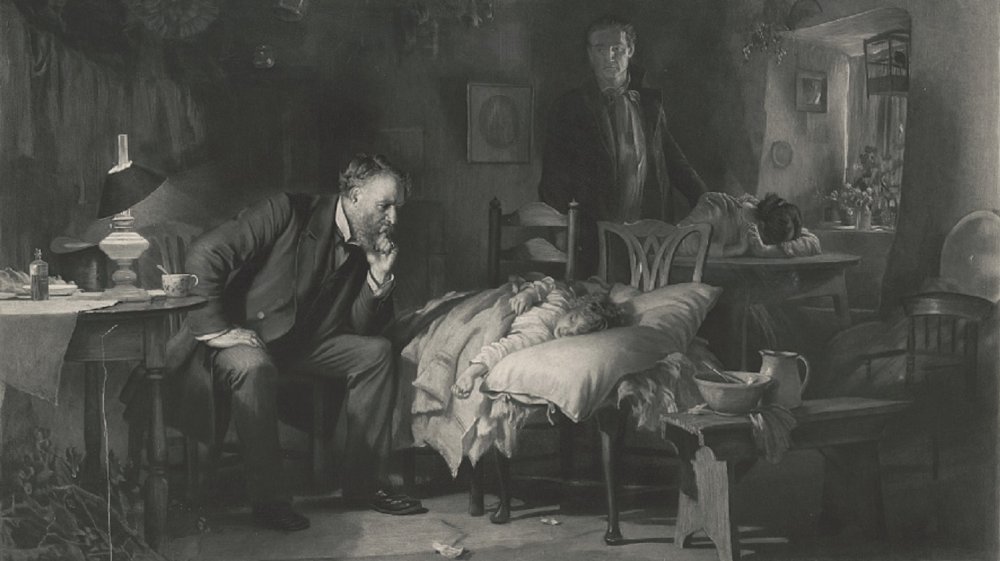
Take a summer undershirt and soak it in brine made with, a half pint of ordinary salt to about a quarter of water, and put out to dry. Wear this shirt next to the body. It is not unpleasant to wear and will, I am sure, keep off grip and bad colds, and, I firmly believe, consumption. If I were to live to be eighty years old, I have so much faith in the salted shirts that I would never cease to wear them. My reason for preferring the thin gauze shirt is because the salt makes a heavy shirt too stiff and hard. Wear the heavy shirt over the salted shirt
NOTE: This article written in 1892. It was the latest in medical news back then, but not necessarily now.
Sequoyah
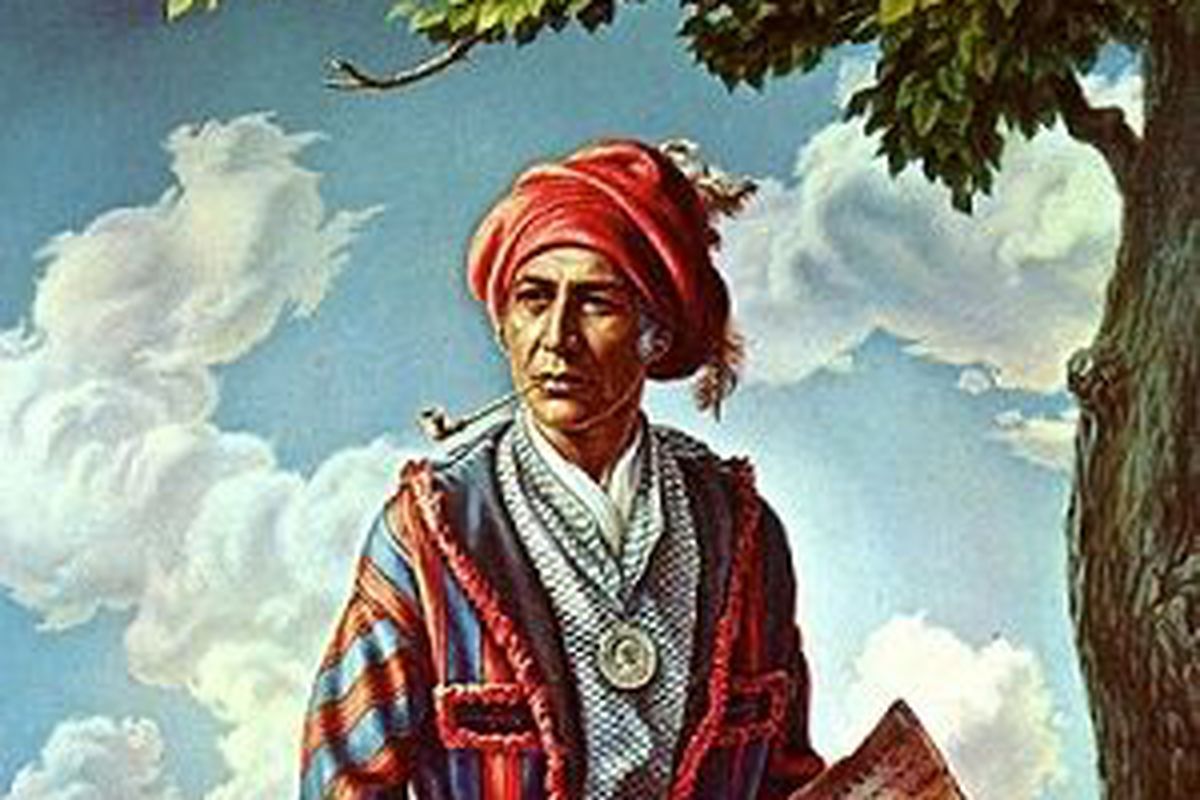
Sequohah, born in 1760 in Tennessee, grew up among his mother’s people, the Cherokee. He became a metal craftsman, making beautiful silver jewelry. As a young man he joined the Cherokee volunteers who joined Andrew Jackson in the War of 1812. While with the American soldiers, he became intrigued with what he called “talking leaves,” or words on paper that somehow recorded human speech. Although Sequohah had no formal education, he somehow comprehended the basic nature of the symbolic representation of sounds.
In 1809 he began working on a Cherokee language. At first he tried picture symbols, but soon found them to be impractical. Then he started looking at English, Greek and Hebrew. He finally developed 86 characters that would express the various sounds in the Cherokee language. It was so simple in its concept that it could be mastered in less than a week.
In 1821 he submitted his new written language to the Cherokee leaders. As a demonstration Sequohah wrote a message to his six-year-old daughter. She read the message and responded in kind. The tribal council immediately adopted the system. And Cherokee of all ages started learning the written language.
The Cherokee were divided into two groups, Sequohah’s in Georgia and Tennessee, and the western Cherokee in Oklahoma. In 1822 Sequohah went to Oklahoma, and taught the alphabet to the Cherokee there.
Finally, on February 21, 1828 the first printing press with Cherokee type arrived in Georgia. Within months, the first Indian language newspaper appeared. It was called the Cherokee Phoenix.
Sequohah later went to Mexico to teach Cherokee there the language. While in Mexico he became ill with dysentery, and died. Great monuments to the man who developed the Cherokee alphabet stand today along the northern California coast. They are the giant redwood trees called the Sequoia.
Bat Masterson – Gunfighter
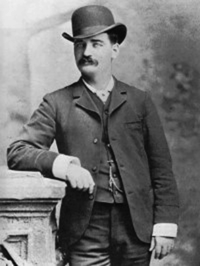 I find Bat Masterson one of the more intriguing men of the Old West. He is known as a gunfighter, but he was in very few gun fights.
The last gunfight he was in took place on this day back in 1881. It was to help out his brother Jim. Jim owned a business in Dodge City and was having trouble with Al Updegraff, a business partner. It had even involved gunfire.
I don’t know if Jim actually said the words, “I going to get my big brother and he’ll beat you up,” but Bat, in Tombstone at the time, heard about the conflict and jumped on a train to Dodge City.
Not a man to mince words, Bat immediately spotted Updegraff and brother-in-law Peacock and said, “I have come over a thousand miles to settle this. I know you are heeled, now fight!” All three men immediately drew their guns.
In the fracas Updegraff took a bullet in his right lung. The mayor and sheriff arrived with shotguns and stopped the shooting. No one was mortally injured in the shooting, and in accordance with Old West standards, the gunfight was fought fairly. So Masterson was fined $8. He paid the fine and took the next train out of Dodge City.
As an aside, had Bat not left Tombstone to help his brother, the chances are excellent he would have been around to help his friend Wyatt Earp in another gunfight…The one that took place at the OK Corral.
Robert Leroy Parker – We Know Him as Butch Cassidy
 Back in 1866 Robert Leroy Parker was born in Beaver, Utah Territory. But we know him as Butch Cassidy.
Supposedly, he picked up the name “Butch” from the short period of time he worked in a Rock Springs, Wyoming butcher shop. The last name came from a minor criminal mentor by the name of Mike Cassidy…I also suspect he didn’t want to bring shame on his strict Mormon family by using Parker.
Although Butch’s organizational skills and personality were probably suited more for a legitimate business life, he assembled a group of ruffians known as the “wild bunch.” Even though they could be considered misfits, Butch was able to meld them into a sophisticated criminal operation.
By the 1900’s the wild days of the West were fading and law enforcement was becoming more effective. So Butch, The Sundance Kid and Etta place fled to Argentina.
Here’s where legend and fact get blurry. Some say Butch Cassidy and the Sundance Kid were killed by Bolivian troops. However members of his family maintain Butch came back to the United States and died of old age under another name.
Just as an aside. There are more than a dozen Old West outlaws, including Billy the Kid, who were supposedly not really killed, and they lived a long life under an alias. Sometimes I wonder if any Old West outlaw was ever killed.
Pearl Hart and the Wild Old West
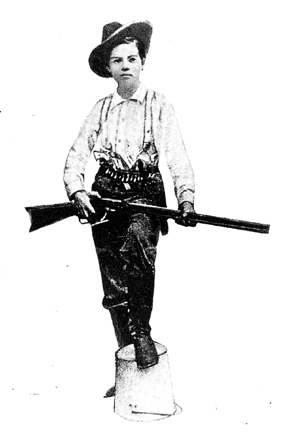 Just when everyone thought the wild Old West was gone, in 1899 a small slight woman by the name of Pearl Hart and her boyfriend held up a stagecoach in the Florence, Arizona area.
Their take was a little over $400. But they weren’t able to spend it, because in a short time they were captured and jailed.
Shortly afterward, with the help of some men, Pearl escaped. But, because of her fame, she was recognized and returned to jail.
Pearl and her boyfriend were tried and convicted. The boyfriend got 30 years and Pearl got 5.
Pearl’s life after she got out of jail is surrounded in myth. Some say she became “The Arizona Bandit” with Buffalo Bill and in vaudeville. Others say she married a Calvin Bywater and settled down to a life of domestic bliss.
Whichever one it was, Pearl never got crosswise with the law again.
Antonio Lopez de Santa Anna Dies
 In 1876 Antonio Lopez de Santa Anna died. I know of no other Old West character whose life was more of a roller coaster.
Born to middle-class parents in Mexico, as a teenager he joined the army. In 1821 he gained national prominence as a military leader in Mexico’s fight for independence against Spain.
This resulted in his being elected the President of Mexico in 1833. And just two years later he proclaimed himself the dictator of Mexico.
During this time the Anglos in the area that is now Texas were agitating for independence.
Determined not to let this happen, Santa Anna took command of the army and invaded Texas. As we all know Santa
Anna was captured and Texas became an independent republic.
While he was a captive of Texas, he was deposed. Eleven times over the next two decades, Santa Anna regained and lost his dictatorship. The last time was in 1855.
The once mighty Antonio Lopez de Santa Anna died embittered and impoverished.
William Quantrill Dies
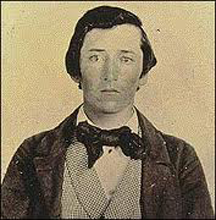 On June 6, 1865 William Quantrill dies of wounds encountered in a skirmish with Union Soldiers.
At one time I referred to Quantrill as a man without any redeeming qualities. I was promptly told not to go into the Deep South and say that. I may not return under my own steam.
William Quantrill was Frank and Jesse James’ mentor. He was born in Ohio and after getting into trouble in Utah and Kansas he fled to Missouri where he became a strong supporter of slavery, even getting into violent conflicts with neighbors.
When the Civil War broke out…It’s also referred to by some as “the war of Northern aggression”…he formed a group of gorilla irregulars. As indicated earlier, Frank and Jesse James were members of Quantrill’s Raiders.
Quantrill not only attacked Union forces, he would attack unguarded pro-Union towns; most notably Lawrence, Kansas where the raiders shot every man and boy they could find. After killing 150 civilians, they left the town ablaze.
Incidentally, since Quantrill’s guerillas weren’t considered legitimate soldiers, they were never given amnesty after the conclusion of the war.
Republic of California
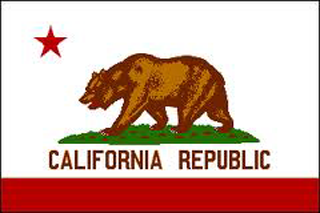 We all know that Texas was an independent republic before becoming a state. But did you know that California was an independent republic too? Here’s more about the Republic of California.
Although owned by Mexico, back in 1846 there were very few Mexican settlers in California. In reality there American settlers comprised the largest segment of the population.
On June 14, 1846, anticipating a war with Mexico, 33 Americans lead by William Ide invaded the Mexican outpost of Sonoma, north of San Francisco. They surrounded the home of Mexican General, Mariano Vallejo. With a bloodless victory, the Americans took a cotton sheet and with red paint they made a flag of a grizzly bear and single red star…A reference to the Texas Republic…and printed the words on the flag “California Republic”. The revolt was known as the Bear Flag Revolt.
Three weeks after California became an independent republic; American forces took control of Monterey and officially raised the American flag over California. Since this was what the American rebels wanted, they dissolved their government.
Incidentally, that Bear Flag became the official flag of California.
Phantom of the Black Hills – Hellbilly Music
When we started Cowboy to Cowboy we said we would have an occasional “off the wall” item. Well, here’s one. We old farts are always concerned about young people appreciating and getting involved with the history of the Old West. Maybe the group named The Phantom of the Black Hills could be an avenue to bridge that gap. They play what is called Hellbilly Music.

Although they call themselves a cowpunk band, they do have an interesting message. One of their songs is directed to the government: “First you take my money, then you take my guns.”
You can view one of their videos by going to:
http://www.youtube.com/watch?v=sf1kll9csSI
What do you think?
Warren Earp – Bringing a Knife to a Gunfight
 We’ve all heard about bringing a knife to a gunfight. Well, on this date back in 1900 that’s just what James, Morgan, Virgil and Wyatt’s little brother did.
After participating in Wyatt’s ride of vengeance because of the cowboy’s wounding of Virgil and killing Morgan, Warren went to live with his parents in Colton, California.
With Warren regularly getting into trouble, his father got fed up with him and sent him packing. Warren ended up in Willcox, Arizona where he did a little cowboying and a lot of drinking. On July 6, 1900, Warren got crossways with a John Boyet. Some say it was because of a woman, others say it was a carry-over from the Tombstone days. In a confrontation, Warren kept pushing Boyet, until Boyet finally pulled his gun and killed Warren. This was a case of bringing a knife to a gunfight. For, it was discovered that Warren didn’t have a gun. But he did have a knife.
It seems that, to his dying day, Warren was trying to live up to the reputation of his brothers Wyatt and Virgil by being able to buffalo a man, and disarm him.
Doc Holliday – Myth and Fact
We all think of Doc Holliday as a deadly shootist, killing scores of men. But, in this case our thinking is wrong. In reality, it can only be verified that Doc killed two men…One of them back in 1879. Here is some Doc Holliday – Myth and Fact: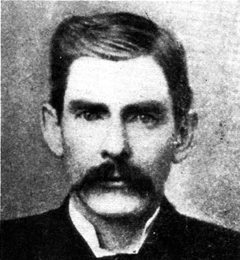
Doc Holliday was a partner in a saloon in Las Vegas, New Mexico. A former army scout named Mike Gordon tried to persuade one of Holliday’s saloon girls to quit her job and run away with him. When she refused, Gordon became upset, and he went out to the street and began to fire bullets into the saloon. After the second shot, Holliday calmly stepped out of the saloon and dropped Gordon with a single shot. Gordon died the next day.
Incidentally, the second killing took place the following year. You may have heard about it. It’s was during the OK Corral Shootout.
The Long Riders Movie
I had a couple of hours downtime yesterday and I decided to watch a western movie. I picked one from my collection of DVD’s that I hadn’t seen in a while… The Long Riders.
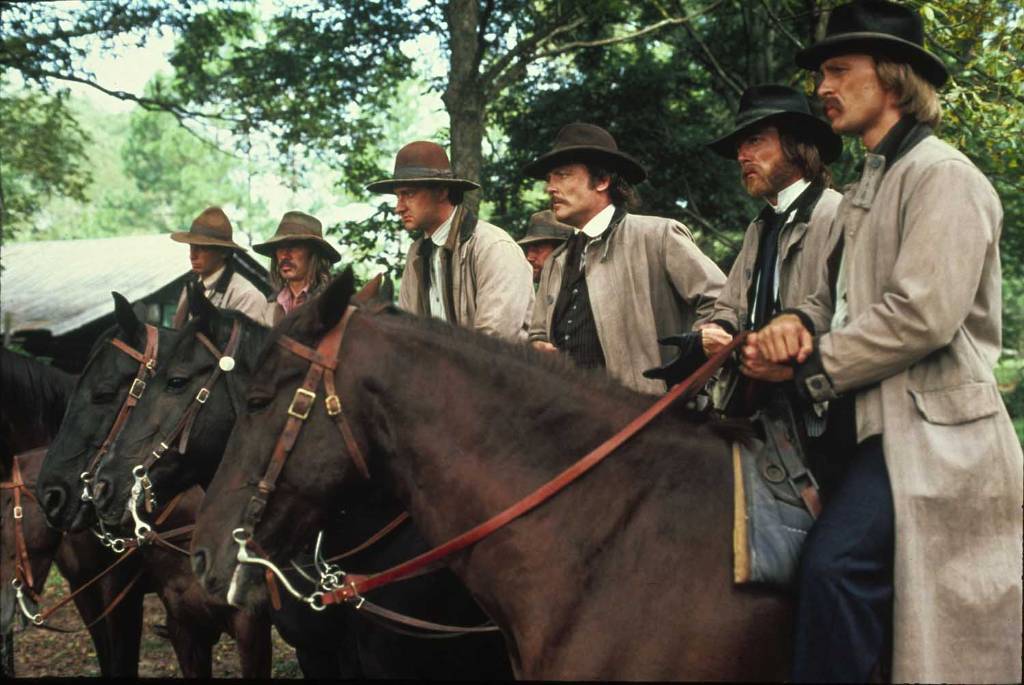
This movie was written and produced by Stacey and James Keach. It’s about the James-Younger gang. As far as I’m concerned it’s an extraordinary film. The unique thing is that actor brothers play outlaw brothers. The Carradines are the Youngers, and the Keachs are Jesse and Frank. Even Robert Ford and his brother are played by brothers.
Historically, it’s fairly accurate as well. Probably Bell Starr had a bigger role in the movie than she did in the life of Cole Younger.
What’s your opinion of the movie?
Old West Myth and Fact: Five Cartridges?
Here’s another Old West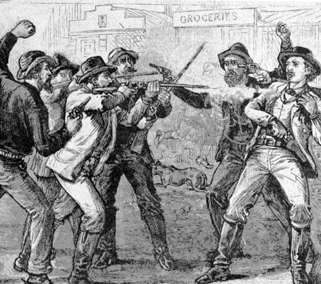 Myth and Fact. Tradition and the early Colt Pistol manuals says to load only five cartridges in a pistol and leave the empty cylinder under the hammer. The reason being if the hammer is accidently hit with a live cartridge under it, it could go off…Incidentally; modern pistols have a safety bar to prevent accidental firing.
So, did they load only five cartridges? Not always. Wyatt Earp’s pistol fell to the floor in a saloon and it went off. Lawman Dallas Stoudenmire was being interviewed by a newspaper reporter. During the interview Dallas showed his shooting skills. The reporter said all six shots hit the target. A couple of years ago we published an article in Chronicle of the Old West from 1898 where two men went into the back room of a saloon, and while there a pistol was fired. The people in the saloon though it was a gun fight. Actually, one of the men dropped their pistol.
My feeling is if you were an average Joe you probably loaded five cartridges, but if there was a chance of gunplay you wanted as much firepower as possible. And that extra cartridge could mean the difference between life and death.
Jesse Chisholm Died of Food Poisoning
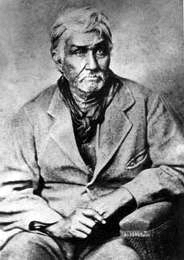 On March 4, 1868 Jesse Chisholm died of food poisoning.
Even though the Chisholm Trail is known for its use during the cattle drive era, Jesse wasn’t a cattleman, but a frontier trader. He had a great knowledge of the southwest that was valuable in trailblazing.
Because he was a trader, Jesse Chisholm’s trail was a straight road with easy river crossings and few steep grades so lumbering heavy freight wagons would have no trouble traveling it.
He had originally used this trail to supply his various trading posts among the Native American tribes in Indian Territory, what is now western Oklahoma. He worked with Black Beaver, a Lenape guide, to develop the trail. Chisholm died before the peak period of the cattle drives from Texas to Kansas; but he was important to numerous events in Texas and Oklahoma history. He served as an interpreter for both the Republic of Texas and the United States government in treaty-making with Native American tribes.
A year before Chisholm died; his trail also began to be used for cattle drives. For five years, more than a million head of cattle traveled up the road, creating a path that was 200 to 400 yards wide. Traces of the trail can still be seen to this day.
Heard Around the Bunkhouse #9 – Wild West Sayings
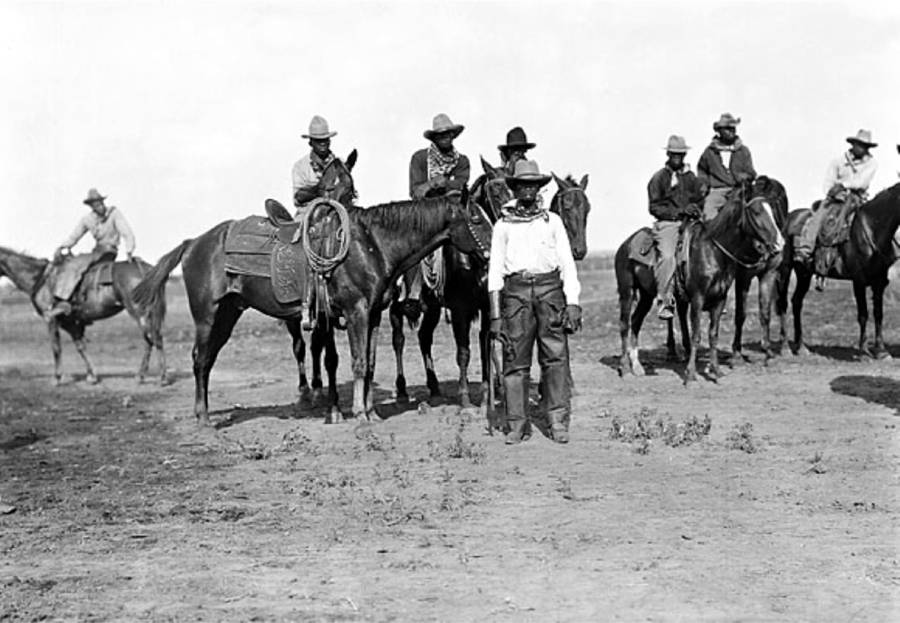 In our feature Heard Around the Bunkhouse we bring you Wild West sayings that they used back in the Old West. Hope you enjoy them, and send us your favorite terms from those past times.
PRAIRIE TENOR – A coyote.
BARKIN’ AT A KNOT – Doing something useless.
WEARING THE BUSTLE WRONG – A pregnant woman.
ROUND BROWNS – Cow chips.
TEAR SQUEEZER – A sad story.
COLD AS A WAGON WHEEL – Dead
End of Kansas Trail Drives
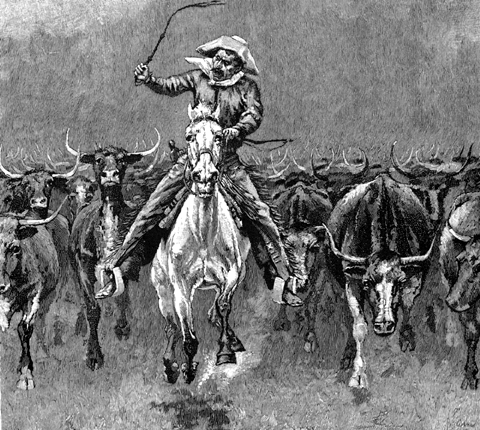 When it came to the Kansas Trail Drives, it seems that Kansas had a love-hate relationship with Texas cattle and the cowboys that brought them up.
The love part was the profits to be made providing supplies to the cattle drives and a good time to trail-weary cowboys. Frontier struggling towns like Dodge City, Caldwell, Ellsworth, Hays, and Newton competed with Abilene to be the top “Cow Town” of Kansas.
But, as Kansas started getting less “frontier” and farming became more important, residents, anxious to attract businesses other than saloons and places of ill repute, started getting less enamored with the Texas cattle industry.
Although the Texas cattlemen tried to stay away from cultivated farmland, according to one cowboy “there was scarcely a day when we didn’t have a row with some settler.”
In addition to this, the Texas cattle carried a tick fever and hoof-and-mouth disease for which they were immune, but the Kansas cattle weren’t.
So, on this date back in 1885 the Kansas Legislature passed a bill that barred Texas cattle from the state between March and December 1.
This, along with the closing of open range with barbed wire fences, signaled an end to the cattle drives to Kansas.
Hiram Rhoades Revels, First Black Congressman
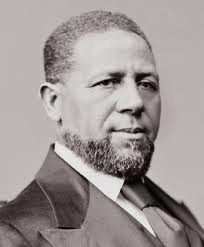 In 1870 Hiram Rhoades Revels, a Republican from Natchez, Mississippi, was sworn into the U.S. Senate, becoming the first Black ever to sit in Congress.
During the Civil War, Revels, a college-educated minister, helped form Black army regiments for the Union cause, started a school for freed men, and served as a chaplain for the Union Army. Revels remained in the former Confederate state after the war and entered into Reconstruction-era Southern politics.
In 1865, Revels left the AME Church, the first independent black denomination in the US, and joined the Methodist Episcopal Church. He was assigned briefly to churches in Leavenworth, Kansas, and New Orleans, Louisiana. In 1866, he was called as a permanent pastor at a church in Natchez, Mississippi, where he settled with his wife and five daughters. He became an elder in the Mississippi District of the Methodist Church, continued his ministerial work, and founded schools for black children.
During Reconstruction, Revels was elected alderman in Natchez in 1868. In 1869 he was elected to represent Adams County in the Mississippi State Senate.
It’s interesting to note that the Senate seat Revels held was once held by Jefferson David, the former president of the Confederacy.
The Prospector and the Gunfighter
Here’s the story of the Prospector and the Gunfighter, with not one, but five lessons for each of us:
An old prospector shuffled into town leading a tired old mule. The old man headed straight for the only saloon to clear his parched throat.
He walked up and tied his old mule to the hitch rail. As he stood there, brushing some of the dust from his face and clothes, a young gunslinger stepped out of the saloon with a gun in one hand and a bottle of whiskey in the other.
The young gunslinger looked at the old man and laughed, saying, “Hey old man, have you ever danced?”
The old man looked up at the gunslinger and said, “No, I never did dance. Never really wanted to.”
A crowd had gathered as the gunslinger grinned and said, “Well, you old fool, you’re gonna dance now,” and started shooting at the old man’s feet.
The old prospector — not wanting to get a toe blown off — started hopping around like a flea on a hot skillet. Everybody was laughing, fit to be tied.
When his last bullet had been fired, the young gunslinger, still laughing, holstered his gun and turned around to go back into the saloon.
The old man turned to his pack mule, pulled out a double-barreled shotgun, and cocked both hammers.
The loud clicks carried clearly through the desert air. The crowd stopped laughing immediately.
The young gunslinger heard the sounds too, and he turned around very slowly. The silence was almost deafening.
The crowd watched as the young gunman stared at the old timer and the large gaping holes of those twin barrels.
The barrels of the shotgun never wavered in the old man’s hands, as he quietly said, “Son, have you ever kissed a mule’s ass?”
The gunslinger swallowed hard and said, “No sir. But — I’ve always wanted to.”
There are a few lessons for us all here:
1 – Never be arrogant.
2 – Don’t waste ammunition.
3 – Whiskey makes you think you’re smarter than you are.
4 – Always, always make sure you know who has the power.
5 – Don’t mess with old men; they didn’t get old by being stupid.
Pearl Grey, Future Old West Author
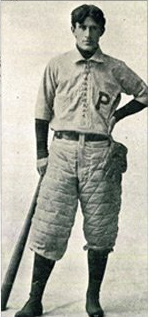 Today’s story is about a man who was a dentist. But he gave up his career to go out west and gain fame in a completely different profession. Do you think you know the person I’m talking about? You may be surprised: Pearl Grey was born on January 31, 1872. He was a talented baseball player, and played for the University of Pennsylvania while getting a degree in dentistry. Pearl was scheduled to follow in his father’s footsteps as a dentist. Looking for some excitement, he played some semi-pro baseball. But that didn’t satisfy his need.
Incidentally, Pearl Grey never liked his first name, which was thought by everyone to be a woman’s name. So he decided to change it to his mother’s maiden name, Zane.
Pearl Zane Grey (January 31, 1872 – October 23, 1939) was an American author and dentist best known for his popular adventure novels and stories associated with the Western genre in literature and the arts; he idealized the American frontier. Riders of the Purple Sage (1912) was his best-selling book.
In addition to the commercial success of his printed works, his books have had second lives and continuing influence when adapted as films and television productions. His novels and short stories have been adapted into 112 films, two television episodes, and a television series, Dick Powell’s Zane Grey Theater.
Chuckwagon: Dutch Oven Trout
 The following recipe is for Dutch Oven Trout: As soon as possible after catching your trout, clean them and wipe the inside and outside of the trout with a cloth wet with vinegar water. Don’t put the trout in the water. Roll the trout in a mixture of flour, dry powdered milk, cornmeal, salt and pepper. Heat deep fat in a Dutch oven and fry until crisp and golden brown.
*Courtesy of Chronicle of the Old West newspaper.
Old West Book Review: The Frontier World of Fort Griffin
 The Frontier World of Fort Griffin, Charles Robinson Ill, University of Oklahoma Press, 800-627-7377, $14.95, Paper. 236 Pages, Illustrations, Notes, Bibliography, Index.
This fast-paced, fun to read book tells of the exciting, albeit short, life of the rip-roaring Texas town called Fort Griffin. Wild and dangerous, it sprouted from the desolate prairie to fulfill the needs of pioneers battling Indians, thus an army post was established. Next came buffalo hunters with hides to sell, then cowboys on cattle drives. Nicknamed “The Flat”, Fort Griffin was also known as “Hide Town”. The biggest settlement between Fort Worth and El Paso back in the 1870’s, it eventually dwindled into little more than a few stone foundations found today.
When the buffalo hunting days ended, and the great Indian raids ceased, the army moved out. The only real business for the town ended too when the great cattle drives no longer came through the area. Cattle were shipped by train, and into the late 1880s the land around Fort Griffin was slowly turned into small farms crossed by barbed wire fences.
Today, Fort Griffin does not exist as a town at all. But Western historians frequently come across stories about it as one of the wildest towns in the Old West. The author has delved through newspapers, court documents, and personal interviews to find the stories about what happened here.
It all started when the Republic of Texas was annexed to the United States in 1845. Next came a few hardy settlers demanding protection from marauding Indians. Protecting the early settlers came the Army, followed by ranchers with cattle raising ideas. More feuds, more fights, and eventually the buffalo hunters arrived decimating the great buffalo herds that provided sustenance for the Indians. Through all this Fort Griffin with its bustling activity naturally attracted gamblers, prostitutes, rustlers and gunmen who in turn were soon at odds with the local vigilance committee.
Rustlers and thieves were regularly hanged by night-riding locals seeking law and order, and sometimes revenge. Meanwhile, infamous people such as Henry “Doc” Holliday. Big Nose Kate, Pat Garrett, Lottie Deno, Wyatt Earp and a passel of lesser-known characters who were just as vicious and handy with guns came through town making plenty of trouble. Several chapters in the book are dedicated to downtown merchants, newspaper editors and the otherwise law abiding, but the real story concerning Fort Griffin seems to be about the tough, gritty, ambitious folks who were willing to shoot first and ask questions later.
This book is filled with odd and unusual characters who lived and sometimes died in Fort Griffin. For instance, Mrs. Lam drove a fast-moving buggy to town to try to save her husband from the vigilantes, but arrived too late. A man named Brock spent years traveling about the country trying to find a man he was accused of murdering in Fort Griffin because Brock wanted to clear his name.
Fort Griffin is compared with other tough towns such as Dodge City and Tombstone, but Fort Griffin was not to become a tourist town or a modern-day survivor. Only a few scraps of lumber and the walls of the Fort Griffin Lodge No. 489 remained in 1992 when this book was written. Each year locals gathered to celebrate the old town’s history filled with cowboys, buffalo hunters, soldiers, soiled doves, gamblers and vigilantes. Researchers will find that browsing through the various chapters will likely turn up some valuable information not easily found elsewhere. I discovered Glen Reynolds, a sheriff killed by Apaches in Arizona, had originally ridden at least one time with the vigilantes in Fort Griffin. This book is a little treasure for sure. It belongs in your Old West library.
Publisher’s Note: The reviewer, Phyllis Morreale-de la Garza, is the author of numerous books about the Old West including Death For Dinner; the Benders of (Old) Kansas, Silk Label Books, P.O. Box 700, Unionville, New York 10988-0700. Phone (845)-726-3434. Www.silklabelbooks.com
A Duel With The Cactus
September 2, 1892, Daily Herald, El Paso, Texas – “Halt! What’s that?” said our leader in a sharp whisper.
It was a clear moonlight night in the extreme southwest of Mexico.
I was visiting a friend who conducted a large ranch and hacienda there.
A local revolt had just been quelled in the neighborhood and a spirit of lawlessness still pervaded the atmosphere. Only the night before my friend had been fired upon and one of his storehouses robbed by a band of Indians some fifteen or twenty strong. Early in the morning four of us, under the leadership of our host, had set out upon the track of the robbers.
We were well mounted, and resting only a few hours at noon had followed hard after them in a fair field we could drive them into quarters like cows to a pen, but we had no mind to run into a trap in the dark with five against fifteen; hence caution.
“Halt! What’s that?” our leader had whispered. We had come to the edge of a dense woods, and across an open space, upon the brow of a low sand hill, clearly outlined in the moonlight against the sky, we had discovered a dozen or more half naked fellows, with their arms extended in every direction, engaged in some sort of a weird, fantastic dance.
We could not see their legs, for the tops of the trees beyond the hill rose waist high, making a black background, but their arms moved slowly to and fro and we could easily imagine their legs keeping company.
“Those are the thieves!” our host muttered. “I know them, even at night. You fellow just come to the edge of the wood, where they can see you without knowing how many there are of you, and I’ll have them down here in no time.”
He rode out alone to the foot of the hill.
It required no little courage, and we watched him with proportionate admiration.
The figures did not cease their dance or notice him. Suddenly, with his rifle at his shoulder, he called to them: “I have you there! If one of you moves I’ll shoot him dead!”
The wind had been blowing through the trees, so that we could not have heard their response, but fortunately at that moment it ceased, and in the deep silence which settled down upon the forest in such a momentary lull we waited for the result.
Every Indian suddenly ceased his dancing and stood like a statue outlined against the sky.
“Come down here now,” shouted our host. “Come quietly, too, for the first man who makes any trouble drops dead.”
We could hear a sound, as of a hurried consultation of some sort, going on upon the hill for a moment, but the wind sprung up again before we could distinguish a single voice, and to our utter astonishment the fellows actually began their solemn dance again.
“Come down or I’ll shoot!” roared our host, but they kept on dancing and he did shoot.
Then there was commotion enough. A wild cry, followed by a cloud of dust rose from the brow of the hill.
“Fire!” yelled our host, and we responded with a well aimed volley, while he whipped out his heavy revolver and gave them another peppering.
There was a perfect bedlam of screams from the hill, and the dust hid everything from the view. They were either coming down or running for their lives.
For us it was either fly or follow. We waited irresolutely for the word of our leader, when the dust settled and there stood the Indians, silently going on with their fantastic dance as though we were a hundred miles away.
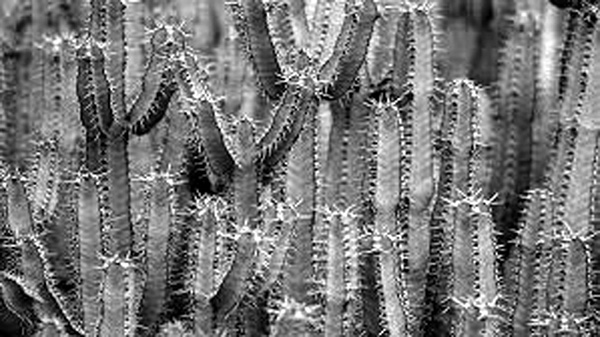
With a fierce ejaculation our host put spurs to his horse and dashed up the hill. We followed, without command, to find him upon the summit, sitting on the ground beneath a line of gaunt and ghostlike prickly pears—the ungainly cactus of Mexico.
The extended along the brow of the hill, their naked, skeleton branches spreading out in every unaccountable way and swaying solemnly in the breeze.
Among the roots a multitude of burrows in the dry dust showed where the sand birds had been lying, half buried, and quietly sleeping; and it was their noisy yelp we heard when they were frightened away by our host’s duel with the cactus.e ungainly cactus of Mexico.
The extended along the brow of the hill, their naked, skeleton branches spreading out in every unaccountable way and swaying solemnly in the breeze.
Among the roots a multitude of burrows in the dry dust showed where the sand birds had been lying, half buried, and quietly sleeping; and it was their noisy yelp we heard when they were frightened away by our host’s duel with the cactus.
Indian Cures
 October 9, 1892, Call, San Francisco, California – In the depths of the forest, an Indian breaks his leg or arm, said Dr. Hingston is his address at the British Medical Association meeting at Nottingham. Splints of softest material are at once improvised. Straight branches are cut, of uniform length and thickness. These are lined with down-like moss or scrapings or shavings of wood or with fine leaves interlaid with leaves, if in summer; or with the curled-up leaves of the evergreen cedar or hemlock, in winter; and the whole is surrounded with withes of willow or osier or young birch. Occasionally it is the soft but sufficiently unyielding bark of the poplar or the bass wood. Sometimes when near the marshy margin of our lakes or rivers the wounded limb is afforded support with wild hay or reeds of uniform length and thickness. Thus is the genius of Indian cures.
To carry a patient to his wigwam or to an encampment a stretcher is quickly made of four young saplings, interwoven at their upper ends, and on this elastic, springy couch the injured man is borne away by his companions. When there are but two persons and an accident happens to one of them two young trees of birch or beech or hickory are used. Their tops are allowed to remain to aid in diminishing the jolting caused by the inequalities of the ground. No London carriage maker ever constructed a spring which could better accomplish the purpose. A couple of crossbars preserve the saplings in position, and the bark of the elm or birch cut into broad bands and joined to either side forms an even bed. In this way an injured man is brought by his companion to a settlement, and often it has been found on arrival that the fractured bones are firmly united and the limb is whole again. This is affected in less time than with the whites, for the recuperative power of these children of the forest is remarkable. In their plentitude of health osseous matter is poured out in large quantities and firm union is soon affected.
The reparative power of the aborigines when injured is equaled by the wonderful stoicism with which they bear injuries and inflect upon themselves the severest torture. They are accustomed to cut into abscesses with pointed flint; they light up a fire at a distance from the affected part (our counter-irritation; they amputate limbs with their hunting-knives, checking the hemorrhage with heated stones, as surgeons were accustomed to do in Europe in the time of Ambrose Pare, and sometimes they amputate their own limbs with more sang fiord than many young surgeons will display when operating on others. The stumps of limbs amputated in this primitive manner are well formed, for neatness is the characteristic of all Indians’ handiwork.
The Indians are familiar with and practice extensively the use of warm fomentations. In every tribe their old women are credited with the possession of knowledge of local bathing with hot water and of medicated decoctions. The herbs they use are known to a privileged few and enhance the consideration in which their possessors are held.
The Turkish bath, in a simpler but not less effective form, is well known to them. If one of their tribe suffers from fever or from the effects of long exposure to cold a steam bath is readily improvised. The tent of deerskin is tightly closed, the patient is placed in one corner, heated stones are placed near him, and on these water is poured until the confined air is saturated with vapor. Any degree of heat and any degree of moisture can be obtained in this way. Europeans often avail themselves of this powerful sudatory when suffering from rheumatism.
The Indians have their herbs—a few, not many. They have their emetics and laxatives, astringents and emollients, all of which are proffered to the suffering without fee or reward. The “Indian teas,” “Indian balsams” and other Indian cures —the virtues of which it sometimes takes columns of the daily journals to chronicle— belong to nature and are not theirs. To the white man is left this species of deception.