TRANSCONTINENTAL TELEGRAPH
On October 24, 1861, the Western Union Telegraph Company linked the nation’s eastern and western telegraph networks at Salt Lake  City, Utah, completing a transcontinental line that allowed instantaneous communication between Washington, DC and San Francisco, California. The first official telegraph was sent by California Chief Justice Stephen J. Field to President Abraham Lincoln, predicting that the telegraph would ensure the loyalty of the western states to the Union during the Civil War.
The push to create a transcontinental telegraph line had begun only a little more than year before when Congress authorized a subsidy of $40,000 a year to any company building a telegraph line that would join the eastern and western networks. The Western Union Telegraph Company took up the challenge, and immediately began work on the section between the western edge of Missouri and Salt Lake City.
To accomplish this, telegraph wire and glass insulators had to be shipped by sea to San Francisco and carried eastward by horse-drawn wagons over the Sierra Nevada Mountains. Because much of the area was treeless, thousands of telegraph poles had to be shipped from the western mountains.
Indians were also a problem. In the summer of 1861, a party of Sioux warriors took a section of wire for making bracelets. Later some of the Sioux wearing the telegraph-wire bracelets became sick and a Sioux medicine man convinced them that the great spirit of the “talking wire” had avenged its desecration. So, the Sioux left the line alone, and the Western Union was able to connect the East and West Coasts of the nation much earlier than anyone had expected.
Incidentally, the transcontinental telegraph caused the end of the Pony Express.
SUTRO TUNNEL
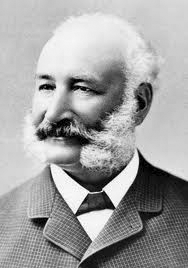 On October 19, 1869, Prussian-born mining engineer, Adolph Sutro, began work on one of the most ambitious projects of the day: a four-mile-long tunnel through the solid rock at the Comstock Lode mining area.
One of the richest silver deposits in the world, the Comstock Lode was discovered in 1859. But as miners sank shafts deeper into the rock, they began to encounter large amounts of water that had to be pumped to the surface at great expense.
Adolph Sutro’s idea was to tunnel through the rock of the neighboring Mt. Davidson and straight into the heart of the Comstock mine. Mine water would thus drain through the tunnel without need for expensive pumps, and the mining companies would also be able to use the tunnel to move men and ore in and out of the mine, greatly reducing transportation costs.
Although everyone agreed that Sutro’s tunnel would be a boon to the Comstock, progress slowed down by resistance from some of the major mining interests who feared that Sutro would use his tunnel to take control of the entire lode. Only after securing European capital was Sutro able to complete the $5-million project in 1878.
It was every bit as successful as Sutro though it would be. Unfortunately, by 1878, the richer sections of the Comstock Lode had been tapped out. However, Sutro was able to sell the tunnel at a fantastic profit. He moved to San Francisco where he became one of the city’s largest landowners as well as the city’s mayor from 1894 to 1896.
WILD BILL LONGLEY
William Preston Longley was born on October 16, 1815. We don’t know his as William Preston, but as “Wild Bill”, a sadistic and murde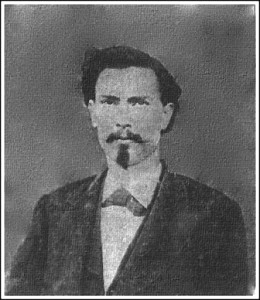 rous Old West gunman.
Although little is know about him as a young man, it’s generally accepted that before he was 20 years old, Longley had already killed several men. He was short-tempered and he frequently killed simply because he believed he had somehow been slighted or insulted. He had a particularly strong dislike of blacks.
Legend has it that Longley was once hanged along with a horse thief; but shots fired back by the departing posse cut his rope, and he was saved.
After killing a minister, Wild Bill fled Texas. But he was captured and returned to Lee County, Texas, where he was tried and found guilty of murder. Sentenced to hang, during his final days Longley became a Catholic, wrote long letters about his life, and claimed that he had actually only killed eight men. On the day of his execution, October 28, 1878, he climbed the steps to the gallows with a cigar in his mouth and told the gathered crowd that his punishment was just and God had forgiven him.
A noose was put around his neck, and he was hanged. Unfortunately, the rope slipped so that Longley’s knees hit the ground. After the hangman pulled the rope taut once more, Wild Bill slowly choked to death. It took 11 minutes before he was pronounced dead.
TOM MIX
On October 11, 1 940, the famous cowboy actor Tom Mix is killed in a freak car accident near his ranch in Florence, Arizona. He was driving his single-seat roadster with luggage on the rear shelf of the car. Tom was traveling along a straight desert road, when he unknowingly came to a bridge spanning a shallow gully that was out. When his car went down into the gully a heavy suitcase flew off the rear shelf of his car and crushed him.
Tom Mix had been one of the biggest silent movies stars in Hollywood during the 1920’s, appearing in more than 300 westerns and making as much as $10,000 a week. Unlike most of the actors appearing in westerns, Mix had actually worked as a cowboy, and had been a Texas Ranger.
In 1906, Mix joined a Wild West show, and four years later he started acting in motion pictures. He helped define the classic image of the western movie cowboy as a rough riding, quick-shooting defender of right and justice, an image that would be copied by hundreds of other actors who followed him.
With the coming of talking pictures, Mix’s movie career stalled. When he died in 1940 at the age of 60, he had lost most of his wealth and was largely forgotten.
Today a black iron silhouette of a riderless bronco marks the site of Mix’s death on the highway about 17 miles south of Florence, Arizona.
DALTONS & COFFEYVILLE
On October 5, 1892, the famous Dalton Gang attempted a daring daylight robbery of two Coffeyville, Kansas banks at the same time. The y wanted to do something no other outlaw gang had done. Instead, they were nearly all killed by quick-acting townspeople.
The gang rode into Coffeyville and tied their horses to a fence in an alley near the two banks and split up. Bob and Emmett Dalton headed for the First National, while Grat Dalton led Dick Broadwell and Bill Powers into the Condon Bank.
Unfortunately for the Daltons, they were recognized and the word quietly spread that the town banks were being robbed. The townspeople ran for their guns and surrounded the two banks. When the Dalton brothers walked out of the bank, a hail of bullets forced them back into the building. Regrouping, they tried to flee out the back door of the bank, but the townspeople were waiting for them there as well.
Meanwhile, in the Condon Bank a cashier had managed to delay Grat Dalton, Powers, and Broadwell with the claim that the vault was on a time lock and couldn’t be opened. That gave the townspeople enough time, and suddenly a bullet smashed through the bank window and hit Broadwell in the arm. The three men bolted out the door and fled down a back alley. But they were immediately shot and killed, this time by a local livery stable owner and a barber.
When the gun battle was over, the people of Coffeyville had destroyed the Dalton Gang, killing every member except for Emmett Dalton. But their victory was not without a price…The Dalton’s killed four of the townspeople.
BATTLE OF GONZALES
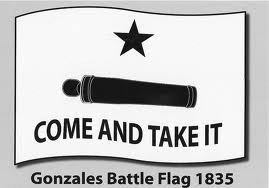 The ever patient Texans could take no more when on October 2, 1835 Mexican soldiers attempted to disarm the people of Gonzales.
Even though Texas had technically been a part of the Spanish empire since the 17th century, as late as the 1820s, there were only about 3,000 Spanish-Mexican settlers in Texas.
After winning its own independence from Spain in 1821, Mexico invited Anglo-Americans to come to Texas in the hopes they would be able to tame the Comanche Indians and the harsh land. During the next decade men like Stephen Austin brought more than 25,000 people to Texas, most of them Americans.
Even though these emigrants became Mexican citizens, they continued to speak English, and had closer trading ties to the United States than to Mexico.
In 1835, the president of Mexico, Antonio Lopez de Santa Anna, overthrew the constitution and appointed himself dictator. Recognizing that the “American” Texans were likely to use his rise to power as an excuse to secede, Santa Anna ordered the Mexican military to begin disarming the Texans whenever possible. This proved more difficult than expected, and on October 2, 1835, Mexican soldiers attempting to take a small cannon from the village of Gonzales encountered stiff resistance from a hastily assembled militia of Texans. After a brief fight, the Mexicans retreated and the Texans kept their cannon.
The determined Texans would continue to battle Santa Ana and his army for another year and a half before winning their independence and establishing the Republic of Texas.
LIVING THE CODE
I’m excited to a nnounce my long awaited book…at least it was long awaited for me…is now available. The book is titled “Living The Code” and is based on seven principles that represent the precepts developed on America’s frontier and made us a great country.
Since 2004 I’ve been promoting these principles through Chronicle of the Old West publication and our radio shows.
This is a book I truly believe has the capability of changing a person’s life. To get more information go to www.LivingTheCode.com.
SHERIFF BILL HICKOK
On September 27 back in 1869, Ellis County Sheriff Wild Bill Hickok and his deputy responded to a disturbance by a 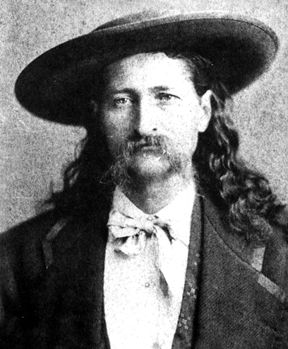 local ruffian named Samuel Strawhun and several of his drunken buddies at John Bitter’s Beer Saloon in Hays City, Kansas. Hickok ordered the men to stop, Strawhun turned to attack him, and Hickok shot and killed him.
This was typical of Wild Bill’s approach to a confrontation. As one cowboy said, Hickok would stand “with his back to the wall, looking at everything and everybody under his eyebrows–just like a mad old bull.”
But some Hays City citizens wondered if their new cure wasn’t worse than the disease. Shortly after becoming sheriff, Hickok shot a soldier who resisted arrest, and the man died the next day. Then, a few weeks later Hickok killed Strawhun. Even though his ways were effective, many Hays City citizens were less than impressed in that after only five weeks in office he had killed two men.
During the regular November election later that year, the people expressed their displeasure, and Hickok lost to his deputy, 144-89. Though Wild Bill Hickok would later go on to hold other law enforcement positions in the West, his first attempt at being a sheriff had lasted only three months.
OLIVER LOVING
On September 25, 1867 pioneering cattleman Oliver Loving died from gangrene poisoning in Fort Sumner, New Mexico. Living h ad been attacked by 500 Comanche at the Pecos River. Although he managed to escape and reach Fort Sumner, he had been shot in the arm and leg. Loving soon developed gangrene in his arm, a common infection in those days. Even then he might still have been saved had his arm been removed, unfortunately the fort doctor had never amputated any limbs and didn’t want to undertake such work.
If this story sounds familiar, it’s because the lives of Oliver Loving and his partner, Charles Goodnight, were portrayed in the movie Lonesome Dove. Robert Duvall played Gus, a takeoff of Oliver Loving.
OKLAHOMA LAND RUSH
 On September 16, 1893, the largest land run in history begins with more than 100,000 people pouring into the Cherokee Strip of Oklahoma to claim their homesteads. With a single shot from a pistol the mad dash began, and land-hungry pioneers on horseback and in carriages raced forward to stake their claims to the best acres.
Ironically, not many years before that same land had once been considered worthless desert. Early explorers of Oklahoma believed that the territory was too arid and treeless for white settlement, but several suggested it might be the perfect place to resettle Indians, whose rich and fertile lands in the southeast were increasingly coveted by Americans.
By the late nineteenth century, farmers had developed new methods that suddenly made this land valuable. The giant Cherokee Strip rush was only the largest of a series of massive “land runs” that began in the 1890s, with thousands of immigrants stampeding into Oklahoma Territory and establishing towns like Norman and Oklahoma City almost overnight.
HOPALONG CASSIDY
 After almost 40 years of riding across American TV and movie screens, the cowboy actor William Boyd, best known for his role as Hopalong Cassidy, died on September 12, 1972 at the age of 77.
His greatest achievement was to be the first cowboy actor to make the transition from movies to television. After World War II Americans began buying television sets in large numbers for the first time, and soon I Love Lucy and The Honeymooners were standard evening fare for millions of families. But despite their proven popularity in movie theaters, westerns were slow to come to TV. Many network TV producers scorned westerns as lowbrow “horse operas” unfit for their middle- and upper-class audiences…As if I Love Lucy and The Honeymooners was highbrow.
During the 1930’s, William Boyd made more than 50 successful “B-Westerns” starring as Hopalong Cassidy. After the war, Boyd recognized an opportunity to take Hopalong into the new world of television, and he began to market his old “B” westerns to TV broadcasters in Los Angeles and New York City. A whole new generation of children thrilled to “Hoppy’s” daring adventures, and they soon began to ask for more.
Rethinking their initial disdain for the genre, producers at NBC contracted with Boyd in 1948 to produce a new series of half-hour westerns for television. Soon other TV westerns followed. In 1959, seven of the top-10 shows on national television were westerns. The golden era of the TV western would finally come to an end in 1975 when the long-running Gunsmoke left the air, three years after Boyd died.
NORTHFIELD RAID
 The movies show frontier town folk as being meek and easily intimated. But this was not so. These were people who were tough enough to brave the trip to the frontier, as well as being tough enough to endure frontier life. And after 1865 many were ex-soldiers.
A good example of the toughness of the frontier people is an event that took back in 1876 on September 7.
The James-Youngers were the “cock of the walk.” They were robbing everything in sight. And even though the famous Pinkerton Detective Agency was after them, the Pinkertons were stymied at every turn.
So, the gang decided to go to Northfield, Minnesota and rob a bank there.
From the moment they walked into the bank, they encountered resistance. The bank cashier said the safe was on a time clock. Then a bank teller ran out the back door and sounded the alarm.
The citizens of Northfield surrounded the bank and shot the robbers as they tried to escape. The result was that, with the exception of Jesse and Frank James, the gang was either shot up in Northfield or was captured by a posse some two weeks later.
It seems there was another gang known as the Daltons who had a similar problem in Coffeeville, Kansas.
CRAZY HORSE
He had blue eyes, light bro wn hair and pale skin. He was one of the greatest cavalry tacticians of his time. When he was born, his name was simply “Curly.” However, when he was a teenager his father gave him his name, which was “Crazy Horse.”
Crazy Horse was an Oglala Sioux chief who showed his skills in war as he took part in the Fetterman fight, the Hayfield fight and the Wagon Box fight. And, he harassed the outposts along the Bozeman Trail until the government abandoned them.
In 1876 when the War Department ordered all Sioux to come to reservations, Crazy Horse ignored their order. Crazy Horse and his people joined Sitting Bull, who had also defied the War Department. In June of 1876, he played a major role in the defeat of Custer.
After the battle, most of the Indians migrated to Canada. But, Crazy Horse and his people stayed in Montana. In May of 1877 he came in and was placed on a reservation near Camp Robinson in Nebraska.
Fearing Crazy Horse was going to leave the reservation, a party was sent to arrest him. On September 5, 1877, while being transferred to jail in the company of soldiers and Indian police, a soldier bayoneted Crazy Horse, and he died.
RENDEZVOUS OF GUNFIGHTERS
 This Friday we’re headed down to Tombstone, Arizona for the Labor Day weekend’s Rendezvous of Gunfighters.
For 31 years our friend Ben Traywick has been hosting this gathering of gunfight groups from around the country. The groups will be performing their shows in the O.K. Corral.
The festivities begin Saturday, September 1st and run through Monday, September 3rd. An 1880’s costume parade will be held on Sunday, September 2nd at 12:00 pm. During the parade a panel of independent judges will choose the most authentic appearing costumes for the 1880-1890 era in the following categories: Gunfighter, Cowboy, Male Townsperson, Madame, Saloon Woman, Female Townsperson, Children (16 & under).
If you happen to be in the area, stop by and say hi as we walk the streets of Tombstone.
JOHN WESLEY POWELL
Today’s story is a lesson about quitting.
Back in 1869 John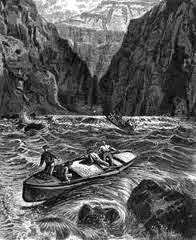 Wesley Powell took an expedition of 11 men and 4 wooden boats down the Colorado River through the Grand Canyon. It was an under-financed project, and virtually every day the expedition was on the verge of destruction.
On this date, near the lower end of the canyon, the party saw a giant rapids. They spent the night on the shore. Powell wrote, “The billows are huge and I fear our boats could not ride them…There is discontent in the camp tonight and I fear some of the party will take to the mountains but hope not.”
The next day, convinced the rapids were impassable, three of Powell’s men did leave. On this day in 1869, Seneca Howland, O.G. Howland, and William H. Dunn said goodbye to Powell and the other men and began the long climb up out of the Grand Canyon.
The remaining members of the party steeled themselves, climbed into boats, and pushed off into the wild rapids. Amazingly, all of them survived and the expedition emerged from the canyon the next day.
When Powell reached the nearest settlement, he learned the three men who left had been less fortunate–they encountered a war party of Indians and were killed.
JOHN WESLEY HARDIN ARRESTED
August 23, 1877 climaxed probably the most dramatic manhunt in the Old West.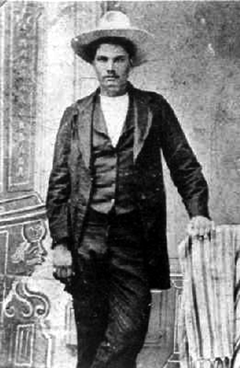
Although John Wesley Hardin had killed a number of men, on May 26, 1874 Harden Killed Deputy Sheriff Charles Webb in Texas and killing a lawman couldn’t be overlooked.
For three years Hardin was able to elude the Texas Rangers by using an alias and keeping a low profile. He also moved to Florida.
But, the Rangers discovered where he was, and even though they had no authority in Florida, sent John Armstrong after him.
Acting on a tip, Armstrong spotted Hardin in the smoking car of a train stopped at the Pensacola station. Local deputies were stationed at both ends of the car, and the men burst in with guns drawn. Hardin reached for the gun holstered under his jacket. The pistol caught in Hardin’s fancy suspenders, this allowed Armstrong time to club Hardin with his long-barreled .45 pistol instead of having to shoot him.
They spirited Hardin back to Texas on the next train. Hardin was tried and found guilty of killing Sheriff Webb and sentenced him to life in the Texas state prison at Huntsville. He served 15 years before the governor pardoned him.
FESTIVAL OF THE WEST
I would think most of you are familiar with the National Festival of the West, and the fact that it didn’t take place this ye ar.
ar.
I spoke to Mary Brown…the founder of the event. She said the event will be back on line in 2013. It will take place from March 21 to 24 at Westworld in Scottsdale.
If you are interested in keeping up with things as they move along visit their web site: www.festivalofthewest.com.
We’re always sorry when we loose an Old West venue, but happy when it comes back.
VIGILANTES
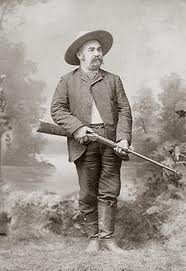 One of the aspects of the Old West that has always intrigued me was the vigilantes. I can understand the frustration with how many times crime was running rampant, with towns popping up ahead of the town’s infrastructure…which included the law.
And even in more developed towns, the law was handicapped because of the number of lawmen, the territory they had to cover, the technology and even that sometimes the lawmen were also the outlaws.
Probably the most amazing aspect of the vigilantes is that they were usually known by everyone…sometimes pictures were taken…yet I’m not aware of any vigilante being tried for his actions.
Why am I talking about this at this time? This is the birthday of one of the Old West’s most famous vigilantes, John X. Beidler or just “X” as he was known by everyone.
He was a leader of the Montana vigilantes. Unlike most vigilantes, who tried to remain unknown, X relished the notoriety. He was the principal hangman for at least five of the vigilante’s victims, and he survived several narrow escapes in his relentless pursuit of dangerous men.
After Montana was rid of “The Innocents”…the name of the outlaw gang…the vigilantes disbanded.
As an old man X fell on hard times and lived off the charity of people who remembered his service as a vigilante.
When he died in Helena, Montana, in 1890, his death certificate listed his occupation as “Public Benefactor.”
PHOEBE ANN MOSES
This coming Monday we’ll be celebrating the birthday of Phoebe Ann Moses…If you don’t know who she is by the picture, it’s “Little Sure Shot,” Annie Oakley.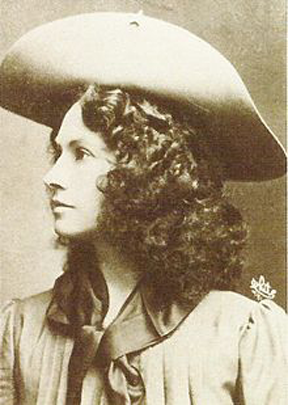
From the time she shot a squirrel for the family’s stew pot at the age of eight, she knew she had a special talent.
We all know about her talent, but what most people don’t know about is the love she and her husband had for each other, Frank Butler.
Frank Butler was also a sharpshooter with his own traveling show. On Thanksgiving in 1876 they had a match, and Phoebe Ann beat Frank.
By June of the next year they were married in Oakley, Ohio. Phoebe Ann changed her name to “Annie Oakley”, and, as they say, the rest is history.
Even though over the years, Annie Oakley’s popularity far outdistanced her husband’s, Frank’s love for Annie grew even more. And they were always together.
After injuries from a train accident and later an auto accident she retired, and Annie and Frank moved to Greenville, Ohio.
Annie Oakley died in 1926 at the age of 66. Frank Butler was so devastated that he stopped eating and died 18 days later.
JOHN WAYNE
For anyone who’s a fan of John Wayne…Actually, I don’t know anyone who isn’t…Michael F. Blake turned me on to a great piece done by Roger Ebert.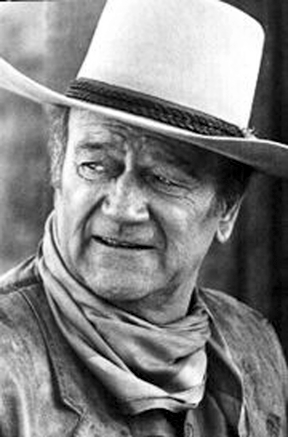
One thing about John Wayne, you knew where he stood. And that was 100% behind the United States.
To read the piece go to:
http://blogs.suntimes.com/ebert/2012/05/john_wayne_shall_we_gather_at_.html
FOLLOWING THE LEGENDS
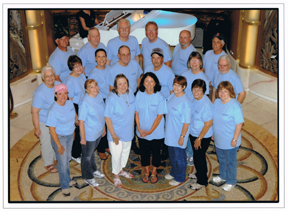 We’ve been away for a little over a week on our first Following the Legends cruise to Alaska.
What a ball! There were twenty of us. Sunny and I were able to meet some great people…A few of whom will continue as close friends.
The food was unbelievable, and the scenery was awesome. Everyone saw whales.
We learned about the Old West, went on excursions and ate, ate, ate.
We’re planning another cruise in August of 2013. I’ll be passing on information as things come together.
FOLLOWING THE LEGENDS CRUISE
We’re headed down the hill to Phoenix to catch a flight to Seattle, Washington to go on our Following the Legends Cruise to Alaska.
Sunny and I, a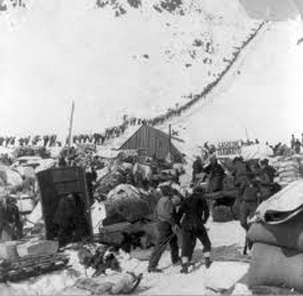 long with a group of Old West enthusiasts are going to be spending a week on Princess Cruise traveling along the inland passage.
During the Alaska gold rush Wyatt Earp, John Clum…founder of the Tombstone Epitaph and mayor of Tombstone…Nellie Cashman…the miner’s angel, both in Alaska and Tombstone…and con-man Soapy Smith were all up there.
In addition it was extremely tough for the gold miners. They had to take a year’s supply of food with them. The food and equipment would weigh about 2,000 pounds. To get these provisions to the gold fields, a prospector would have to make 30 round trips for a total of 2,500 miles. The picture shows the line of miners on the trail.
We’re going to have a lot of fun…Wish you were here.
JOAQUIN MURRIETA
On July 25 back in 1853 Joaquin Murrieta was supposedly killed by California Rangers led by L.A. Deputy Sheriff Harry Love.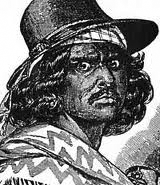
Joaquin and his gang had been terrorizing Anglos in Central California, and the state had put a reward of $6,000 on his head.
Just before the reward deadline had run out Harry Love and his men ran into a group of Mexican outlaws and engaged in a fire-fight.
When I said the reward was “on his head” it was literally that. Love brought in Joaquin’s severed head in a jar of whiskey.
Since there were several Spanish outlaws with the name of Joaquin, many said it wasn’t “the Joaquin.”
But Harry Love didn’t care. He got his $6,000 and later he took Joaquin’s head on tour for a $1 a look.
EMPERIOR NORTON
Did you know that back in the 1870’s the United States was ruled by an Emperor? Well, even back then most of the citizens didn’t know  it. Our Emperor was Emperor Norton, and he lived in San Francisco.
If you visit this link you’ll get the full story: