Chuckwagon: Fried Cakes
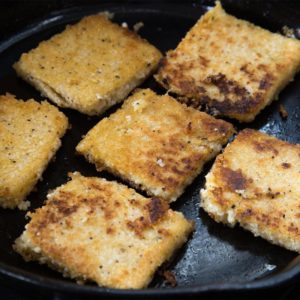 Here is a great treat whether you are a cowboy on a cattle drive; a member of a family on your way west; or spending the evening watching TV. Obviously today you need to substitute an oil that builds less cholesterol than rendered beef fat. Sprinkling the Fried Cakes with sugar can make them a great dessert.
Fried Cakes
Mix well with fork 1-½ cups of flour and 1 cup water. With plenty of flour on hands and rolling surface, roll out dough to ¼ inch thickness. Cut into 2-inch squares. Heat rendered beef fat in skillet, and add dough squares. Brown on both sides. Sprinkle fried cakes with salt. Makes about 20 cakes.
*Courtesy of Chronicle of the Old West newspaper, for more click HERE.
Air Conditioning in the Old West – A Reader’s Question
Question: It’s so hot in the West and the Southwest during much of the summer that even today with air-conditioning, it can get downright uncomfortable. How did they beat the heat in the Old West?
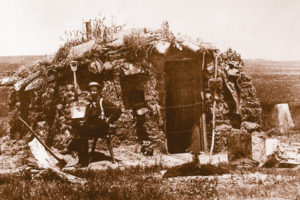 Answer: There were several things people on the frontier did to make the hot, dry summers more bearable. In some cases they used ingenuity. In others it came with the territory. One that came with the territory was on the plains. With no lumber for homes, but plenty of territory or sod, they cut it into one foot by two foot rectangles and used the sod to make their homes. Although these “soddies” had a lot of drawbacks, they were warm in the winter and cool in the summer.
Those frontiersmen who settled in areas with available lumber, built homes with overhanging porches on all sides. That way no matter where the sun was located, the overhang shaded the windows. The porch also provided a shady place to take a Sunday afternoon rest in a rocking chair. And on hot nights a sleeping bag thrown on the porch provided an area with a cool breeze and protection in case of a midnight shower. Cowboys living in bunkhouses often slept outside under the stars during the summer.
Even businesses found ways to keep their customers cool. Back in 1880’s the town of Florence, in southern Arizona, bragged of having the coolest tavern in the southwest. In the rear of the regular saloon, a tunnel had been dug in the ground. That cool cave was called the Tunnel Saloon.
Natural Gas is Giving Out
The Supply Cannot Be Depended Upon, and Must Be Abandoned
April 30, 1892, Bee, Sacramento, California – The days of natural gas are numbered. There is surprising unanimity among the mining engineers on this point. They agree that more gas can be found, and that wells may continue to flow to some extent, but they say that experience has proven that the supply cannot be depended upon for manufacturing or for heating purposes. The amount of natural gas reached its maximum two years ago. It has fallen off each year since, notwithstanding the large number of new wells bored.
 Said a Pittsburg engineer: “We have had a pretty bad time this winter in Pittsburg. The flow has given out repeatedly just at the time, perhaps, when most needed. People who had no coal in their houses have had the gas go out on them in some of the very coldest weather. Manufacturers who depended on gas for fuel have had to shut down, business has been deranged, and home life has been made miserable. Some people are still boring wells and trying to keep up a supply by tapping places, but with only partial success. One after another the wells give out. When they cease flowing the only thing to be done is to turn the valve and leave them alone. Sometimes a well will start up again and flow gas after it has been idle for some time, but all the same to reach a state of exhaustion sooner or later. Manufacturers are going back to coal again, and householders are agreeing that it will not do to depend upon natural gas. One thing has been made certain, the theory that this manufacture of gas is going on fast enough to supply the flow is all wrong. It is a slow process. We have already bored holes enough to overtask Nature.”
Newspapers Report on the Discovery of Gold
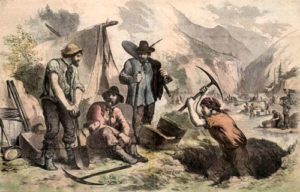 The year was 1848. The headline was the discovery of gold. The West would never be the same.
The California and California Star newspapers were the first to run stories about the discovery of gold at Sutter’s Mill. But they ceased reporting on the gold fields after a couple of months.
It was January of 1848 when James Marshall, working at John Sutter’s sawmill, discovered a couple of gold-colored rocks in the race that could be beaten into different shapes, but not broken. It was gold.
The first mention of the discovery of gold in a newspaper was on May 3. Admitting that the discovery was just a rumor, the Californian newspaper said that “Seven men with picks and spades could gather $1,600 worth of gold in fifteen days.” That’s the equivalent of more than $280,000 in today’s money.
Then, on May 6 Samuel Brannan, a reporter for the California Star, returned from the gold fields stating that the diggings had “full flowing streams, mighty timber, large crops, luxuriant clover, fragrant flowers, and gold and silver.” He concluded by saying, “Great country, this.”
By May 26, according to the Californian, “The whole country, from San Francisco to Los Angeles, and from the seashore to the base of the Sierra Nevadas, resounds with the sordid cry of gold! Gold!! GOLD!!! While the field is left unplanted, the house half built, and everything neglected, but the manufacture of shovels and picks.”
That was the last report the Californian newspaper made on the gold field, because three days later the Californian closed its doors. All the employees, including editor Benjamin Beckelew, went to seek gold.
With great joy the California Star reported that their competitor was dead. And the verdict of the inquest was gold fever. But, the California Star didn’t have long to gloat, because in less than a month, the California Star’s editor, Edward Kemble, headed out to the gold fields and the California Star also folded.
Old West Book Review: A Pair of Shootists; The Wild West Story of S. F Cody & Maud Lee
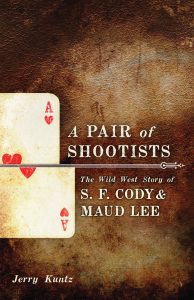 A Pair of Shootists; The Wild West Story of S. F Cody & Maud Lee, Jerry Kuntz, University of Oklahoma Press, (405‑325‑3200) $29.95, Hardcover. Photos, Notes to the Chapters, Index.
This carefully researched book brings to light the story of S. F. Cody, a Wild West performer who was in no way related to the famous Buffalo Bill Cody. Included in this book is background information regarding many of the Wild West performers and the numerous shows that featured cowboys, Indians, acrobats, wild horse stampedes and the carnival atmosphere surrounding the entertainment of long ago. Beginning around 1888, these shows became popular and grew in number. Touring every state in the Union, they hauled horses, cattle, equipment, Indians, trick riders and shootists who dazzled audiences with their derring‑do.
The forerunner of the Wild West shows actually began around 1883 when various sharpshooters held public contests to see who could out‑shoot the other using moving targets. In the beginning live birds were used, but eventually the sport graduated to glass‑ball targets. Soon these shooting contests added wild horse races, stagecoach holdups, and circus acts.
In this book, Samuel F. Cowdery is the central figure. Born in Davenport, Iowa in the 1870s, he traveled Out West seeking adventure and became an experienced buffalo hunter, horse trainer, cowboy and miner. In the late 1880s he joined the Forepaugh’s Wild West Show. His name was shortened to S. F. Cody by show promoters who were not bashful about fooling people into thinking Cowdery was either Buffalo Bill himself, or, at least Bill’s son.
There was no question that S. F. Cody could ride hard and shoot straight. He even looked like Buffalo Bill with his long hair, distinctive moustache and fringed buckskin garb. Next came Maud Maria Lee, a sixteen year old girl in 1888 who hailed from Norristown, Pennsylvania. Maude was the same size and shape as the famous Annie Oakley. An attractive brunette, Maud had some gymnastic training, loved the circus life, rode horses and was a crack shot. Also a member of the Forepaugh Wild West Show, it did not take long for Maud to meet Cody, and it did not take long for the Forepaugh promoters to seize upon the opportunity to make audiences believe that Maud Maria Lee was Annie Oakley.
The story tells of the pair’s travels with various touring groups, their trip to Europe with the Wild West extravaganza complete with advertising posters done in England bragging that S. F. Cody was the son of Buffalo Bill.
Long travel, harsh weather conditions, serious injuries, and the vagaries of salary payment took their toll. Maud began using narcotics to ease her pain and she gradually slid into mental instability. Maud returned to her parents in America while Cody took up with a new lady partner for his shooting act as well as in real life. While still in England, Cody developed an interest in the early airplane experiments. Certain the airplane would be invaluable for war, he even worked for a time for the British government. Cody was killed in 1913 in a crash with his biplane, and is buried in the military service cemetery at Thorn Hill.
After drug use, arrests, lawsuits, and brushes with the law, Maud was committed by her parents to the Norristown State Hospital, a mental institution where she died in 1947 from heart failure at age seventy‑five.
The wild west story of S. F. Cody and Maud Lee is not a happy one. Their best years together were those few when they first met, when the world was young, when they were the center of attention. Crowds cheered, the horses were fast, the shooting was usually straight, but they were never really Buffalo Bill or Annie Oakley. They had to settle for second best, and until now have been mostly forgotten.
A haunting story, this book is filled with good information heretofore overlooked.
Editor’s Note: The reviewer, Phyllis Morreale‑de la Garza is the author of numerous books including the novel Silk and Sagebrush; Women of the Old West, published by Silk Label Books, P.O. Box 700, Unionville, New York 10988‑0700.
*Courtesy of Chronicle of the Old West newspaper, for more click HERE.
Eighth Grade Exam
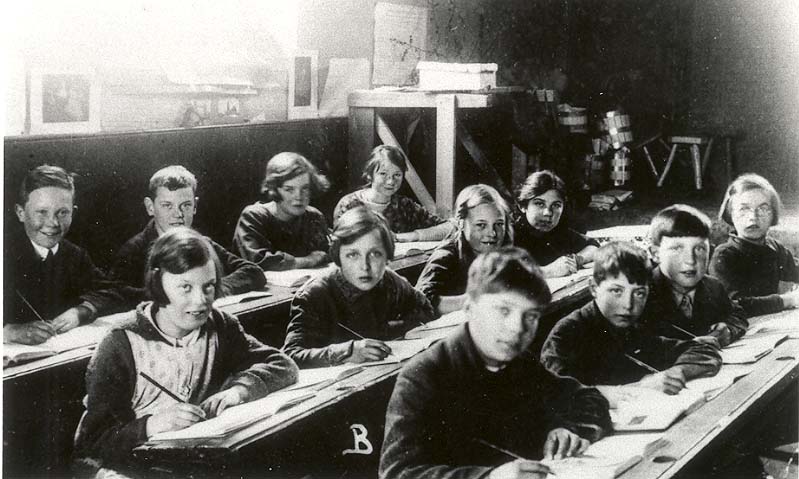
Below is the actual final exam for the Salina, Kansas eighth grade in 1895. Could you pass the test?
GRAMMAR (Time, one hour)
- Give nine rules for the use of Capital Letters.
- Name the Parts of Speech and define those that have no modifications.
- Define Verse, Stanza and Paragraph.
- What are the Principal Parts of a verb? Give Principal Parts of do, lie, lay, and run.
- Define Case. Illustrate each Case.
- What is Punctuation? Give rules for principal marks of Punctuation.
7 through 10. Write a composition of about 150 words and show therein that you understand the practical use of the rules of grammar.
ARITHMETIC (Time, 1.25 hours)
- Name and define the Fundamental Rules of Arithmetic.
- A wagon box is 2 ft. deep, 10 feet long and 3 ft. wide. How many bushels of wheat will it hold?
- If a load of wheat weighs 3942 Ibs., what is it worth at 50 cents/bushel, deducting 1050 Ibs. for tare?
- District No. 33 has a valuation of $35,000. What is the necessary levy to carry on a school for seven months at $50 per month, and have $104 for incidentals?
- Find cost of 6720 Ibs. of coal at $6.00 per ton.
- Find the interest of $512.60 for 8 months and 18 days at 7 percent.
- What is the cost of 40 boards 12 inches wide and 16 ft. long at $20 per meter?
- Find the bank discount on $300 for 90 days (no grace) at 10 percent.
- What is the cost of a square farm at $15 per acre, the distance around which is 640 rods?
- Write a Bank Check, a Promissory Note, and a Receipt.
U.S. HISTORY (Time, 45 minutes)
- Give the epochs into which U.S. History is divided.
- Give an account of the discovery of America by Columbus.
- Relate the causes and results of the Revolutionary War.
- Show the territorial growth of the United States.
- Tell what you can of the history of Kansas.
- Describe three of the most prominent battles of the Rebellion.
- Who were the following: Morse, Whitney, Fulton, Bell, Lincoln, Penn, and Howe?
- Name events connected with the following dates: 1607, 1620, 1800, 1849, and 1865.
ORTHOGRAPHY (Time, one hour)
- What is meant by the following: alphabet, phonetic, orthography, etymology, and syllabication?
- What are the elementary sounds? How are they classified?
- What are the following, and give examples of each: trigraph, subvocals, diphthong, cognate letters, and linguals?
- Give four substitutes for caret ‘u’.
- Give two rules for spelling words with final ‘e’. Name two exceptions under each rule.
- Give two uses of silent letters in spelling. Illustrate each.
- Define the following prefixes and use in connection with a word: bi, dis, mis, pre, semi, post, non, inter, mono, sup
- Mark diacritically and divide into syllables the following, and name the sign that indicates the sound: card, ball, mercy, sir, odd, cell, rise, blood, fare, last.
- Use the following correctly in sentences: cite, site, sight, fane, fain, feign, vane, vain, vein, raze, raise, rays.
- Write 10 words frequently mispronounced and indicate pronunciation by use of diacritical marks and by syllabication.
GEOGRAPHY (Time, one hour)
- What is climate? Upon what does climate depend?
- How do you account for the extremes of climate in Kansas?
- Of what use are rivers? Of what use is the ocean?
- Describe the mountains of North America.
- Name and describe the following: Monrovia, Odessa, Denver, Manitoba, Hecla, Yukon, St. Helena, Juan Fernandez, Aspinwall and Orinoco.
- Name and locate the principal trade centers of the U.S.
- Name all the republics of Europe and give the capital of each.
- Why is the Atlantic Coast colder than the Pacific in the same latitude?
- Describe the process by which the water of the ocean returns to the sources of rivers.
- Describe the movements of the earth. Give the inclination of the earth.
Samuel Maverick
 In 1835 Samuel Maverick moved to the San Antonio, Texas area, and started practicing law. He was even one of the signers of the Texas Declaration of Independence.
As the story goes, a neighbor owed him $1,200. With no ready cash, the neighbor offered to pay him in cattle. So, reluctantly Samuel agreed to take 400 head of cattle. Not wanting to deal with the cattle, Samuel hired someone to take care of them. At first the hired hand branded the calves with Samuel’s MK brand. But soon things got out of hand, and many of the calves went unbranded.
By 1854 Samuel’s unbranded cattle were roaming all over the area, and his neighbors started complaining, stating that if Samuel didn’t do something about them, he wouldn’t have any.
Finally, in 1856, Samuel sold his cattle to another rancher. The cattle were sold on the basis of “range delivery.” This meant that the rancher bought an approximate number of cattle that happened to be located on the open range. Whenever the new owner found an unbranded cow, he claimed them as Samuel Maverick’s cattle, or “Maverick’s”. By 1857, people in the area were referring to unbranded cattle as “mavericks.”
But the term didn’t come into general use until after the Civil War, when the cattlemen returned to find tens of thousands of unbranded cattle roaming the plains. It’s interesting to note that during this time, although taking a branded cow was a hanging offence, to take an unbranded calf that wasn’t following a cow, or a maverick, was not rustling. And rounding up mavericks is the way many a cattle ranch started out.
Trailing Louis L’Amour From California to Alaska – Part One
THE FRONTIER SPIRIT OF LOUIS L’AMOUR
THE LAND OF THE SUNSET SEA
By
Bert Murphy

In five novels Louis L’Amour lets you experience Old California and the Pacific coast circa 1800 to 1880. When the railroad reached California in 1869, it diminished the frontier period. When it reached Los Angeles in 1876, the western frontier was essentially closed. The cowards who never started and the weak that might have died on the way could now ride west on cushioned seats.
However, frontier pockets still remain. In my life, I have known many who have the frontier-pioneer spirit. They are the few of the many, both men and women, who have the heart, nerve and sinew to push into the unknown of space or ideas. They don’t particularly give a damn what their contemporaries think. They are driven to see and know. If they think of them at all, they scorn the historical revisionists who would deprive us of our heroes. They joke about extreme environmentalists who are unreasoning obstructionists. Yet they understand and protect the earth. They love their country and despise these who are destroying it. They support and defend our hard- won and kept Republic, the Constitution and the Bill of Rights.
Those of the pioneer spirit drive on into the great unknown to make a better world. Soon they will feel the snarl of the jets at their backs as they drive toward the frontier of space. L’Amour recognized this final frontier. There will be L’Amour novels tucked into cargo pockets of space suits. There will be men like L’Amour, Service, London, Kipling, Grey, Clark, Asimov and Heinlein to tell their stories. They will tell of courage, love, loyalty, survival and lonely death in the endless frontier of space. The arenas will change. Those frontiersmen and women of space will have the pioneer spirit L’Amour knew and wrote of.
The virtues and characteristics of pioneers and heroes will not change. L’Amour’s main characters were people of stamina and intelligence. They did not lie, steal or cheat. They were independent and killed their own snakes. They celebrate the free human spirit.
Many of the things that Louis L’Amour teaches in his writings are useful to any age. Paleo hunters or spaceman must know that peripheral vision is the best to use at night. Aim low at an uphill or downhill target. Firearms are sighted horizontally above the target to allow for gravity drop. Uphill or downhill the gravity vector is reduced or eliminated. Weapons shoot high. So, as L’Amour wrote, shoot low. Read the signs around you. When did that horse go by-was he ridden? The spaceship that landed-was it ours or theirs? Carry a knife and fire maker-they will get you out of all kinds of trouble. Know the place you are in. Can you eat that plant? Where is the water? There is much field craft in L’Amour’s novels.
In Trailing Louis L’Amour in New Mexico, I quoted L’Amour as saying, “man is tracked in his mind.” With his tenth-grade education, great intelligence, amazing memory, extensive travel, war experience and voluminous reading, L’Amour was as erudite a person as you will meet. A reasonable estimate would be that he read seven thousand books and “dipped into” many more. His amazing memory let him recall much of what he read and experienced. He chose historical fiction as his genre, and he chose to be historically and geographically accurate. He added much in the way of science to his novels. He showed an extensive knowledge of the world’s odd corners, history, Indian lore, literature, field craft, botany, geology, geography, archeology, anthropology, psychology and other hard and soft sciences. He wrote of and speculated on the paranormal. Read Louis L’Amour for pleasure, knowledge or both. There is much to be gained.
A background and knowledge of the stage where the L’Amour novels play out adds to the enjoyment and understanding of his stories. A knowledge of the land, people and forces that made California and the Pacific Coast what they were when L’Amour’s characters encountered them in the 1800’s will let you appreciate his marvelous research, accuracy and craft. You will enjoy his novels even more.
Read more about Louis L’Amour HERE.
Clay Allison – Old West Psychopath
 Clay Allison can be truly called a psychopath. At the height of the Civil War when the Confederate Army was drafting into service anyone who could hold a rifle, Clay was released on a medical discharge because he was maniacal.
 Old West Book Review – The Texas Frontier and the Butterfield Overland Mail
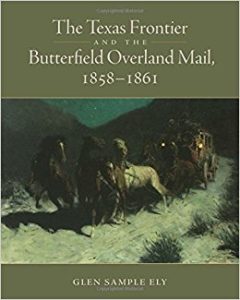 The Texas Frontier and the Butterfield Overland Mail 1858-1861, Glen Sample Ely, University of Oklahoma Press, $34.95, Cloth, 440 pages, Illustrations, Maps, Photographs, Notes, Index.
Anyone interested in early Texas history will find this book a fascinating journey across that state during the years prior to the Civil War. While the Butterfield Overland Mail extended 2,795 miles from St. Louis, Missouri to San Francisco, California this book targets the 740 miles, border to border, across the Texas frontier.
The book combines Texas politics and intrigues while at the same time explaining the history and workings of the Butterfield stagecoach line. Throughout the book readers find both early photos taken by original Butterfield researchers Margaret and Roscoe Conkling, with modern-day pictures taken by author Ely as he meticulously followed their trail. Comparisons are made between Conkling photos taken 80 years ago, and the new pictures and how the sites look today. Changes due to weather erosion and human agricultural disruptions are noted.
All of the stagecoach sites are pictured; the crumbling walls, rock foundations, and long-forgotten artifacts help tell the story. Belt buckles, bullets, bridle bits, forks and knives plus various tools have been unearthed and on display here, including some graves with the stories of their occupants. At the end of the book readers will find notes containing all of the information available regarding dates, locations, employees, station masters, Indian raids, and everything you could ever possibly want to know about these stagecoach station sites.
As the author and friends traipsed from one location to the next across Texas, he brings to us the stories of those people who braved this frontier at a time when great changes were occurring in our country. Prospectors, adventurers, cattle ranchers, military men, schemers as well as honest pioneers tried to build and tame this unforgiving land. Always the threat of murderous Indian raids loomed as hardy people determined to make homes for themselves.
Meanwhile, scattered throughout the book are wonderful paintings done by Frederic Remington showing the dangerous journey traveled by these coaches. Butterfield crews, passengers, and hostlers alike braved this rugged road. Indians lurked along the way, and the accommodations at home stations usually offered little more than poor food and scant lodging. The coaches are described as rough-riding, jostling contraptions rattling over hard-packed roads or wallowing in muddy streams.
Apart from the actual everyday management of the stagecoaches, there were business executives back east busily working to make the enterprise financially lucrative. Some joined with Texas politicians and businessmen to make decisions about everything from toll bridges to the establishment of small communities.
Readers are taken on a journey through a rough and tumble time in antebellum Texas, covering everything good and bad about people striving to settle a wild frontier.
This book is a huge project by author Glen Sample Ely, a Texas historian and documentary producer. His love for Texas history is proudly displayed here, along with his talent for careful research and dogged determination to get it right. Readers will learn from the narrative, while being mesmerized by the haunting photographs showing what happened here. He also authored the book Where the West Begins: Debating Texas Identity.
The book is a must for your Old West library if you are interested in Texas history and the Butterfield Overland Mail.
Editor’s Note: The reviewer Phyllis Morreale-de Ia Garza is the author of numerous books about the Old West including the novel Charissa of the Overland, published by Silk Label Books, P.O. Box 700, Unionville, New York 10988 (845) 726-3434. www.silklabelbooks.com
William Brazleton – Masked and Unmasked
 William Brazleton was about 6 feet tall, and weighed around 200 pounds. He was described as “a great big, good natured fellow who was as harmless as any man could be.” Little is known about his early life. He did tell a friend that he had robbed a couple of stages in northern Arizona, three over by Silver City, New Mexico, and four around Tucson.
 Chuckwagon – Curing Bacon
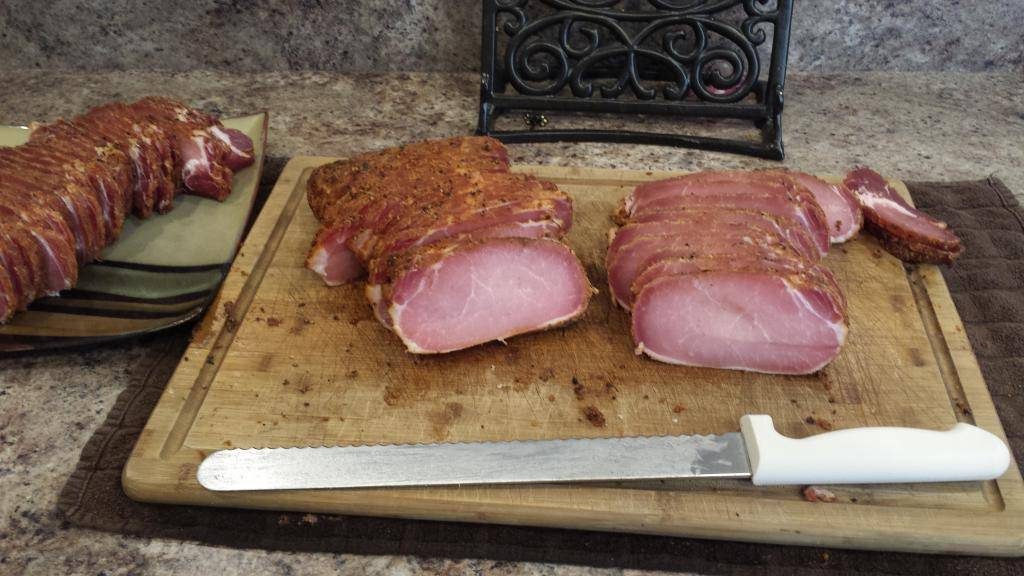
For curing bacon you will need one peck salt to five hundred pounds pork. To five gallons water add:
4 pounds salt
1 pound sugar
1 pint molasses
Mix, and after sprinkling the fleshy side of the ham with the salt, pack in a tight barrel. Hams first, then shoulders, and middlings. Pour over the brine; leave the meat in brine from four to seven weeks.
*Courtesy of Chronicle of the Old West newspaper, for more click HERE.
William Johnson and an Old West “Romeo and Juliet”

Shot His Wife Because She Loved a Second-Rate Barkeeper
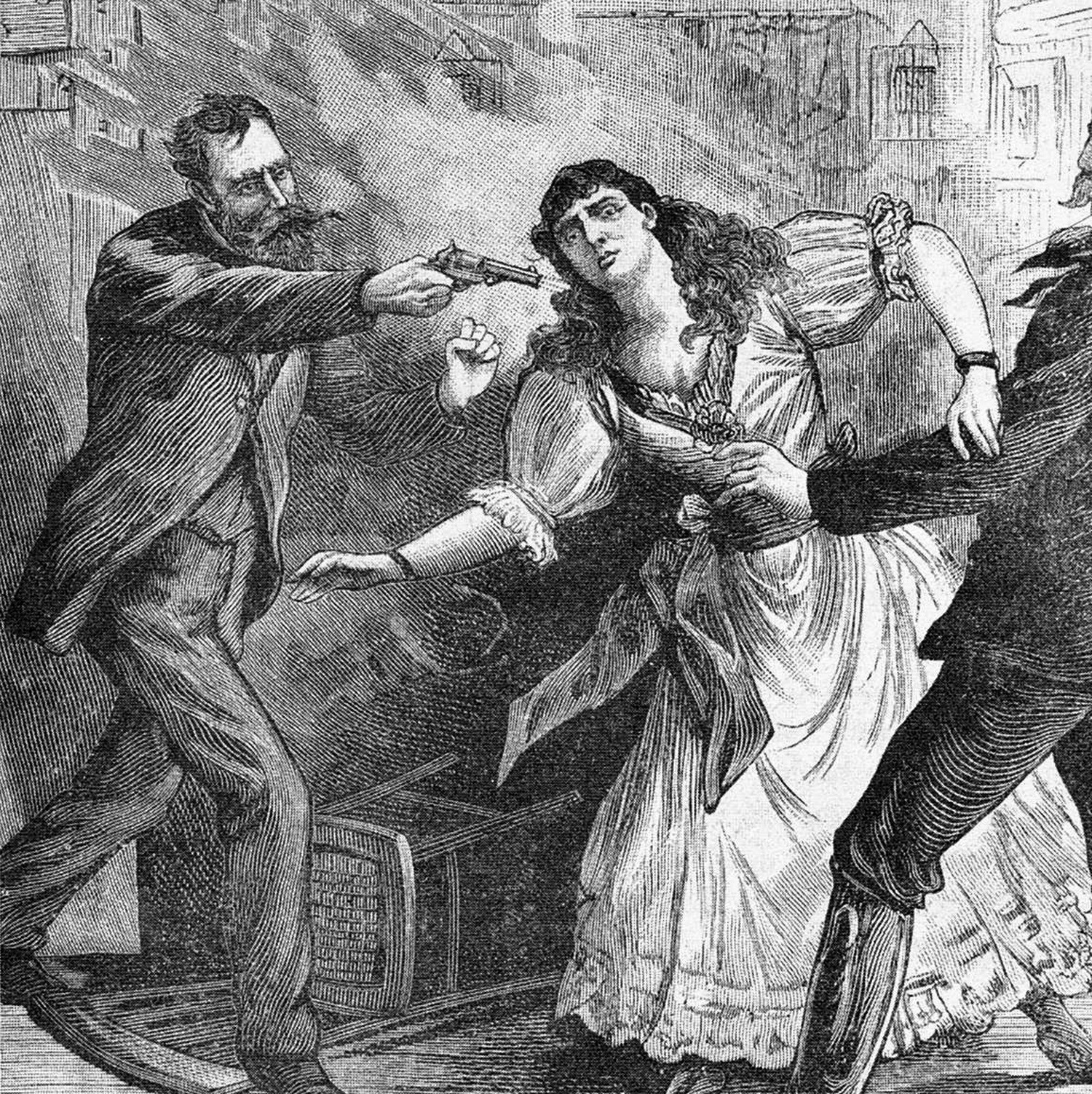 April 9, 1889, Daily Record-Union, Sacramento, California – Mrs. Mary Sanders was shot and probably fatally wounded last Saturday night by her husband, who then attempted to commit suicide by shooting himself in the neck. The couple were married about eighteen months ago at Whitesboro, Mendocino County, and they lived happily together until the wife became infatuated with Dan Callaghan, a Eureka saloonkeeper, and ran away with him about six months ago. They were followed to this city by Sanders, who traced his wife to 508 Pine Street, where she was living with Callaghan. He went there bent on killing Callaghan, but bloodshed was averted as Callaghan happened to be out at the time. There was reconciliation between husband and wife, and the police say that they next heard of Mrs. Sanders was in a DuPont Street bagnio, where she was placed by her husband. Sanders then commenced drinking heavily, and his wife left him. He started in search of her but it was not until about 7 o’clock Saturday night that he found her, on Fourth Street, near Mission. He asked her to return to him and she refused, whereupon he drew a revolver and fired three shots at her. One of the bullets took effect above her right hip and ranged inwards, indicting a wound which it is believed will cause her death. When she fell to the sidewalk Sanders, believing his murderous work complete, placed the muzzle of the pistol to his mouth and fired. The bullet lodged in his neck, producing a painful but not fatal wound.
David Neagle – Marshall of Tombstone
 On July 15, 1880 David Neagle arrived in Tombstone, Arizona. If he had had the ability to see the future, he would probability have continued on down the road.
 Old West Book Review: Charles Goodnight: Father of the Texas Panhandle
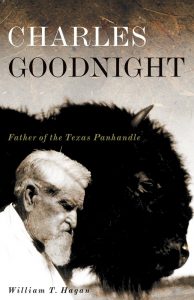 Charles Goodnight: Father of the Texas Panhandle, William T. Hagan, University of Oklahoma Press, (405) 325‑3200, $19.95, Paperback. Illustrations, 168 pages, Maps, Bibliography.
Pioneer rancher and cattle baron of the Southwest, Charles Goodnight is known for his exploits as a Texas Ranger, scout, Indian fighter, and businessman. This book only touches upon Goodnight’s early life, and is really aimed at the last 30 years of his life. Complete biographies about Goodnight are written by J. Evetts Haley titled Charles Goodnight: Cowman and Plainsman, and The No‑Gun Man of Texas, by Laura V. Hamner.
Born in Illinois in 1836, Goodnight’s childhood included hard work, poverty, and long hours of drudgery on a farm. His education included only two years of school. However, he grew into a man of sharp business ability combined with his dedication to hard work. He blazed cattle trails in Texas, Colorado and Kansas but is best known for his exploits during the early days of Texas. When Goodnight was 28 years old, he was a member of the Ranger unit who found the white Indian captive Cynthia Ann Parker. Years later, Goodnight would become friendly with her son, Quanah who became a Comanche spokesman.
One incident in the life of Charles Goodnight is told about in the memorable Larry McMurtry Western movie “Lonesome Dove.” During a cattle drive through Colorado, Goodnight’s business partner Oliver Loving was fatally wounded by Indians, and the dying man requested that his body be returned to Texas. Goodnight made good on his promise, having Loving’s body packed in charcoal to make the long wagon journey back home.
This book covers the years spent building his ranches in the Texas Panhandle, with the financial banking of wealthy investors from as far away as Ireland. Foreign speculators had the money, and Goodnight had the experience and guts. Standing over 6 feet tall, weighing 200 pounds, a six‑gun on his hip and with grizzled beard and no‑nonsense steely eyes, Charles Goodnight seemed to fear no one.
Goodnight married a Texas school teacher named Mary Dyer, whose portrait shows her to be a thin‑lipped, cold‑eyed woman whose no‑nonsense demeanor seemed to match her husband’s. The couple had no children. After many years of hard ranch life, Goodnight described his wife as being a truly strong woman who even though living with no female companionship, and 75 miles from town, made married life cheery and pleasant.
Fights with partners, the railroad, encroaching neighbors, and politics are covered in this book. Goodnight remained sympathetic to the Indians’ plight, even though having been an Indian fighter in the 1870s with the Texas Rangers, he understood how these people had been forcibly removed from their land.
During the last year’s of Goodnight’s life, he sold most of his ranch holdings. Mary died several years before Goodnight did, and he was about to spend the last few years of his life in lonely isolation when a 26‑year‑old lady named Corrine Goodnight showed up wondering if they were related. The 91‑year‑old Goodnight enjoyed her company, hired her to be his secretary, and soon thereafter married her.
The couple traveled to Arizona, taking up residence first in Phoenix and then moving to Tucson where Goodnight died Dec. 12, 1929. Corrine had him laid to rest beside his first wife Mary, in Goodnight, Texas.
Charles Goodnight out‑lived most of his friends, and all of his enemies. He and Mary built a ranching empire in Palo Duro Canyon in the 1870s, and they are remembered for their contributions to the cattle industry, as well as being an inspiration to those dedicated to hard work, determination, and honest dealings.
Editor’s Note: The reviewer, Phyllis Morreale‑de la Garza is the author of many books about the Old West including Hell Horse Winter of the Apache Kid, Silk Label Books, P.O. Box 700, Unionville, New York 10988 Ph. (845) 726‑3434 www.silklabelbooks,com
Chuckwagon: Spotted Pup Pudding
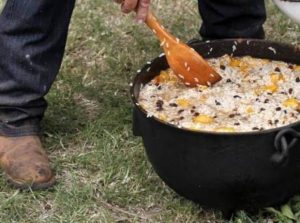 To make Spotted Pup Pudding, take whatever amount needed for hungry cowboys of fluffy, cooked rice. Put in Dutch oven and cover with milk and well-beaten eggs. Add a dash of salt; raisins and a little nutmeg. Sweeten well with sugar. Add raisins and a little nutmeg and vanilla. Bake in slow oven until egg mixture is done and raisins soft.
*Courtesy of Chronicle of the Old West newspaper, for more click HERE.
Cheyenne Dog Soldier Chief Tall Bull
 Tall Bull was a fairly common name for the Cheyenne, had by several braves. But the Tall Bull known by the whites of the Old West was Cheyenne Dog Soldier Chief Tall Bull. And under his leadership, they became one of the toughest foes of the United States government in the bloody Plains Indian Wars.
 Martin Sweeny Indian Agent
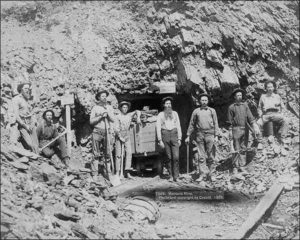 Martin Sweeny, Indian Agent, was born in Massachusetts in 1845, and decided to head out West at the age of 23. He ended up in Arizona shoeing horses on the Apache reservation. Here he learned the Apache language, and developed an appreciation for their lifestyle.
 Billy Wilson and Pat Garrett
 During the Old West men changed names so freely that sometimes there’s confusion as to their real ones, and their aliases. Some say the subject of today’s story’s real name was Billy Wilson; others David Anderson. In reality, what a man calls himself isn’t important; it’s what he does while using that name. Under the name of Billy Wilson, our man came to Lincoln County, New Mexico and bought a livery stable. Later he sold it, and was paid in crisp new $100 bills. Unknown to him, they were counterfeit. On the run for passing counterfeit money, he joined Billy the Kid and his renegade posse.
 Old West Book Review: Cowboy’s Lament, A Life on the Open Range
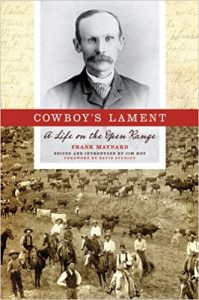 Cowboy’s Lament, A Life on the Open Range, Frank Maynard, Texas Tech University Press, www.ttuDress.org, $29.95, Cloth. Maps, Photos, Bibliography, Index. Foreword by David Stanley, professor emeritus of English, Westminster College, Salt Lake City.
The Introduction to the book is a biography of the life and times of Frank Maynard, written by Jim Hoy, director of the Center for Great Plains Studies at Emporia State University in Kansas. The book is included in the “Voice in the American West” series, published by Texas Tech University Press.
This book is “dedicated to all the old-time cowboys whose stories didn’t get told.” It was written by a man who spent part of his early life riding the open range for a variety of cattle companies beginning in the 1870s when the great roundups were at their height. Maynard was a teenager when he left his happy home in Iowa and headed for Towanda, Kansas where he signed on with an outfit heading for Colorado.
For the next 15 years he experienced every exciting event in the life of a working cowboy that included rough horses, shooting scrapes, injuries, illness and uncertainty, plus wild and free comradery with his pals. What made Frank Maynard different is that he was a romantic who chronicled his experiences, writing stories and poetry about life as a cowboy. Meanwhile, he handled guns, broke horses had some narrow escapes dealing with disgruntled co-workers, cattle rustlers and Indians, but he always remained on the side of law and order. Maynard remained in touch with his family, having a close relationship with his parents and sisters.
In time he met a young lady named Flora Vienna Longstreth whom he fell in love with. However, it took Flora nearly three years to make up her mind about marrying a cowboy. Maynard’s poems indicated how his broken heart pined for her affection until she finally relented.
After the wedding Maynard gave up the cowboy life and became a successful carpenter where the couple lived the remainder of their lives in Colorado Springs. A photo of Flora shows her to be a stem, tight-lipped individual, and people who knew the Maynards thought Flora “ruled the roost.” Frank spent a great deal of time working in his carpentry shop, and writing about his adventures. In time he published some magazine articles as well as poetry, which are included in this book. He is credited with penning “The Cowboy’s Lament”, later put to music in “The Streets of Laredo.”
Maynard died of a heart attack in 1926 at age 73, and is buried in the Evergreen Cemetery in Colorado Springs. Flora died 5 years later.
Frank Maynard was one more cowboy who rode the open range in the old days, chasing cows, battling the elements, meeting gunslingers and lawmen who became famous such as Ed Masterson. He wrote about aII of it as it happened and as he experienced it. He tried having his material published in his old age but at that time there was little interest in the cowboy experience. However, now, one hundred years later the reading public is happy to hear from somebody who was really there. Maynard remained true to himself, a straight-shooter known for his loyalty to his family and friends, who avoided scrapes with drinking, gambling, and the outlaw elements that led many other cowboys astray.
When readers turn the last page, it occurs to us that this is the haunting story of a man who gave up the life he loved for the woman he would forever be faithful to. When looking at his photographs, we see his eyes glowing with a depth of sadness. This man was caught between two worlds; true to his marital vows while struggling with an aching heart filled with memories about those wild and free days when he lived on the open range.
Editor’s Note: Reviewer Phyllis Morreale-de la Garza is the author of numerous books about the Old West, including The Earp Gamble, published by Silk Label Books, P.O. Box 700, Unionville, New York 10988-0700. www.Silklabelbooks.com.
*Courtesy of Chronicle of the Old West newspaper, for more click HERE.
Robert Leatherwood – Accidental Hero

Red Beard the Terror

Old West TV – Dr. George Goodfellow
 Dakota Livesay gives us a great story about a good doctor, …well maybe! Here is more info on Dr. George Goodfellow:
George Emory Goodfellow (December 23, 1855 – December 7, 1910) was a physician and naturalist in the 19th-century American Old West who developed a reputation as the United States’ foremost expert in treating gunshot wounds. As a medical practitioner in Tombstone, Arizona Territory, Goodfellow treated numerous bullet wounds to both lawmen and outlaws. He recorded several significant medical firsts throughout his career, including performing the first documented laparotomy for treating an abdominal gunshot wound and the first perineal prostatectomy to remove an enlarged prostate. He also pioneered the use of spinal anesthesia and sterile techniques in treating gunshot wounds and is regarded as the first civilian trauma surgeon.