Edward Cash – Cattle Rustler
 Edward Cash was a hard working rancher with a wife who lived in Coryell County, in the southeastern part of Texas. Although he wasn’t necessarily handy with a gun, he was handy with his fists. And his ability to intimidate people was an asset to his ranching business. This was because Cash worked hard at acquired cattle one at a time… from his neighbor’s stock. It was virtually impossible to prove Cash as the thief because he was successful at getting rid of the stolen cattle. And, his neighbors didn’t really want to confront Cash and call him a cattle rustler based on just their suspicions.
 How Tombstone, Arizona Was Named
 On April 1, 1877, a young prospector named Ed Schieffelin arrived at Fort Yachuca in southern Arizona. He told the soldiers he was going into Apache country and trying his hand at prospecting. They told him that the only thing he would find there would be his tombstone. That is how Tombstone, Arizona was named.
County Seat War
 Finally Asa Soule, from Ingalls, decided to take the situation into his own hands. He figured that as the crown or miter was the authority of a king, the records of a county were the authority of a county seat. So, on January 11, 1889 he deputized a group of men to steal the county records. These lawmen weren’t novices. They included Bill Tilghman, Neal Brown and two of Bat Masterson’s brothers, Jim and Tom.
Doniphan’s Thousand
 As a young man Colonel Alexander W. Doniphan had no plans on being a military man. Born in Kentucky, Alexander went to college to be a lawyer, later practicing in Missouri. A far cry from what would become Doniphan’s Thousand.
Crazy Horse’s Final Battle
 It was the end of June of 1876. Crazy Horse, along with Sitting Bull, had just completed the greatest victory of the Indians over the U. S. military with the defeat of George Custer at Little Big Horn. The American people demanded revenge. These were the events that lead to Crazy Horse’s Final Battle.
Chuckwagon: Apple Water
 Apple Water:
Roast two tart apples until they are soft;
put them in a pitcher,
pour upon them a pint of cold water,
and let it stand in a cool place an hour.
It is used in fevers and eruptive diseases,
and does not require sweetening.
From An 1888 Cookbook
*Courtesy of Chronicle of the Old West newspaper, for more click HERE.
Nathan Meeker of Horace Greeley’s New York Herald
 Nathan E. Meeker started out as an agricultural writer for Horace Greeley’s New York Herald. He had a particular interest in cooperative farming and living. So Horace Greeley sent him to study what the Mormons were doing in this area. On January 6, 1870 Nathan headed west. But, when he got to Colorado, Meeker decided Colorado was a good place to start his own communal colony. So he started the temperance colony of Greeley, Colorado.
Old West Book Review: Butch Cassidy My Uncle
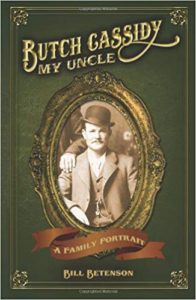 Butch Cassidy My Uncle, Bill Betenson, High Plains Press (1-800-552-7819), $1995, Paperback. 300 pages, Photographs, Notes, Bibliography, Index.
Back in the 1960s, most of us who love western movies went to see a flick called Butch Cassidy and the Sundance Kid. Paul Newman and Robert Redford played the important roles, and we came away impressed and intrigued having seen a cowboy movie we were told was based on facts.
Butch and Sundance were real, and most of their exploits have been delved into now that Hollywood brought the pair to light. So much has been written and told about Butch Cassidy, that one family member Bill Betenson, the great-grandson of Butch’s youngest sister, decided to try to set the record straight. Butch Cassidy came from a large and mostly law-abiding family. Except for one uncle, Dan Parker, who spent time in the Detroit House of Corrections for holding up a store, the rest of the Parkers were embarrassed by Butch’s outlawry.
This book begins with the early life of Butch, whose real name was Robert LeRoy Parker, telling of his youth, schooling and employment. Betenson has access to family memorabilia, plus he has done an admirable job of searching through historical documents, newspaper articles, and public records as well as visiting many of the places where Butch lived.
Butch (a nickname he acquired after working as a butcher), seemed easily attracted to life on the wild side. He did have real jobs in ranching and mining, and his employers always spoke highly of his good manners and careful attention to his duties. But he was also intrigued with adventure and easy money. At various times he took up with characters of questionable integrity, and was therefore involved in a variety of robberies. He rode with a gang holed up in the wilds of Utah. Robbing banks, stagecoaches, trains and even horse rustling were the usual endeavors. Butch spent most of his adult life hunted by sheriff’s posses, cavalry units and detectives working for Pinkertons
This book is filled with family photos and various scenes from Butch’s past, including images of his friends and relatives, besides members of the gang when he hooked up with Harry Longabaugh, (the Sundance Kid). Butch traveled with Sundance and a variety of other gang members, even going as far away as New York City, joined by an attractive young woman known as Ella Place. Butch, Sundance and Ella finally drifted to South America where authorities in the United States continued to hunt them. They wound up in Argentina, and even bought a cattle ranch where they planned to start anew. But alas the Pinkertons and other law enforcement people seemed always lurking nearby.
Again the trio got involved in bank robberies, and conflicting reports has them either killed in South America, or having gotten away due to some other American outlaws killed by police, being mistakenly identified as Sundance and Butch. This of course led to all the modern day controversy. Did Butch die in South America? Did he really come home years later as some of his friends and relatives insist? It has long been told, even in the movie, that Butch and Sundance died in a hail of lead in South America after they robbed a bank. However, there is a strong case told here that while Sundance may have died there, Butch survived and returned years later to the United States.
The last chapter of the book delves into all of the available information the author has gleaned pointing to Butch’s return. The author writes an intriguing account in a forthright manner without trying to sway the reader’s opinion one way or the other. This book is a treasure of factual information about the life and times of Butch Cassidy, and most likely the best written so far. It’s another good one from High Plains Press.
Editor’s Note: The Reviewer, Phyllis Morreale-de la Garza is the author of many published books, including the novel Nine Days at Dragoon Springs, published by Silk Label Books, P. 0. Box 700, Unionville, New York 10988 (845-726-3434) www.silklabelbooks.com.
*Courtesy of Chronicle of the Old West newspaper, for more click HERE.
John Heath – Old West Lynching
 On December 16, 1883, five masked men attempted to rob a store in Bisbee, Arizona. The robbery went bad, and the masked men started shooting at bystanders. They killed two men instantly. A third man died later. Tragically, a pregnant woman with her child, watching from a window in a nearby building, was also killed. This led to an old west lynching.
I See By Your Outfit, Historic Cowboy Gear of the Northern Plains
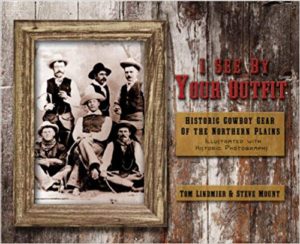 I See By Your Outfit, Historic Cowboy Gear of the Northern Plains, Tom Lindmier & Steve Mount, High Plains Press, Glendo, Wyoming. $19.95, Paperback. Photos, Illustrations, Bibliography, Index.
Here is yet another non-fiction winner published by High Plains Press. Authors Tom Lindmier and Steve Mount have joined forces, writing a wonderfully accurate book filled with information about what real cowboys of the late 1800s looked like and wore on the American Northern Plains.
Every bit of clothing is described, from hats to boots, including favorite equipment used with their horses. Saddles, bits, bridles and spurs, ropes, saddle blankets and more fill these pages. Readers find a list of names of providers of clothing and horse equipment like Montgomery Ward, Sears, Roebuck, and Porter Saddle and Harness Company appear, including the prices. Additionally, the authors have not forgotten the guns. Every type of shootin’ iron the old-time cowboys used are pictured and discussed. Names like Spencer, Sharps and Winchester fill the chapter on revolvers and rifles.
The book is filled with original photographs showing cowboys wearing shotgun chaps, mohair “woolies”, and batwings. Most men wore vests, a garment practical for all weather besides having pockets to stuff watches and other valuables. You won’t see fancy Stetsons, but a different shaped, mostly-flat brimmed hat meant to resist gusty winds. It was known as “Boss of the Plains” and looked nothing like the hat Roy Rogers wore. The book explains how the cowboy clothing and horse gear was mostly meant for practicality rather than rodeo flair. These cowboys needed jeans, shirts and gloves to protect them from all the harsh elements from saddle sores to rope burns. Spurs were meant to keep a horse alert to sudden starts, and bits with rollers and chains had their practical uses, too.
Page after page keeps the reader intrigued with good information as well as some personal letters written by the cowboys themselves as they told about life on a cattle drive. The many photographs are particularly intriguing showing the men at work, or sitting on the ground beside a campfire. Near the chuck wagon stands a sullen cook wiping his hands down his greasy apron while a cigarette dangles from his lip. (This leaves you wondering what may have fallen into the stew.) The dust, the campfire smoke, the rough and ready cows and horses are all pictured here.
The chuck wagon was home. Pots, pans, Dutch ovens, water barrels and stacks of coffee, flour, sides of bacon, beans, sugar, dried apples and peaches, plus rice made up the load. There were canned tomatoes mixed with the emergency medical supplies. Chuck wagons and how they operated is explained, while another vehicle called a “bed wagon” was included in the roundups, but is seldom seen in movies. This wagon carried the cowboy’s gear…blankets and bedrolls, and other personal items necessary for the long trips.
Readers learn something new with every page, the old-time pictures are marvelous. Some studio photos the cowboys had made of themselves shaved and clipped gives us a glimpse of their showoff side, too.
Several of the pictures taken on the range show Nate Champion, a hero of the Johnson County War. Nate, a brazen tough-guy who stood up to the big ranchers, was murdered by a gang of Texas gunslingers for hire. Nate’s tragic story is told elsewhere, but he’s shown right here in the middle of things, riding with his pals reminding us what a real western hero was all about.
Whether you are reading for fun, or a serious writer/researcher working on an old-west project requiring authenticity, this is the book for you.
Publisher’s Note: The reviewer, Phyllis Morreale-de Ia Garza is the author of numerous books about the Old West including Death For Dinner, the Benders of (Old) Kansas, published by Silk Label Books, P.O. Box 399, Unionville, New York 10988. www.silklabelbooks.com
Chuckwagon: Buffalo Stew For An Army
 Buffalo Stew For An Army:
2 large size buffalo
Lots of brown gravy
Cut buffalo into bite size pieces. This may take up to two months.
Put in a very large pot and add enough gravy to cover the meat.
Add vegetables as desired.
Cook stew over a fire for about 4 weeks at 400 degrees.
Periodically add water and stir.
*Courtesy of Chronicle of the Old West newspaper, for more click HERE.
Benjamin Rush Milam – Texas, Mexico and the Anglos
 Benjamin Rush Milam was born in 1788 in Frankfort, Kentucky. He served in the War of 1812, and in 1818, along with other Anglos, he went to Texas, and as was necessary for land ownership there, became a Mexican citizen. During this time, Texas, Mexico and the Anglos had a difficult relationship. Mexico both welcomed and feared the Anglos coming to Texas. Eventually, Mexico started imposing unfair regulations on the Anglos. And, in 1835, when Santa Ana established himself as dictator, Milam renounced his Mexican citizenship and joined the rag-tag army of Anglos fighting for the independence of Texas.
Wyatt Earp, Boxing Referee
 Wyatt Earp had left behind his days in Tombstone. He was now living as a gentleman in San Francisco. Because of his interest in boxing and his celebrity status, on December 2, 1896, Wyatt was asked to referee a championship-boxing match between Fitzsimmons and Sharkey. The purse was $10,000. Winner take all. Here is the story of Wyatt Earp, Boxing Referee:
Chuckwagon: Pie Plant Pie
 3 cups pie plant (rhubarb)
1 cup sugar
1 tablespoon full flour
1 teaspoon full butter
Pie crust for top and bottom
Wash pie plant, do not skin; cut into small pieces.
Mix sugar and flour well with pie plant.
Place in crust, dot with butter and cover with upper crust.
*Courtesy of Chronicle of the Old West newspaper, for more click HERE.
Old West Book Review: The Hog Ranches of Wyoming; Liquor, Lust and Lies
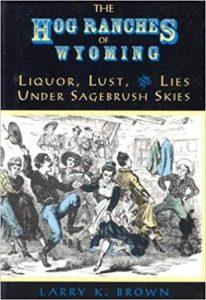 The Hog Ranches of Wyoming; Liquor, Lust and Lies Under Sagebrush Skies, Larry K. Brown, High Plains Press, (800-552-7819) $9.95, Paperback.
When the comment is made by those who know little about the Old West, “The Wild West is a Hollywood myth,” I always chuckle. I can’t imagine life getting much wilder than at the “Hog Ranches” that appeared near almost every military fort on the old frontier. Whiskey, women, card games, shoot-outs, music and murder were all part of these establishments built for the express purpose of separating lonely soldiers, wayward frontiersman and even cowboys from their wages.
This book centers around those infamous establishments far from law and order where good guys, bad guys, lawmen, cowpokes, soldiers and highwaymen gathered for a good old time. The author has sifted through newspaper articles, court documents, letters and census records, Military Post Returns, and diaries for the facts regarding some Wyoming Hog Ranches we don’t usually read about in history books.
The origin of the name “Hog Ranch” suggests a certain unpleasantness about the property, but it is pointed out while hogs were sometimes raised here, the name probably referred to the lowdown characters who inhabited these walls. How the name came to be has never been entirely proven, but what has been proven are the illicit activities that drew lonely people to these dens of iniquity. Here they found camaraderie and enjoyed the crude buildings, rustic furniture, out-of-tune pianos, earthen floors, missed spittoons and mortal injuries that sometimes ended the careers of those who paid their money and took their chances.
With names like “Bad Man Charlie Anderson’s Hog Ranch”, and “Six Mile Hog Ranch”, they were visited by members of the Wild Bunch and even Alfred Packer, the notorious cannibal who had escaped from prison after dining on at least seven of his fellow travelers during a snow storm in the Rockies.
To say the characters found at these places were dangerous, is putting it mildly. Calamity Jane worked for a time at the Six Mile Hog Ranch. She is pictured in the book dressed in garb once worn by her military customers. Calamity stares back at the camera while showing off a big pistol on her hip. Other stories include women who helped their husbands run the saloons at these ranches and tell how they cheated customers when selling drinks. One interesting character was “Old Mother Featherlegs” who ran her place of entertainment on the Cheyenne-Black Hills stage route in 1876. The lady was said to have flowing red hair and wore a pair of long red pantalettes. When riding horseback, she was compared by a local wag to a “feather-legged chicken in a high wind.” In cahoots with some local road agents, Featherlegs hid their stolen money under her shack, but got mixed up with a trapper nicknamed “Dangerous Dick” who eventually murdered her for the dough. Her body was found shot in the back; Dick’s moccasin prints were recognized nearby.
Murder, shoot-outs, venereal disease and double-cross were all part of the game people played when they associated with the hog ranches. Tragedy struck in other ways as was evidenced by the tiny graves on nearby hillsides where some soiled doves buried children born here. Cold, snow, dust and disease were all part of the desolate lifestyle known to these girls.
Some of the stories related here are humorous, some are harsh and sad. This book is only 120 pages in length, but is filled of interesting material including photographs of some buildings, a few felons, a couple of sheriffs, and a peek into the wild side of life on the Old Frontier.
Grab a copy HERE.
Editor’s Note: The reviewer, Phyllis Morreale de la Garza is the author of numerous books including Wild Women of the Old West, published by Silk Label Books, P.O. Box 700, Unionville, New York 10988-0700 (845) 726-3434
*Courtesy of Chronicle of the Old West newspaper, for more click HERE.
Texas Rangers: Why Are They Called Rangers?
 In 1826 Stephen Austin authorized a force of men to fight Indians. This group was the inspiration that inspired the Texas Legislature to form the Texas Rangers on November 24, 1835. They were formed, not as a law enforcement group, but to protect the Texas frontier from Comanche Indians and Mexican banditos crossing over the border. Why are they called Rangers? They were called Rangers because their job was to “range” over wide areas.
Lindsey Applegate, Indian Agent

Indian Agent Lindsey Applegate was born in Kentucky in 1808, later moving to Missouri. In 1822, fur trader William Ashley advertised for 100 “enterprising young men” for a fur trading expedition to Yellowstone. Even though he was just 14, Lindsey joined the expedition. After the expedition Lindsey came back to Missouri and worked in various businesses with his family.
Old West Book Review: The Mysterious Private Thompson
 The Mysterious Private Thompson, Laura Leedy Gansler, Free Press a Division of Simon & Schuster, Inc., $25.00, Hardcover.
It is not unusual for women to become soldiers in our day and age, but back in the 1860s, it was shocking to think a girl would don men’s clothing, cut off her hair, change her name and join the Union Army.
This is the fascinating story of Emma Edmonds, born in New Brunswick, Canada in 1841. The last of six children, five of whom were girls, Emma grew up on a hard-working farm in a remote wilderness with a father who let it be known he wanted sons. In an effort to please her father, Emma learned to ride and shoot, follow a plow, split logs and work in the fields like a man to please her pa. However, she was never quite good enough. The girl developed a deep resentment toward men, read lots of books, and dreamed of becoming a missionary. She finally ran away from home at seventeen when her father tried to marry her off to an elderly, newly widowed neighbor with a passel of children who needed a mother.
Hiding in the back of a carriage while her father was in the fields, Emma made her escape. She worked briefly in a millinery store in town but feared her father would find her. Desperate not to be dragged back to the farm, Emma hacked off her hair, dressed as a boy, and dared to answer an ad in an American newspaper advertising for help as a subscription salesman and book agent in the vicinity of Hartford, Connecticut. Practicing masculine walk and talk, Emma ventured to the United States and got the job. Having changed her name to Frank Thompson, she embarked on this daring lifestyle, always careful not to become too friendly with anyone who might discover the truth.
Cherishing her freedom as a man, she became a successful book salesman, continually moving about and even enjoying a few “dates” to keep up appearances. By 1860, with Civil War looming, Emma got caught up in the excitement of North vs. South, and vowed to perform her duty. She enlisted in the Union Army as a member of the Michigan Brigade. Fortunately for her, physical examinations during those early days consisted of mere questioning by the military doctors to determine a recruit’s health.
It has been estimated that between 250 and 500 women disguised themselves as men to fight in the Civil War, so Emma was hardly the only woman to do this. Nevertheless, Emma, now known as Frank Thompson, knew she would not like to carry a gun so she volunteered to work in the field hospitals. This turned out to be easy since most recruits shied away from the ghastly chores associated with assisting battlefield doctors under crude field conditions. Too, among her duties, she became a mail courier since she was lighter than most men and excelled in riding horses at a quick pace over long distances.
The book tells about battles fought, Emma’s spy escapades, her falling in love with a fellow soldier, her desertion and ultimate return to life as a civilian female.
The author of the book, Laura Leedy Gansler follows Emma all the way to her life in Kansas where she applied for her military pension, wrote about her escapades, and surprised her fellow soldiers-in-arms when they discovered the courier and hospital attendant they knew during Civil War days was really a woman. Even after Emma became a married woman with children, she wore pants around town, rode her horse astride, and was known as an eccentric who did not care what her neighbors thought of her. Mrs. S.E.E. Seelye of Fort Scott, Kansas had never been one to worry about wagging tongues. That said, you can get this amazing book HERE.
Editor’s Note: The Reviewer, Phyllis Morreale-de la Garza is the author of many published books, including Silk and Sagebrush: Women of the Old West, published by Silk Label Books, P.O. Box 700, Unionville, New York 10988 (845-726-3434) www.silklabelbooks.com
*Courtesy of Chronicle of the Old West newspaper, for more click HERE.
Santee Sioux Hanging
 For almost 50 years the Santee Sioux, located in Minnesota, were mistreated by almost everyone with whom they came into contact. First, white settlers invaded the Minnesota Valley where they traditionally lived. With pressure both from settlers and the army, they relocated to a reservation. On the reservation they came under the authority of corrupt Indian Agents. The agents demanded a kickback on all the rations they distributed. When the Sioux realized they couldn’t live on what was left of the rations and refused to give them the normal kickback, the agents withheld all food distribution. On the verge of starvation, the Indians sought help. But no one came to their aid.
Camillo Orlando Hanks and Barbed Wire
 Barbed wire had encircled the cattle. So, cowboys weren’t needed to ride the line, making sure cattle didn’t wander away. The railroads had been built down to Texas, so cattle drives weren’t necessary anymore. And many of the large ranches were being purchased by eastern conglomerates looking for a quick return for their money, or the ranches were simply broken up. So, many cowboys had to look for other means of employment.
California Joe
 Moses Embree Milner was a well-built man, more than 6 feet in height. Not only did he constantly smoke a pipe, he chewed tobacco at the same time. In 1849, at the age of 20, he went to California like everyone else… for gold. Then he moved up to Oregon, and then to Montana where he acquired the name California Joe.
Hop Alley Riot
 As the West entered into the 1880’s there was a tremendous amount of prejudice against the Chinese who had been brought to the West to build the railroad. Ten years earlier Denver, Colorado had encouraged the Chinese to come there in the hopes of relieving the labor shortage conditions. Because of the access to drugs in the Chinese district, cowboys would often visit there. The main area of this district was appropriately called Hop Alley.
As the West entered into the 1880’s there was a tremendous amount of prejudice against the Chinese who had been brought to the West to build the railroad. Ten years earlier Denver, Colorado had encouraged the Chinese to come there in the hopes of relieving the labor shortage conditions.
As the West entered into the 1880’s there was a tremendous amount of prejudice against the Chinese who had been brought to the West to build the railroad. Ten years earlier Denver, Colorado had encouraged the Chinese to come there in the hopes of relieving the labor shortage conditions.
Old West TV: James Marshall and the Gold Rush
 This episode of Chronicle of the Old West TV Dakota Livesay tells us about the California Gold Rush and James Marshal. Here is some info on the man:
James Wilson Marshall (October 8, 1810 – August 10, 1885) was an American carpenter and sawmill operator, who reported the finding of gold at Coloma on the American River in California on January 24, 1848, the impetus for the California Gold Rush. The mill property was owned by Johann (John) Sutter who employed Marshall to build his mill. The wave of gold seekers turned everyone’s attention away from the mill which eventually fell into disrepair and was never used as intended. Neither Marshall nor Sutter ever profited from the gold find.
Old West Book Review: Charles M. Russell: Printed Rarities from Private Collections
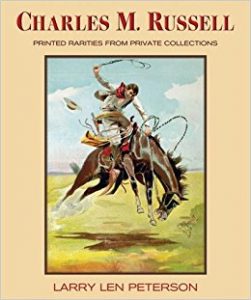 Charles M. Russell: Printed Rarities from Private Collections, Larry Len Peterson, Mountain Press Publishing Co., (800-234-5308),74 black-and-white images, 35 historical photographs, Index, Cloth $70, Paper $45.00.
This magnificent book, filled with dozens of Charles M. Russell Western images, tells the story of a modest man who came to be one of the most famous artists of the American West.
Charles Marion Russell was born March 19, 1864 in St. Louis Missouri. The third of six children, Charlie’s early life was one of financial security. He wanted for nothing, and his father expected the boy to become a businessman. However, Charlie chose to spend his time riding horses, reading dime cowboy novels, and drawing pictures. Determined to go “Out West”, Charlie convinced his father to send him to Montana on his sixteenth birthday. The boy traveled by train, then stagecoach and wound up on a Montana sheep ranch owned by a family friend. Charlie’s father was sure his son would sour quickly from this experience, but Charlie fooled him. For the next fifteen years the young man worked at various ranches; horses and cattle became his way of life. Meanwhile, he continued sketching pictures of horses, cattle, Indians, and the wilderness around him. He carried wax in his pockets, and when not sketching, he modeled little figurines he gave away to friends.
Charlie Russell admitted he was not a good businessman. He wanted to earn his living as an artist, but he often gave his drawings away. Too embarrassed to ask a fair price for his pictures, he barely eked out a living.
That all changed in 1896 when he married Nancy Cooper, a seventeen-year-old who had been abandoned by her stepfather. When Nancy’s mother died in 1894 of tuberculosis, Nancy went to work as a housekeeper for a family in Cascade, Montana where Charlie rented a small artist’s studio. Nancy was Charlie’s most loyal fan, determined that his artwork should bring a fair price. Nancy stood by her man, driving hard bargains, promoting Charlie’s artwork, and eventually hiring lawyers, if necessary, to draw up contracts and make important business deals.
They traveled, built a new home and artist studio, and took trips while Charlie enjoyed celebrity status during his lifetime. The Russells had no children, but adopted a boy they named Jack whom they spoiled and adored. During his lifetime, Charlie’s friends included such notables as screen star Harry Carey and political humorist Will Rogers with whom he spun many yarns. Charlie Russell loved to tell funny stories, had a great sense of humor and while he did not drink alcohol, spent many an evening “swapping windies” with his old cowboy buddies at the local saloons.
In his old age he suffered from gout, together with breathing difficulties due to his years of chain smoking. Charlie Russell died of heart failure on October 24, 1926 in Great Falls, Montana. The “Cowboy Artist” was buried at the Highland Cemetery in Great Falls on a day when all businesses and schools in that community closed in his honor.
His widow lived another fourteen years until dying of a heart attack in 1940.
Nancy spent all of her remaining fourteen years promoting Charlie’s work, and finalizing the disposition of his estate. Much of his artwork including his sculptures are today found in museums throughout the United States.
This book contains images of famous paintings, as well as rare sketches commissioned to appear on advertising trays, phony money, menus, stationery, business flyers, Western novels, rodeo flyers and calendars. Charlie Russell’s artwork is known for its authenticity depicting ornery broncs, marauding Indians, killer snow storms, bawling cattle, howling wolves and buffalo hunters. This book makes a wonderful gift, or a treasured keepsake for your Old West library. You can get it HERE.
Editor’s Note: The reviewer, Phyllis Morreale-de la Garza is the author of fourteen published books about the Old West including The Apache Kid, published by Western lore Press, P.O. Box 35305, Tucson, Arizona 85740
*Courtesy of Chronicle of the Old West newspaper, for more click HERE.