Lawrie Tatum – Quaker Indian Agent
 In 1869 the Kiowa and the Comanche were being relocated to a reservation near Fort Sill, Oklahoma. President Grant felt if Quakers were hired as Indian Agents, they would be able to teach the Indians to be pacifists. So, Lawrie Tatum, a man known for his Quaker work, was appointed to the unenviable job as the Kiowa-Comanche agent.
 Old West Book Review: Riding the Edge of an Era
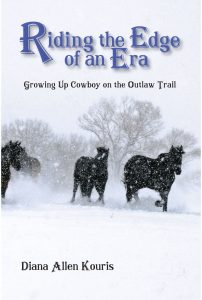 Riding the Edge of an Era; Growing up Cowboy on the Outlaw Trail, Diana Allen Kouris, High Plains Press (800) 552-7819, $17.95, Paperback.
High mountain trails deep with snow, ice storms and hail, bone-chilling wind mingled with the faraway cries of wily coyotes fill the pages of this real-life adventure. Carefully written from beginning to end by a lady whose family spans several generations of ranchers, the setting is Butch Cassidy country where Utah, Wyoming, and Colorado meet. From the writer’s earliest days, there was a no-nonsense approach to life where one mis-step could lead to serious injury and even death. The family consisted of parents and six children; a cowboy father, and a mother who could ride and rope as easily as rustle up Christmas dinner.
There was no TV or electricity, but the kids had many horses and memorable days filled with everything from hummingbirds to snowflakes. Picnics, swimming, and favorite pets are remembered, including a pony named Comet whose favorite sport was scraping his riders off under trees. Long trail drives, wild horse roundups, killer storms, and the learning of independence, the children grew into teenagers, and eventually adults. The reader grieves when a favorite horse is found dead where he fell in the mountains, and when another struggles in vain against fever, leaving his heart-broken young owner to mourn over the carrion remains. When the seven-year-old sister is crushed under the back wheels of a farm truck, and when at the end of the story the brave mother dies of cancer, and a favorite brother is lost in an accident, you will close the last page with a lump in your throat and tears in your eyes.
The author has captured real ranch life as it existed in the days between the old and new West, before battles between ranch families and the government’s Bureau of Land Management. Eventually the land is lost to Uncle Sam for a recreation area, and the family must make profound decisions.
Along the way, the author rides past crumbling cabins and deserted home sites where historic murders took place, and bodies were found. Most crimes were never solved due to a lack of enough lawmen in territories too sparsely populated for a sheriff to be interested. People faced life as it came at them on a daily basis. They were tough and independent, they solved their own problems, they never asked for a handout.
Filled with photographs complimenting the text, we see Nonie and Diana, Bob and Marie and Bill Allen and the others in the story as they grin back at camera lenses. The author writes with a sharp eye for detail and never misses describing scenes of “candy colored cactus flowers,” or “nighthawks darting overhead in evening coolness.” There is love, devotion, loyalty, sacrifice, and through it all, the powerful bond existed between Marie and Bill Allen, and their children. There were no crybabies here. If you fell off your horse, bloodied your knee, bumped your head or fell into the creek, you learned to laugh about it. This book is not about fluffy toy animals on Sesame Street or even fairness. It’s about surviving the elements, self-sufficiency and courage. It’s about cold winter cabins deprived of hot water, indoor plumbing or electric light. It’s about doing laundry by hand, milking a cow, and stacking hay during school vacations. It’s about Diana Allen, the smallest of the children helping drive a herd of cattle in a snowstorm when she was only 6 years old.
This highly memorable book reminds us of what good writing is about, how important original detail is to the text, and in the age of hard to find good stories, we can be grateful some wise storytellers still exist. This book is almost breathtaking in its sincerity; a most memorable read.
Editor’s Note: The Reviewer, Phyllis Morreale-de la Garza is the author of many published books, including Silk and Sagebrush: Women of the Old West, published by Silk Label Books, P.O. Box 700, Unionville, New York 10988 (845-726-3434) www.silklabelbooks.com
*Courtesy of Chronicle of the Old West newspaper, for more click HERE.
Texas Rangers Surrender
 The stories of the bravery of the Texas Rangers are legendary. However, there was one incident when a group of them were cowards. It was when events made the Texas Rangers surrender.
Buffalo Bill Cody

Sunset Route of the Southern Pacific Railroad
 With the completion of the transcontinental railroad by the Central Pacific and Union Pacific Railroads in 1869, the men dubbed as the “western railroad barons” decided to join forces and create a monopoly on any rail traffic coming to the West Coast. So, in 1870 Collis P. Huntington, Charles Crocker, Leland Stanford and Mark Hopkins created the Southern Pacific Railroad.
 Mickey Free – “Half Mexican, Half Irish and Whole SOB”
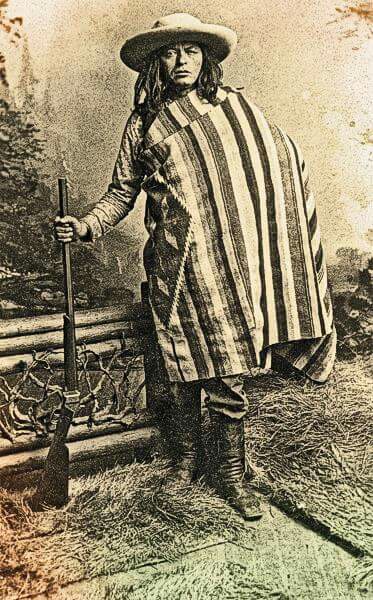 Wherever Mickey Free went, death seemed to follow. Even when he was a kid.
 Old West Book Review: When Law Was In The Holster- The Frontier Life of Bob Paul
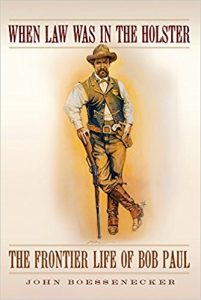 When Law Was In The Holster – The Frontier Life of Bob Paul, John Boessenecker, University of Oklahoma Press, (1-800-627-7377) $34.95, Hardcover.464 pages, Illustrations, Maps, Footnotes, Bibliography, Index.
This is the biography of Sheriff Bob Paul, a frontier lawman in Old Arizona. He is remembered mostly as the shotgun messenger riding the Tombstone stage that was ambushed one night in March, 1881. The driver, Bud Phitpott was killed during a volley of gunshots fired by the robbers hidden beside the road. Philpott’s body hurled over the side of the coach while the driving lines slipped away and the terrified horses bolted. Bob Paul worked the brake for nearly a mile until he finally got the runaway team under control.
This stage holdup had to do with Tombstone history and has been told many times in connection with the days of Doc Holliday and the Earps. However, Bob Paul was far more important as a lawman, and his history is filled with excitement and derring-do that more than matched the Earps who dabbled periodically in law enforcement while Bob Paul spent nearly 50 years behind a badge.
Paul was born on June 12, 1830 in Lowell, Massachusetts. The youngest of three brothers, Paul spent his first few years in Lowell before the family moved to the seaport town of New Bedford. Here, they worked hard in their boardinghouse.
Paul’s father died in 1839, leaving the family in dire financial straits. Young Bob, only 12 years old, signed on as a cabin boy with the 197-ton whale ship Majestic.
Thus began a succession of experiences on a variety of whale ships for the next 8 years. Bob Paul advanced from cabin boy to second or third mate, sailing the South Pacific from Peru to the Sea of Japan and back to Hawaii.
In 1848, Paul learned of the huge gold strike in California, and seething with gold fever, asked for a discharge from the whale ship Nassau. He sailed right away for San Francisco. In time his prospecting led to law enforcement, as he learned the vagaries of the gold mining business did not always lead to economic security. Paul, a straight-shooter who stood over six feet tall, with massive frame and lighting fists, had a no-nonsense demeanor. In the rough and tumble goldfields, he arrested claim jumpers, rescued a number of individuals from vigilante justice, and himself oversaw legal hangings when he became sheriff of Calaveras County.
The book discusses his marriage to a young Catholic woman, followed by his employment as a Wells Fargo detective. Eventually the Paul family, having added a number of children, moved from California to Pima County, Arizona where Margaret lived with the children in Tucson.
In Cochise County Paul dealt with Tombstone politics, the rustler element, and a succession of notorious outlaws. He supervised the execution of the murderers who perpetrated the “Bisbee Massacre”, and eventually ran for Pima County Sheriff. For the rest of his life he dealt with political enemies, newspaper critics, and family tragedies. Sheriff Paul is the man who arrested and held the infamous lady stagecoach robber Pearl Hart in his Tucson jail.
Sheriff Bob ‘Paul is not a romantic figure wearing a long black coat, or having a squadron of brothers who looked just like him. The one woman in his life was his beloved wife from whom he never strayed. Hollywood did not single him out to star in romanticized flicks, but Sheriff Bob Paul was the real deal, and deserves to be finally recognized. This fascinating story so well written and carefully researched is certainly an important addition to your Old West library. Kudos to author John Boessenecker for a job well done.
Editor’s Note: The reviewer, Phyllis Morreale-de la Garza is the author of 15 published books about the Old West, including Nine Days at Dragoon Springs, published by Silk Label Books, P. 0. Box 700, Unionville, New York 10988-0700 www.silklabelbooks.com.
*Courtesy of Chronicle of the Old West newspaper, for more click HERE.
Tucson Etiquette
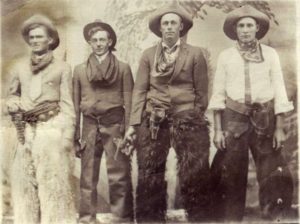 February 10, 1887, Daily Star, Tucson, Arizona Territory – The steady progress of Tucson in the direction of “culchah” and civilization, awakens the liveliest hopes of the future. As evidence that we are on the right road at last, we append the following rules of deportment posted in the office of a popular old resident of this country:
1 – Gentlemen entering this office will leave the door wide open, keep their hats on, and walk with the right hand carelessly foundling the handle of their six-shooters.
2 – Those having no business should remain as long as possible, take a chair and lean against the wall, and may prevent its falling on us.
3 – Gentlemen are required to smoke, especially during office hours; tobacco will be supplied.
4 – Spit on the floor, as the spittoons are only for ornament.
5 – Talk loud or whistle, especially when we are engaged. If this does not have the desired, effect, sing! And if that will not answer, then dance, or tell some old story; long ones preferred.
6 – Put your feet on the tables, or lean against the desk; it will be of great assistance to those writing on them.
7 – As an office is exclusively for your accommodation, call frequently when you have leisure – especially when we are busy; then ‘tis very pleasant.
8 – In making your visits, never come alone – the old adage – “the more the merrier.” Ride your broncos right into the office. It will make a good laugh all round. So Long.
Old West Cowboy Boots
“I can tell by your outfit that you are a cowboy.”
 Next to his hat, a cowboy’s footwear has traditionally been the most important symbol of his identity. Here are some little known facts about Old West Cowboy Boots:
Prior to the end of the Civil War, cowboys wore heavy-soled boots of virtually any style they could find. Often his boots were made on the same form for both the right and left foot. Although they eventually conformed to the foot, this wasn’t the most comfortable way to make a boot.
With the beginning of the cattle drives, and the cowboy having to work cattle and ride a horse for months at a time, he started realizing he wasn’t wearing the best boot for the job. So, when he got to Abilene and the other cattle towns, the cowboy got together with boot makers and came up with what has come to be known as the cowboy boot.
Early boots were called “stovepipes” because they were black, about fourteen inches tall and had level tops. The 1870’s cowboy had three choices: boots off the shelf, boots made by a local boot maker or custom made mail order boots.
The Old West cowboy was very vain about his attire. He was willing to pay as much as a month’s wages for a pair of custom boots that were designed more for looks than comfort.
Although the northern cowboy and the southern cowboy dressed differently, they did agree on their boots. The exception was how the boot was decorated. The Texas cowboy wanted a lone star or crescent on the front of his. The northern cowboy’s boots were heavily stitched. And their tops were rarely less than seventeen inches high.
Boots had square or rounded toes. (Pointed toes are a modern design.) The soles were thin. Supposedly, to better feel the stirrup. Besides, a cowboy never walked very far. The heels were “underslung.” A small foot was desired, and the underslung heel provided a size ten foot with a size seven footprint.
The heels were 2 ½ inch to as much as 4 ½ inch high. This prevented the boot from hanging up in the stirrup. In addition, the heels made it possible to “dig in” when working cattle. The tall heel also added a couple of inches to the height of a cowboy, who tended to be on the shorter side.
In the 1890’s, following the cattle drive era, performers in Wild West shows started wearing highly decorated boots. Then came the movie cowboy. Boots were no longer designed for protection against the elements and critters, or for riding and handling cattle, but for show and tell. And to tell it best, they always added a pair of jingling spurs! You can read more about cowboy boots in the Old West by grabbing this great book HERE.
Old West TV – Time Zones in the United States
 Time in the United States, by law, is divided into nine standard time zones covering the states and its possessions, with most of the United States observing daylight saving time (DST) for approximately the spring, summer, and fall months. Time Zones in the United States is not new, and Dakota Livesay explains how the US got Time Zones.
They Played Poker For Cattle
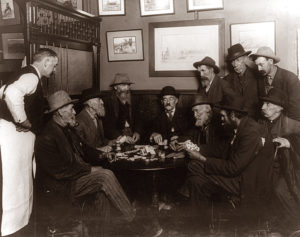 May 9, 1885, Arizona Champion, Phoenix, Arizona – The Kansas City Journal tells of a game of poker played recently in that city between a Texan and Major Drumm. The Texan had no money, but plenty of cattle and an immense desire to play poker with the Major. The latter is known around the stock yards for his great natural resources, and he swept away the seemingly insurmountable difficulty by proposing a game of one steer ante, two steers come in and no limit. They played poker for cattle on this basis.
Major Drumm dealt and the gentleman from Texas anteed one steer. Both came in and the game opened with four steers on the table. Major Drumm drew two tens and caught an unexpected full, while the gentleman from Texas struck a bobtail snag and passed out.
The third was a jackpot and it took three deals to open it. The gentleman from Texas finally drew two jacks and opened the pot with a fine breeding bull, which counted six. Major Drumm covered this with five steers and a two-year-old heifer, and went him twelve better. The gentleman from Texas, who drew another jack, saw the twelve cows and went him fifty steers, twenty two-year-old heifers, four bulls and twenty-five heifer calves better. Major Drumm looked at his hand and placed upon the table six fine Alderney cows, five imported Durham bulls, one-hundred grass-fed two-year-olds, fifty prime to medium corn-fed Colorado half-breed steers, with a side bet of a Normandy gelding to cover the bar bill. The man from Texas made his bet good with an even two hundred and fifty straight Kansas wintered Texas half-breeds and ten Scotch polled cattle, fourteen mustangs and the northeast ¼ of the southwest ¼ of section 10 of the Panhandle of Texas, and called.
Major Drumm held three aces, and put in his hip pocket 750 steers, heifers, etc., and a big stock ranch.
The Electrical Corset
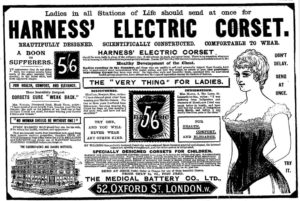
Reprinted from Dakota Livesay’s Chronicles of the Old West column in Cowboys & Indians magazine:
November 5, 1890, Enterprise, Riverside, California – I’ve always been opposed to this promiscuous courting; this vicious system which permits a young man without any intentions to waste a girl’s time with his attentions. At last I have devised a remedy. The electrical corset solves the difficulty. It will no longer be possible for a young man to slip his arm around a girl’s waist or lay his head upon her shoulder without giving the alarm. The “ting-a-ling-ling” will instantly bring her pa, ma or big brother into the room, and the offender will be summarily ejected.
The electrical corset has a great future. Its influence upon the moral tone of society is destined to be incalculable. We shall have no more of these hasty marriages, which end so speedily. Many a young man under the inspiration of the moment when his arm is encircling a girl’s waist breathes a love, which he would otherwise have left untold. This is all wrong. The electric corset will put an end most effectually to this practice.
But let parents be on their guard. These boys will devise means to beat the electric bell of this new corset, just as the conductors did the bell punch.
Old West Book Review: Valentine T. McGillycuddy; Army Surgeon, Agent to the Sioux
 Valentine T. McGillycuddy; Army Surgeon, Agent to the Sioux, Candy Moulton, University of Oklahoma Press, (405) 325-3200, $26.95, Paperback. Biography/U.S. History, 292 pages, Map, Illustrations, Notes, Bibliography, Index.
Valentine Trant McGillycuddy was born in 1849 in Racine, Wisconsin. His parents were shopkeepers. The boy had several siblings, and even as a child was drawn to healing the sick, practicing on the family pets. He entered the University of Michigan at age seventeen, and became a doctor at age twenty, completing medical school at the Marine Hospital of Detroit. The young doctor treated a variety of ailments from accidents and injuries to the hopeless mental conditions of patients at the Wayne County Insane Asylum.
Soon McGillycuddy’s own physical and mental conditions began to fail, and by 1870 he took some engineering courses and joined the U.S. Corps of Topographical Engineers. He headed Out West into the great outdoors to recover his health. Soon he became a cartographer and surveyor as well as physician. Tall and thin, McGillycuddy had a short beard and sharp eyes. He became a rugged outdoors man, good with fractious horses and able to withstand harsh weather conditions as he worked with various surveying crews, and to “keep warm” he became a hard drinker.
A member of the Boundary Commission in 1874, he entered the Northern Plains Indian Territory. From here it was on to the Black Hills where he met eccentric characters such as Calamity Jane tagging along with the Black Hills Expedition. In later years McGillycuddy wrote about Jane’s involvement with the expedition and we see how her imaginative legend was perpetrated as she told many whoppers to anyone who would listen.
McGillycuddy’s adventures led him deeper and deeper into the Territories where he would eventually meet Chief Red Cloud and many of the other important Indian leaders. His had dealings with General George Crook, including events swirling around the days of the Battle of the Little Bighorn. In time he was federally appointed Indian Agent to the Sioux
For a while this book concentrates mostly on all the politics surrounding the Sioux wars, military people, harangues between the generals and politicians in Washington D.C., treaties made and promises broken. All of this information is found in books written with greater detail than found here, but this one gives a quick and easy to understand evaluation of the Indian Wars problems. We wish this were told from McGillycuddy’s point of view, since many pages sometimes go by when he is not mentioned, thus he drifts into the background.
McGillycuddy had a wife named Fanny Hoyt whom he met early in his career, and who traipsed along with him as much as possible keeping a diary about army life and loneliness for a woman in the wilderness. She seemed to be a good sport however, learning to ride horseback and keeping the home fires burning. Rough housing, few female companions and harsh living conditions could not have been easy.
McGillycuddy was present at Camp Robinson the day Crazy Horse was murdered at the fort, where he demanding the dying chief be put into the adjutant’s office rather than the guardhouse.
After Fanny’s death from stroke, McGillycuddy married a second time to a woman much younger than himself who had a daughter with him and wrote his biography. McGillycuddy died in 1939. His cremated remains are buried on Harvey Peak in the Black Hills. He is much to be admired for his hard work, gumption, and straightforward dealings with those around him. He was a good husband and father.
This is a good, well-written book about a fascinating character who has been mostly overlooked by historians until now. Kudos to Candy Moulton for bringing this man to our attention. You can grab this book HERE.
Editor’s Note: The reviewer, Phyllis Morreale-de la Garza is the author of numerous books about the Old West including The Apache Kid, published by Westernlore Press, P.O. Box 35305, Tucson, Arizona 85740.
*Courtesy of Chronicle of the Old West newspaper, for more click HERE.
Wrong Men Hanged From The Gallows
It was 1864 in Jackson County, Missouri. Two men, Dick Merrick and Jeb Sharp had murdered a horse trader by the name of John Bascum. The two men were arrested and put on trial. The jury found them guilty. The judge sentenced them to be hanged from the gallows. And, he said it must be done within twenty-four hours…There wasn’t much of an appeals process in the Old West.
So, on September 6, the townspeople frantically started building a gallows. Just before the twenty-four hour deadline was up, the two men were grabbed, sacks were put over their heads, and they were led to the gallows. Ropes were placed around their necks. The trap door sprung. Before the deadline, their lifeless bodies were hanging from the end of ropes. The townspeople congratulated themselves on a job well done.
Sheriff Clifford Stewart went back to his office to take care of the final paperwork. But, when he stepped inside his office, Sheriff Stewart had the surprise of his life. There in the cell were the murders Dick Merrick and Jeb Sharp. At first, he thought it surely was a mirage. But it wasn’t.
Within a matter of hours, the situation had been sorted out. It seems that the night before two men had been arrested for drunkenness, and the anxious citizens had grabbed them by mistake. The men were still to drunk to protest, and Merrick and Sharp sure weren’t going to tell anybody they had the wrong men.
But that’s not the end of the story. Since the judge had required the sentence be carried out within twenty-four hours, and it wasn’t, the two killers were set free.
This story should persuade any person of the merits of living a temperate life.

Chuckwagon: Calf’s Head Soup
Calf’s Head Soup: From an 1879 cookbook.
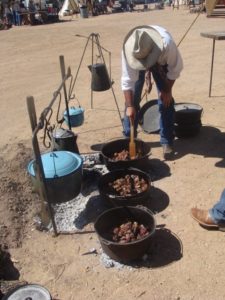 Scald and clean the head, and boil in two gallons water with:
A shank of veal. A small piece of bacon.
2 carrots. A bunch of sweet herbs.
3 onions.
When boiled a half hour, cut meat off head and shank. Let the soup boil half an hour longer, and then strain it. Put meat back in the soup and season. Thicken with butter and brown flour.
Let boil an hour longer. Just before serving add tablespoon of sugar browned in frying pan and a half pint wine. Good substitute for turtle soup.
*Courtesy of Chronicle of the Old West newspaper, for more click HERE.
Cowboys Go On Strike
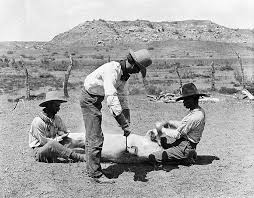 In the late 1860’s and the 1870’s a cattle rancher’s life was simple. He lived in a small cabin, and worked along side the cowboys on his ranch. A cowboy respected his boss, and he would give his life for the rancher and his cattle. As they phrased it, “They rode for the brand.” No one would have thought that cowboys go on strike.
By the 1880’s things were changing. Ranch owners were now living in large homes or were absentee landlords…They were often Eastern, British or Scottish investors. They had ranch foremen to work with the cowboys. When these “foreign” owners did come out west, they brought with them customs unfamiliar to the cowboys. The gap between the cowboy and the owner became wider and wider.
During the spring of 1883, the cowboys from three ranches in the Texas panhandle were rounding up strays together. And, one evening while setting around a campfire, the cowboys were doing their usual griping about working conditions, when they decided to do something about it…to go on strike.
Their demands were simple. Among them, a cowboy’s income would increase from $30 to $50 per month. A cook would get $50 per month. And the head of an outfit would get $75 per month.
Unfortunately, for the cowboys, they quickly drank and gambled away their strike fund, and the area was full of drifters looking for a job. So the strike didn’t last more than a couple of weeks. Some of the cowboys went back to work. Others left the area.
This strike ended up being just one more nail in the coffin of the Old West cowboy as ranchers set up rules to confine even more their traditional activities.
Old West Wind Wagon
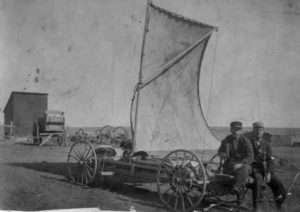 In the 1860’s when a pioneer family headed out west, they usually did it in a covered wagon pulled by horses or oxen. One man, Samuel Peppard, didn’t have horses or oxen, but that didn’t stop him. His idea was a Wind Wagon.
On May 9, 1860 Samuel Peppard headed out west. This was during the time of the Pike’s Peak gold rush, and Samuel wanted to do some gold prospecting. He didn’t have any horses or oxen, and he didn’t want the obligation and expense of taking care of them.
But, he did live in the Kansas Territory. And anyone who has been through Kansas knows it’s pretty flat, and the wind tends to blow rather strongly. Being a creative person, Peppard decided to take advantage of the resources at hand, and so he designed the world’s first wind-sailor. Built like a small boat, it was about 8’ long and 3’ wide, and it had four large wagon wheels. Weighing about 350 pounds, it was designed to hold 4 people.
The first time out, the wind blew the wagon over. So Peppard reconstructed the sails, rudder and brakes. By now everyone called it “Peppard’s Folly”.
With three of his friends aboard, Peppard raised the sails, and “Peppard’s Folly” took off across the prairie. Depending on the strength of the wind, it got up to 30 miles per hour.
On days when there was no wind, Peppard and his three friends just sat back, smoked a cigarette, and swapped stories.
They traveled about 500 miles before a dust devil came along and turned the wind wagon into a pile of rubble.
Peppard and his friends finally made it to Denver, but like most seekers of gold, they didn’t find anything.
Peppard later went back to Kansas, and lived to the ripe old age of 82. But he was always known as the guy who sailed to Denver.
“Pilgrim?” Chronicle of the Old West Newspaper
 Chronicle of the Old West is a 20-page newspaper that contains articles from actual 1800s publications and currently written articles written as if the event has just happened. You would swear it was found in your great grandfather’s old trunk. For more info click HERE.
From Dakota “Here’s another video featuring Kaine, my grandson. Oh yes, I’m in it too. Chronicle of the Old West is probably one of the more unique publications around today. We’ve had wives email us complaining (tongue in cheek, of course) that when Chronicle of the Old West arrives in the mail they know not to speak to their husband until he’s read it cover to cover. Maybe it’s not that bad. It does get him out of her hair for a couple of hours.”
Old West Book Review: The Gray Fox; George Crook and the Indian Wars
 The Gray Fox; George Crook and the Indian Wars, Paul Magid, University of Oklahoma Press, (800 627-7377), $29.95, Cloth, 480 pages, Photographs, Notes, Bibliography, Index.
This book is the second of a trilogy written about the life and military career of General George Crook. The author concentrates here on the years 1866-1877. (The first book is titled From the Redwoods to Appomattox, telling about Crook’s early life and including his involvement in the Civil War, check it out HERE).
Born in Ohio in 1829, raised on the family farm, Crook was admitted to West Point when he was eighteen years old. He graduated near the bottom of his class in 1852. The Indians nicknamed him “The Gray Fox,” which was not exactly a compliment. Crook stood close to six feet tall, with blue eyes a little too close together, a sharply pointed nose, graying close-clipped hair, thin lips and humorless personality. He served for eight years on the Pacific Coast where he campaigned against Indians in both the Rogue River War and the Yakima War. When necessary, he could live off the land. His hunting expeditions while in the field became one of his peculiarities. Crook rarely dressed in military garb while campaigning. He was usually found wearing canvas clothing, high work boots and a straw hat. In Arizona he rode a mule named Apache. Crook relied heavily on mule packing opposed to hauling supplies and equipment in slow-moving wagon trains.
Author Magid follows the tortured and twisting trails of General Crook throughout the early Apache campaign in Arizona, and then Crook is transferred to the Northwest where he is embroiled in battles against Sioux and Cheyenne warriors. Readers follow him through long, grueling marches, freezing winter snows, forage shortages, sick and starving horses, loss of life and always the political harangues he faced with his superiors in Washington, D.C.
Crook was notorious for keeping battle plans to himself, much to the annoyance of some officers in his command. He was known to go off by himself to hunt game, returning to camp with fish and fowl, and occasionally deer or buffalo meat for the troops. He eventually learned the art of taxidermy to preserve some of. his best trophies. He was eccentric, somewhat mysterious, tough on himself as well as the men around him, but the Indians considered him a worthy and dangerous foe. They knew he was a man of his word.
This book is hardly a long, dry history lesson. The talented author keeps the story rolling forward with easy-to-read prose. Crook’s personality is fairly dealt with, even though the man was difficult to understand. Crook had a myriad of complicated issues to deal with, but kept his stoic silence most of the time. The author obviously is a Crook fan, and is to be commended for writing about the murder of Crazy Horse as honestly as possible, telling all sides of the story. Most likely Crook was aware of the skullduggery afoot. When, at the end of the Sioux War, Crazy Horse was lured to Camp Robinson on the pretext of talks about a reservation for his people, the war chief was captured instead, and brutally murdered inside the fort.
When we turn the last page, we have mixed emotions about General Crook. He left no personal diaries or notes about himself, so history must rely on the observations of those who worked and lived with him, as well as his military successes and failures. Criticized by some, praised by others, General Crook is a fascinating personality.
We look forward to the third book in Magid’s trilogy focusing on Crook’s involvement ending the Apache Wars in Arizona.
Editor’s Note: Reviewer Phyllis Morreale-de la Garza is the author of numerous books about the Old West, including the novel Hell Horse Winter of the Apache Kid, published by Silk Label Books, P.O. Box 700, Unionville, New York 10988-0700, www.silklabelbooks.corn.
*Courtesy of Chronicle of the Old West newspaper, for more click HERE.
Bat Masterson and the County Seat War

Chuckwagon: Cowboy Corn Muffins For Breakfast
 For Cowboy Corn Muffins, pour one quart of boiling milk over one pint of fine cornmeal. While the mixture is still hot, add one tablespoonful of butter and a little salt, stirring the batter thoroughly. Let is stand until cool, then add a small cup of wheat flour and two well-beaten eggs. When mixed sufficiently, put the batter into well-greased shallow tins (or, better yet, into gem pans) and bake in a brisk over for one-half hour, or until richly browned. Serve hot.
*Courtesy of Chronicle of the Old West newspaper, for more click HERE.
Cheyenne Chief Dull Knife
 During the 1860’s and 70’s Dull Knife was one of the leading chiefs of the Northern Cheyenne. Early on, he realized the need to be at peace with the United States. But, what he saw happening worried him. For instance, in 1864, a group of Colorado militiamen attacked and killed a peaceful Cheyenne village at Sand Creek.
Old West TV – California Gold Rush and James Marshall
 Dakota Livesay gives us a history lesson about the California Gold Rush and James Marshall, an American carpenter and sawmill operator, who reported the finding of gold at Coloma on the American River in California on January 24, 1848, the impetus for the California Gold Rush.
Alexander Todd Strikes “Gold” in 1849
 Alexander Todd got gold fever. But when he got to California he realized he didn’t have the physical stamina to work the gold fields.