Chuckwagon: Winter Red Flannel Hash
 A great way to use left over corned beef is to add a few new ingredients and create Red Flannel Hash. Who knows who came up with the beets, but it really is colorful, and sticks to the ribs.
1 ½ Cups chopped corned beef
1 ½ Cups chopped cooked beets
1 Medium onion, chopped
4 Cups chopped cooked potatoes
Chop ingredients separately, then mix together. Heat all ingredients in a well- greased skillet, slowly, loosen around the edges, and shake to prevent scorching. After a nice crust forms on bottom, turn out on a warmed plate and serve. If it seems a little dry add a little beef broth. Try with a couple poached eggs, for a hearty meal.
*Courtesy of Chronicle of the Old West newspaper, for more click HERE.
Harry Wheeler – Too Late For The Old West

Old West Book Review: Tracing The Santa Fe Trail
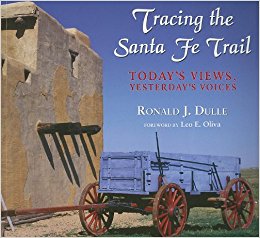 This photographic journey along the Santa Fe Trail is a treasure of outstanding color photos combined with a detailed, step by step history of this important trail wending its way across the American West between the Missouri river valley and northern Mexico.
Readers turn the pages of history from 1821 through 1880, witnessing caravans of freight wagons, lumbering oxen, stoic Missouri mules, and faithful horses traveling this international route used by military men, hunters, pioneers, homesteaders, tradesmen, bullwhackers and every sort of adventurer. By 1880 the railroads put the Santa Fe Trail out of importance but before trains on rails edged out horses and mules, this road seethed with adventure.
Maps inside the book give a detailed description of the trail running from St. Louis, Missouri to Santa Fe, New Mexico. As we turn the pages, magnificent photos combined with carefully written essays tell the story. Scenes of trapper’s tents along the Missouri River, historical markers explaining old battle scenes, patient oxen ready for work, military forts, restored buildings in Kansas boom towns, and haunting wagon ruts are still visible across the prairie.
The author takes us along this spectacular tour of historical places while explaining the importance of each scene. We get an emotional glimpse of what it must have been like to walk or ride along this trail. We imagine the squeak of freight wagons, the clank of trace chains, and can almost feel the lonesome prairie vastness surrounding brave travelers as they went along their way.
Every type of conveyance from buggies to huge Conestogas lumbered along. Trade goods included salt, tools, furs, medicine for fever and malaria, castor oil and opium. Some packages contained wines and brandies, chess sets, violin strings, playing cards, cooking utensils, cloth and leather goods as well as silver and gold. Businessmen Russell, Majors and Wadell, who would eventually come up with the idea of a Pony Express, first ran a freight business that consisted of over 3,500 freight wagons carrying thousands of tons of material.
Fortunes were made and lost, armies tramped cross-country while cemeteries sprang up along the way. This book is filled with surprising historical tidbits that we sometimes forget existed. For instance, we see pictured the historical landmark of Fort Osage built to house soldiers guarding the new Louisiana Territory. Pictures of the soldier’s quarters give us insight about how they lived. Plank floors, spartan bunk beds and a wood kitchen counter remind us of days gone by. Turning the pages we find everything from old adobe buildings to the Palace of the Governor in old Santa Fe. There are churches, Pueblos and Indian kivas inviting exploration.
Every page of this book causes the reader to reflect on the thoughtful and sentimental scenes chosen by the photographer. Faithful mules pulling a U.S. Army wagon, crumbling stone walls of an 1860 stage station, gushing water at a river crossing, remnants of two-hundred year-old cottonwood trees and historical grave markers show what lined the old Santa Fe Trail. We are filled with awe and admiration for the people who braved the new and dangerous land. Photographer Ronald J. Dulle is to be congratulated for his beautifully orchestrated photography combined with this important history lesson. This book belongs in your Old West library. You can grab this beautiful book HERE.
Editor’s Note: The reviewer, Phyllis Morreale-de la Garza is the author of numerous books about the Old West including The Apache Kid, published by Westernlore Press, P.O. Box 35305, Tucson, Arizona 85740
*Courtesy of Chronicle of the Old West newspaper, for more click HERE.
Arbuckles’ Cowboy Coffee, the Flavor of the Old West
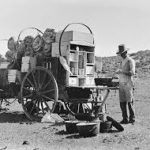 Arbuckles’ Ariosa Cowboy Coffee was a staple of chuckwagons, restaurants and hotels back in the Old West, and to this day you can still enjoy the coffee that has always been Best in the West. Dakota Livesay and his granddaughter Quinn recently shared a word about this great product. Get your coffee order in HERE.
From Dakota: “I discovered if I do a video with one grandchild I had to do one with the other. Because it was the choice of Old West cowboys we had to do a video about Arbuckles’ Cowboy Coffee.“
Old West TV – The Great Camel Experiment
 Dakota Livesay talks about the Great Camel Experiment, when Secretary of War Jefferson Davis asked Congress to fund an experimental herd of camels in the 1855! “My admiration for the camels increases daily with my experience of them. The harder the test they are put to the more fully they seem to justify all that can be said of them,” Edward Fitzgerald Beale wrote in his journal on September 21, 1857. But all did not turn out exactly like Lt. Beale hoped.
Chuckwagon: Chuckwagon Terms
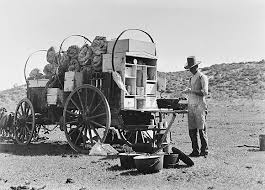 Chuckwagon Terms:
Wreck pan – The pan in which cowboys placed their dirty dishes following a meal.
Squirrel can – The large can in which cowboys scraped the food scraps before placing them in the wreck pan.
Cook’s last job of the evening – Point the tongue of the chuckwagon toward the north so the herd could “follow the tongue” the next day.
Gut robber, greasy belly, biscuit shooter – Cowboys names for both the ranch house and trail drive cook.
Coffee recipe – A hand full of coffee for every cup of water.
Possum belly – A rawhide apron attached to the underside of the chuckwagon in which wood and buffalo chips are stored for the dinner fire.
Why cooks threw dirty dishwater under chuckwagon – This helped protect the cook’s domain by discouraging cowboys from taking a nap in the shade under the chuckwagon.
*Courtesy of Chronicle of the Old West newspaper, for more click HERE.
“Grandpappy?” – John Wayne “McLintock” Weather Vane
 From Dakota:
“Our children and grandchildren came to visit Sunny and me over Thanksgiving.
We were talking about the John Wayne McLintock Weathervane when someone said, “If it’s so great why don’t we make a commercial about it?”
My grandson Kaine is a performer, so he was all for it. I wasn’t so sure, but I was drafted.”
To check out the classic McLintock Weathervane click HERE.
The Hanging of Robber Tom Bell
 Tom Hodges was a brilliant surgeon who served in the U. S. Army during the Mexican-American War. In 1855 he gave up his medical practice and headed out west to make his fortune in the gold fields. He soon found that the gold fields were a lot harder than he had thought.
 Old West Book Review: Cochise County Cowboys
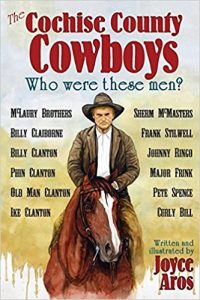 The Cochise County Cowboys, who were these men? Joyce Aros, Goose Flats Publishing (P.O. Box 813, Tombstone, Arizona 85638) www.gooseflats.com/aros/ $11.95, Paperback. 112 Pages, Index.
When we read about “Cochise County Cowboys” it is usually within the context of those individuals accused of being enemies of the Earps during the 1880s conflict in Tombstone, Arizona. Wyatt Earp himself was interviewed in the 1930s, and when talking about his life and times he cooked up a lot of fancy along with the facts, determined to tell his side of the story with an eye toward an eventual book and movie contract. Wyatt might have the reputation of being the greatest “Frontier Marshal”, but in his old age he was also a sharp businessman.
Certainly he and his brothers, and their pal Doc Holliday were greatly embroiled in the booming silver mine town, but in reality they were only in Tombstone less than 2 years when they were chased out of the Territory wanted for murder.
Books, movies, magazine articles, museum artifacts, TV shows and lively historical re-enactors have kept the Tombstone/Earp story alive until it has become so convoluted nobody knows the truth of what really happened. And now, who really cares? Four brothers dressed in long black coats, thumping along the boardwalk, spurs jangling, totin’ well-oiled shootin’ irons is the stuff Hollywood is made of.
For night there has to be day, to have good there must be evil. If we are to believe the Earps were frontier defenders of law and order, then there has to be a pack of villains, con-men, robbers, thieves and cattle rustlers for the Earps to tangle with. The worse these characters were portrayed, the bigger heroes the Earps became. At least, that is what audiences gleaned after reading books about Wyatt, and watching movie and TV dramas starring heroes like Burt Lancaster, Hugh O’Brien, Kevin Costner and Kirk Douglas.
Enter “Cochise County Cowboys”, whose supposed leader was a grizzled individual known as “Old Man Clanton.” He lived in a shack in the hills, a widower with a passel of mean sons who toted guns and rode with their Pa beside a horde of equally murderous barn-burners with names like “Curly Bill’ and “Johnny Ringo.” They supposedly stirred up every conceivable mischief from stagecoach robbery to cheating at cards. They lived by their guns, fast horses and derring-do. A bunch of liars and back-shooters, they were cruel and heartless scoundrels who had taken over Cochise County. Fortunately the Earp brothers arrived just in the nick of time to save the gentle and defenseless townsfolk.
To top it all off, the fighting Earps caught three of those horrible villains at the O.K. Corral on a cold October day in 1881 known as the “Gunfight at the O.K. Corral.” Those gunshots are still being heard around the world. But now, after 135 years, some serious writer-researchers have determined to sniff out the truth, or at least come close to it, and evidence gleaned from census records, newspaper articles, personal letters and courthouse documents bring some truths to light.
Joyce Aros, a resident of Tombstone, Arizona is an astute observer of human nature, careful researcher, and dedicated historian who has doggedly followed the trail of a dozen “Cochise County Cowboys”. She brings to light the reality of how these men really worked, lived, and sometimes died. She is fair in her assessment of their contribution to the Tombstone saga. She scrapes away the frosting on a highly fantasized cake, and takes the reader into a new world of honest evaluation of the characters involved with the Earps in Tombstone. The four Clantons, the McLaury brothers, Frank Stilwell, Johnny Ringo, Major Frink, Billy Claiborne, Pete Spence, Curly Bill and Sherm McMasters are examined here.
If you like old Tombstone stories, and are interested in the real truth; this little book is a must for your Old West collection. I suspect Aros will have more of these books forthcoming; perhaps next will be about the Earp women? You can get Joyce’s awesome book HERE.
Editor’s Note: Reviewer Phyllis Morreale-de la Garza is the author of numerous books about the Old West, including The Earp Gamble, published by Silk Label Books, P.O. Box 700, Unionville, New York 10988-0700, www.silklabelbooks.com
*Courtesy of Chronicle of the Old West newspaper, for more click HERE.
The 1867 Hayfield Fight
 The Hayfield Fight: the year was 1867 and the Red Cloud War had been going on along the Bozeman Trail for almost two years. On August 1 some 500 Sioux, Cheyenne and Arapaho led by Dull Knife and Two Moon, attacked a small detachment of eight troopers and nine civilians that were led by Lieutenant Sternberg. At the time of the attack, Lieutenant Sternberg’s group was in the open crossing a hayfield. Fortunately, they were able to make it to the shelter of a nearby corral. Even more fortunately, the troopers and civilians had repeating rifles.
 Orlando Robbins and the Star Spangled Banner
 Born in Maine, Orlando Robbins left home at the age of seventeen and headed out west. Eventually ending up in the gold fields of Idaho, in 1864 he became the deputy sheriff of Idaho City.
 The Son of Sam Houston – Temple Houston
 Temple Houston was the son of Texas’ founding father Sam Houston. He was an independent young cuss… so independent that at the age of 13, as a rawboned boy with shoulder length hair, he became a cowboy on a cattle drive from Texas to Montana.
 Chuckwagon: Old Fashioned Shortcake
Old Fashioned Shortcake from an 1891 recipe book entitled “Palatable Dishes.”
 For Old Fashioned Shortcake take one quart of nice buttermilk, add to it one teaspoonful of soda, quarter of a teaspoonful of salt, one tablespoonful of unmelted lard, then stir in enough sifted flour to make as soft a dough as can be handled. Roll out to about half an inch thick, cut into diamonds and bake quickly.
*Courtesy of Chronicle of the Old West newspaper, for more click HERE.
Old West Book Review: Murdered on the Streets of Tombstone
 Murdered on the Streets of Tombstone, Joyce Aros, Goose Flats Publishing, (520) 457-3884, $26.99, Paper. 340 pages, Author’s Notes, Photos, Illustrations, Bibliography, Index.
Countess books, movies, magazine articles, radio programs and internet chat rooms have hashed and re-hashed the history of Tombstone, Arizona “The Town Too Tough To Die.” The most important incident triggering all the excitement was a shootout that came to be known as “The Gunfight at the O.K. Corral.”
So along comes Hollywood to tell about a huge band of outlaws and cattle rustlers known as “The Cowboys” who are terrorizing Cochise County. But not to worry, in order to rid the Territory of these villainous, snaggle-toothed ruffians, the illustrious Earp boys arrive from Kansas to settle their hash.
And settle it they did! On a cold and windy day in late October, 1881, things came to a head and when the smoke cleared, brothers Frank and Tom McLaury, and their young pal Billy Clanton lay dead in the street behind the O.K. Corral.
One hundred and thirty years later, why are we still worrying about it? Everybody knows (Burt Lancaster, Kirk Douglas, Hugh O’Brien, and Rhonda Fleming told us) the Earps were the good-guy heroes, and the three dead cowboys had it coming.
But Wait! Not so fast! There is a lot more to the story, and Tombstone writer-researcher Joyce Aros gives us the benefit of her sleuthing. She has tediously combed through courtroom testimony, oral history on file at the Arizona Historical Society, books, letters, interviews plus a good dose of horse sense to draw her conclusions.
Aros begins her book explaining the circumstances of life in the new Territory, and how the Clantons and the McLaurys fit into all this. Aros allows the reader to become familiar with these men by putting faces on them. They were living, breathing human beings who had struggles, hopes and dreams in a new land where hardworking, determined men built their ranches.
The fateful day they came to town, Tom and Frank McLaury had business to finish before heading to Iowa to attend their sister’s wedding. Meeting with them was their friend Billy Clanton, a nineteen-year-old rancher who was on business of his own that day.
Aros is able to show the Earps were prepared to fight, but the young ranchers were not. Tom McLaury was not even carrying a gun, Frank McLaury was leading his horse, (who takes a horse to a gunfight?) and when confronted by the gun-wielding Earps, Billy Clanton shouted “I don’t want to fight!” Even so, guns blazed and in less than thirty seconds three men were dead.
Tom, Frank and Billy were not outlaws. They came to a sad and thunderous end behind a dusty corral on the streets of Tombstone, Arizona where they have been vilified for more than 130 years. When you turn the last page of this book, the Earps might still be your heroes, but certainly Tom, Frank and Billy will become real people whose lives were taken far too soon.
We still do not know for sure what triggered the deadly hatred the Earps had for these three young ranchers. However, through this detailed examination in Murdered on the Streets of Tombstone, Joyce Aros has done an incredible job of finally declaring balance to a tragedy that has gone unchallenged far too long. You can decide for yourself by grabbing the book HERE.
Editor’s Note: The reviewer Phyllis Morreale-de la Garza is the author of numerous books about the Old West including The Earp Gamble, published by Silk Label Books, P. 0. Box 700, Unionville, New York 10988 (845) 726-3434. Www.silklabelbooks.com
*Courtesy of Chronicle of the Old West newspaper, for more click HERE.
Wyatt Earp Kills Cowboy in Dodge City

The Doolin Gang and the OK Hotel Shootout
 In the fall of 1892 Bill Doolin formed the Doolin gang that robbed trains and banks. He caused enough havoc to rile up the law in the area.
 Old West TV – Charles M. Russell
On this episode of Chronicle of the Old West TV, Dakota Livesay shares the history of Old West artist Charles M. Russell.
Chuckwagon: Spiced Corn Beef
To 10 pounds of beef, take 2 cups salt, 2 cups molasses, 2 tablespoonfuls saltpeter, 1 tablespoonful ground pepper, 1 tablespoonful cloves; rub well into the beef.
Turn every day, and rub the mixture in. Will be ready for use in 10 days.
*Courtesy of Chronicle of the Old West newspaper, for more click HERE.
Black Faced Charlie and the Dalton Gang
 It seems that everyone in the Old West had nicknames… And some of them were strange. But, none was as strange as Charles Bryant’s. He was called “Black Faced Charlie.” It seems that when he was a young man he was shot point-blank in the face. The bullet just creased his cheek. But, the burnt powder coming out of the pistol imbedded in his face, giving him his nickname.
 Old West Book Review: Texas Devils: Rangers and Regulars on the Lower Rio Grande
 Texas Devils: Rangers and Regulars on the Lower Rio Grande, 1846-1861, by Michael L. Collins, University of Oklahoma Press, (405) 325-3200, $19.95, Paper. Photographs, Notes to the Chapters, Bibliography, Index.
This book is a carefully researched account of the turbulent times along the Lower Rio Grande in Texas from 1846-1861. The author delves into these fifteen years filled with conflict between Anglo ranchers, homesteaders and businessmen at odds with the Hispanic people after the Mexican War. New International boundaries pointed to trouble when people lost their old homelands and the Republic of Texas established a new government as well as new political rules.
The author creates a page-turner that reads in places like an exciting novel. With measured cadence and vivid word descriptions, the warring factions are brought to life. He explains how the Rangers were hired to defend the homeland, protect the new border and keep the peace. Understandably, the Mexican people were mostly filled with resentment toward these armed posses riding across their old homeland. Known by the Mexicans as Ids diablos Tejanos, or Texas Devils, these men patrolled the countryside often clashing with Mexican bandits and roving Comanches. Here are details regarding the various battles, what happened, who lived and who died. Often young Rangers were brutally murdered, their hacked remains left rolling in the sun.
In retaliation, the Rangers were known to exact their own brand of vengeance, and sometimes committed atrocities with equal savagery upon those they fought against. The book aims to tell the Ranger story with fairness, dispelling some of the romanticized myths surrounding the early Ranger companies.
Important leaders of the Ranger units are given biographical coverage as to their places in history. Some had political ambitions; some were mercenaries interested in land and plunder. Still others, like Major Samuel Heintzelman and Col. Robert E. Lee were military gentlemen performing their duties in Texas with dignity, and who were destined to fight in terrible battlefields back east.
A clear and sentimental portrait is drawn here regarding Robert E. Lee who left his beloved Virginia plantation (now Arlington National Cemetery) in service to his country. He knew the winds of war would call him home to face heart wrenching decisions that would linger to the end of his days.
Too, this Ranger story includes the well known Juan Cortina known on the border as the “Red Robber.” The son of wealthy Mexicans who owned vast ranch lands, he became a champion for the Mexican cause after his mother lost most of their land to gringo lawyers and speculators after the Mexican War. Filled with bitterness and revenge, he led his Mexican followers against the Texas Rangers. Somewhat of a Robin Hood, he became an illusive adversary much loved by the Mexican people.
The author points out that injustice on both sides of the border conflict were experienced by many people. In 1860 Civil War broke out in the United States, and Texas went with the Confederacy. So much turmoil ensued due to that cause, the fighting on the Texas border settled down since there was a much larger conflict to deal with. Meanwhile, old myths and fables die hard because we all need our heroes. However, still to this day Anglos and Hispanics on the Lower Rio Grande have their reasons to mistrust one another. Even after 150 years, there is still much work to be done. Western history readers will reflect on what is written here long after turning the last page. You can grab Michael’s book HERE.
Editor’s Note: The reviewer, Phyllis Morreale-de la Garza is the author of many books about the Old West including Hell Horse Winter of the Apache Kid, Silk Label Books, P.0. Box 700, Unionville, New York 10988 Ph. (845) 726-3434 www.silklabelbooks.com
*Courtesy of Chronicle of the Old West newspaper, for more click HERE.
Soiled Dove Madame Mustache
 Simone Jules was a young French girl who arrived in Northern California at the height of the gold rush. For about four years she worked as a soiled dove in San Francisco’s Bella Union. Accumulating enough money to open her own place, she headed up to Nevada City, California, changed her name to Eleanor Dumont and opened the Dumont Palace gambling saloon.
 Texas Ranger Frank Jones
 Born in Austin, Texas in 1856, Frank Jones joined the Texas Rangers at the age of 17. He saw his first action when he and two other Rangers were sent after some Mexican horse thieves. The horse thieves ambushed the Rangers. Frank’s two companions were immediately taken out, but Frank was able to kill two of the bandits and capture a third.
Chuckwagon: Plum Pudding Sauce
Ingredients: Glass of brandy; 2 oz of fresh butter; Glass of Madeira; Pounded sugar to taste.
Mode: Mix pounded sugar with part of the brandy and the butter. Warm until sugar and butter dissolved then add the rest of brandy. Either pour it over the pudding or serve in a tureen.
*Courtesy of Chronicle of the Old West newspaper, for more click HERE.
Old West TV – Bose Ikard
Dakota Livesay gives us a history lesson about Bose Ikard. Bose Ikard was an African American who participated in the pioneering cattle drives on what became know as the Goodnight-Loving Trail, after the American Civil War and through 1869.