Denver’s 1863 Fire

Teddy Roosevelt’s Boat Thieves
On March 24, 1886, three hard cases were on the move. Unfortunately, an ice-swollen river stood between them and their destination. They came across a small rowboat, and decided to commandeer it. Now, normally the owner would chalk it off as a loss, but not this owner. He happened to be a tenderfoot easterner who had recently become the chairman of the Stockmen’s Association, a position that also carried with it the title of deputy sheriff. This easterner turned cowboy and rancher was a man of grit and determination who was later to hold the highest office in our land. His name was Theodore Roosevelt. This is the story of Teddy Roosevelt’s boat thieves.
Roosevelt had another boat made, and within a week, he and two cowboys were going after the thieves. After three days, they found them.
Because of the icy river, the group traveled eight days trying to get back home. With provisions almost gone, they finally came across a ranch. Roosevelt hired a wagon and driver to take him and the three ruffians the rest of the way. Roosevelt’s two companions remained with the boats.
It took two days and a night to get to the nearest town. Roosevelt stayed awake, with rifle at the ready, the whole time. To make sure he wasn’t jumped, Roosevelt had to walk along behind the wagon.
As deputy sheriff, Roosevelt received a fee for bringing in the men, and mileage for the over 300 miles he had traveled to retrieve them. It was a total of $50. But he had accomplished two things: First, he had upheld the law. Second, people would think twice before stealing anything from him again.

Chuckwagon Vocabulary
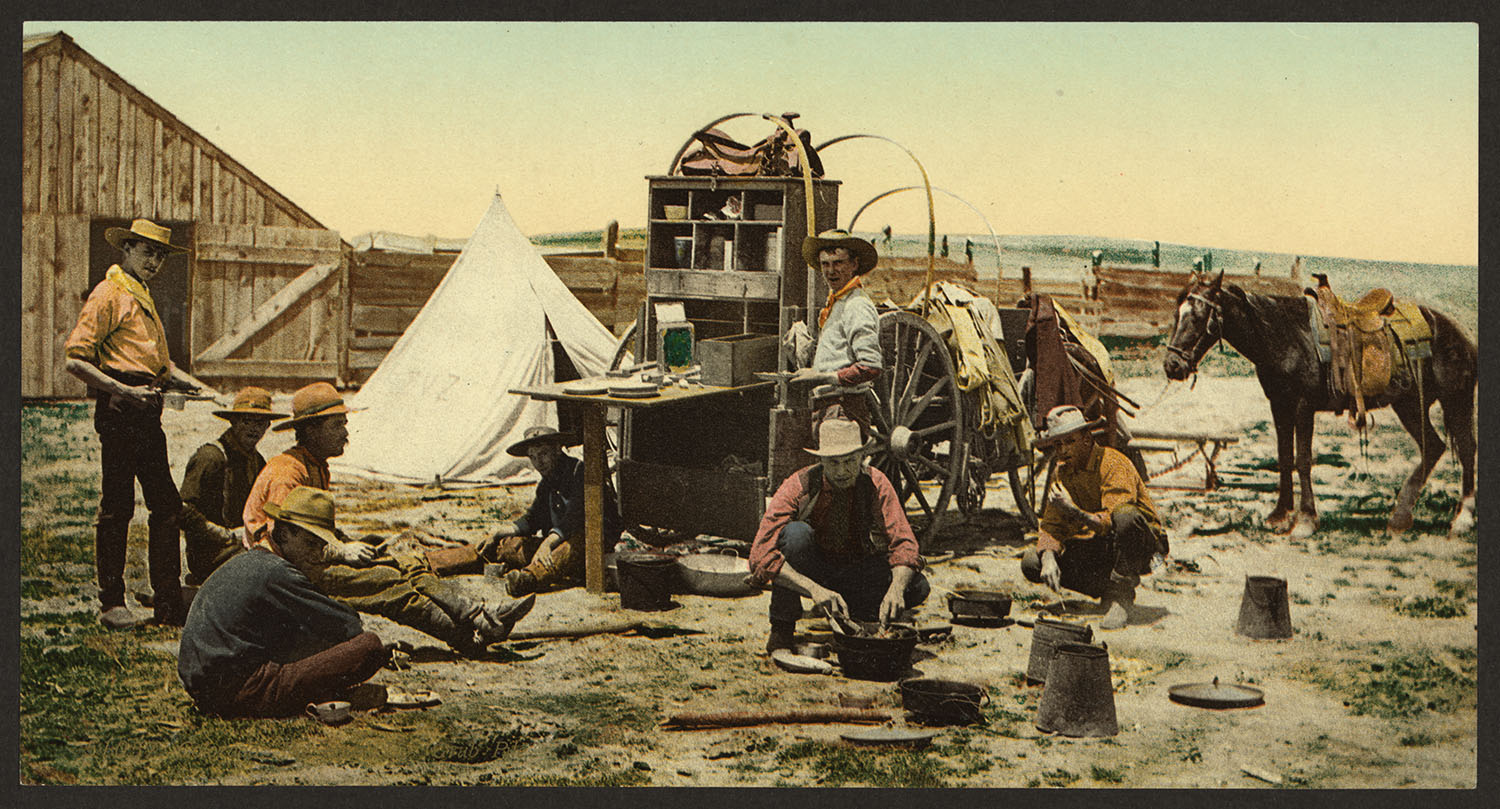
As with everything the cowboy did, when it came to eating, the cowboy developed his own chuckwagon vocabulary. Sometimes it was a perversion of a commonly used word. Other times it seemed to have no relationship to anything other than what was in a cowboy’s mind.
Here are a few of the terms cowboys used for various aspects of eating:
Airtights: Canned goods. Usually corn, peaches, tomatoes and milk.
Arbuckle’s axle grease: Arbuckle brand of coffee was the one most used on the range. Axle grease referred to the strength of the coffee.
Cow Grease: Butter.
Hen Fruit: Eggs.
Padding Out His Belly: Someone who eats anything, anytime.
Slow Elk: Someone else’s steer slaughtered for food.
Swamp Seed: Rice. A staple on the trail.
Texas Butter: Gravy made from steak grease and flour. If available, milk was used.
Judge Roy Bean

Pony Bob

Cynthia Ann Parker Kidnapped Twice

Heard Around the Bunkhouse #4 – Cowboy Slang
 In our feature Heard Around the Bunkhouse we bring you cowboy slang and sayings that they used back in the Wild West. Hope you enjoy them, and let us know your favorite terms from those past times.
OLD STATES – Back east.
PILGRIM – Cowboy term for an easterner or novice cowboy.
SHAVER – Slang for a young boy.
KNOCK GALLEY WEST – To beat someone senseless.
SIMON PURE – The real thing. A genuine fact. “This is the Simon pure.”
HOLD CANDLE TO – To measure up and compare to.
*Courtesy of Chronicle of the Old West newspaper, for more click HERE.
Crime of ’73

Old West Book Review: Comanche Jack Stilwell
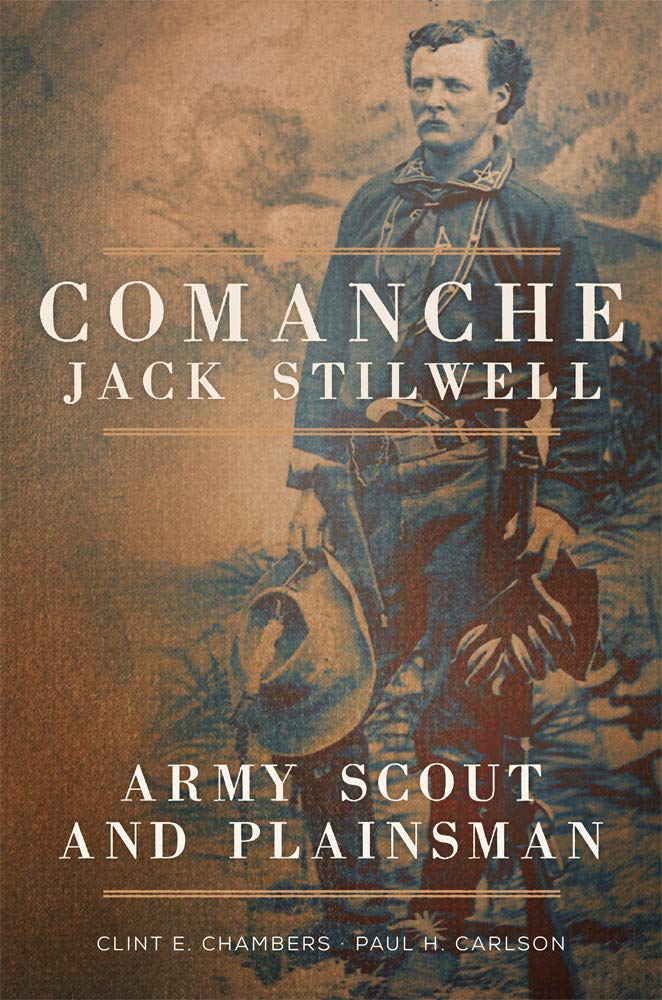 Comanche Jack Stilwell, Clint E. Chambers and Paul H. Carlson, University of Oklahoma Press, $24.95, Paperback, Non-fiction, 288 Pages, 2 Maps, 26 Illustrations, Notes, Index, Bibliography.
When Arizona history buffs hear the name “Stilwell,” we immediately think of Frank Stilwell, killed by Wyatt Earp at the Tucson, Arizona train station in 1882. However, Frank had an older brother “Comanche Jack Stilwell” who led a far more productive and adventuresome life than his younger brother, but not in Arizona.
This book delves into the life and times of Jack Stilwell, beginning with his family history and looking into Jack’s running away from home in Kansas when he was thirteen years old. Unhappy about the separation of his parents due to his father’s infidelity, young Jack decided to head West with a freight outfit lumbering along the Santa Fe Trail. A family story says he went to the local water well where he met a group of lusty men with wagons filled with goods, and the boy signed on.
Thus began years of adventures first as a freighter crisscrossing the vast prairies, learning to speak Spanish as well as several Indian languages, including Comanche, earning him the nickname “Comanche” Jack. He eventually found work as a civilian scout for the U.S. Cavalry.
The Battle of Beecher Island comes up frequently in Stilwell’s biography. This event took place in September 1868 in northeastern Colorado. The fight lasted nine days between Cheyenne, Lakota and Arapaho warriors against soldiers of the Ninth Cavalry. During fierce fighting, Major Forsyth requested that Stilwell try to make the ninety-mile run for help to the closest army fort. On foot, draped in blankets, living on raw horse meat, Jack somehow got through enemy lines and is forever remembered as the hero of the Battle of Beecher Island.
Stilwell met Custer and scouted for him, was a friend of Buffalo Bill Cody, and knew many other famous westerners including Quanah Parker and Frederick Remington. Everyone seemed to like him, speaking and writing favorably about his willingness and good disposition. When his health began to fail he quit scouting and became a cowboy for several years.
In 1882 his younger brother Frank, who lived near Tombstone, Arizona was shot and killed by Wyatt Earp. Jack came to Arizona only long enough to settle his brother’s estate before returning home. With his health deteriorating badly, but still determined, he studied law, became a sheriff, and eventually a judge. Late in life he married a woman half his age.
His health continued to fail, and after a long series of painful issues related to his many years of hard outdoor living, he died February 17, 1903, probably of Bright’s disease. Today he lies buried at Old Trail Town, on the west side of Cody, Wyoming, and is remembered as a true Old West frontiersman.
This book goes into great detail about this man’s personal history, and is a fitting tribute to Comanche Jack Stilwell, “army scout and plainsman.”
Publisher’s Notes. The reviewer, Phyllis Morreale-de la Garza is the author of numerous books about the Old West, including Death For Dinner, the Benders of (Old) Kansas, Silk Label Books, P.O. Box 399, Unionville, New York, 10988. Ph. (845) 726-3434. www.silklabelbooks.com
*Courtesy of Chronicle of the Old West newspaper, for more click HERE.
Chuckwagon: Baked Indian Pudding
BAKED INDIAN PUDDING
5 cups milk, scalded 4 cups
1/3 cup sugar
1/2 cup yellow cornmeal
2/3 cup dark molasses
1 tsp cinnamon
1/2 tsp ginger
1 tsp salt
4 tsb butter
To scalded milk, add sugar, cornmeal, molasses, spices, salt and butter.
Cook until thickened.
Put into greased baking dish.
Bake at 300 for 3 hours.
*Courtesy of Chronicle of the Old West newspaper, for more click HERE.
Joel Fowler – A Vigilante Hanging
 Joel Fowler was born in Maryland, and he later migrated down to Texas. He spent some time on the stage as an actor and entertainer. Not able to earn much of a living at this profession, he tried his hand as a law attorney. Running abreast of the law, in 1879 Joel headed up to New Mexico. But this was still not someone who one would think would end up on the wrong end of a vigilante hanging.
Curing Cowboy Bacon
 For curing cowboy bacon add one peck salt to five hundred pounds pork. To five gallons water add:
4 pounds salt.
1 pound sugar.
1 teaspoonful salt petre.
Mix, and after sprinkling the fleshy side of the ham with the salt, pack in a tight barrel. Hams first, then shoulders, midlings. Pour over the brine; leave the meat in brine from four to seven weeks.
*Courtesy of Chronicle of the Old West newspaper, for more click HERE.
Heard Around the Bunkhouse #3 – Old West Slang
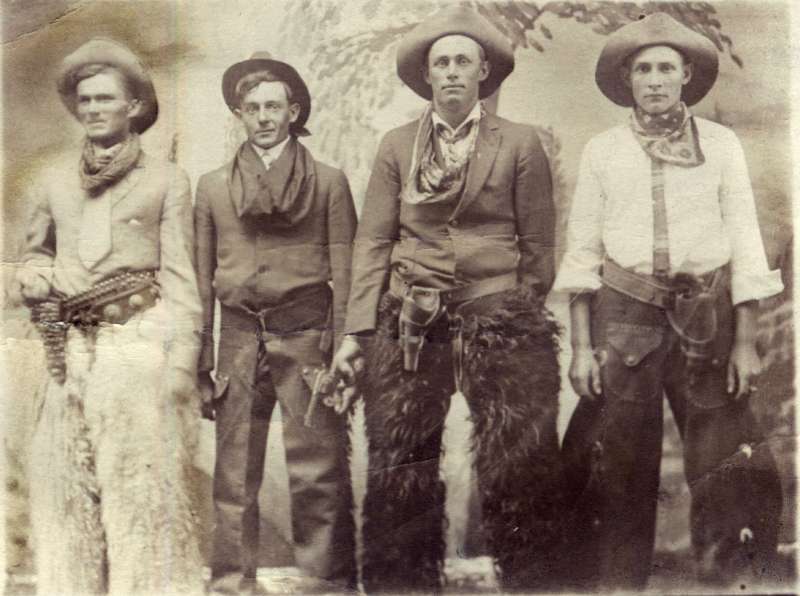 In our feature Heard Around the Bunkhouse we bring you Old West slang and sayings that they used back in the Wild West. Hope you enjoy them, and let us know your favorite terms from those past times.
HEAP – A lot, many, a great deal.
MAKE A MASH – Make a hit, impress someone. It was usually a woman.
HEELED – To be armed with a gun.
DREADFUL – Very. “Oh, her dress is dreadfully pretty.”
HARD CASE – A worthless person or bad man.
DOWN ON – Opposed to. “His wife is really down on drinking and cigars.”
*Courtesy of Chronicle of the Old West newspaper, for more click HERE.
Old West Book Review: According To Kate – Tale of Big Nose Kate
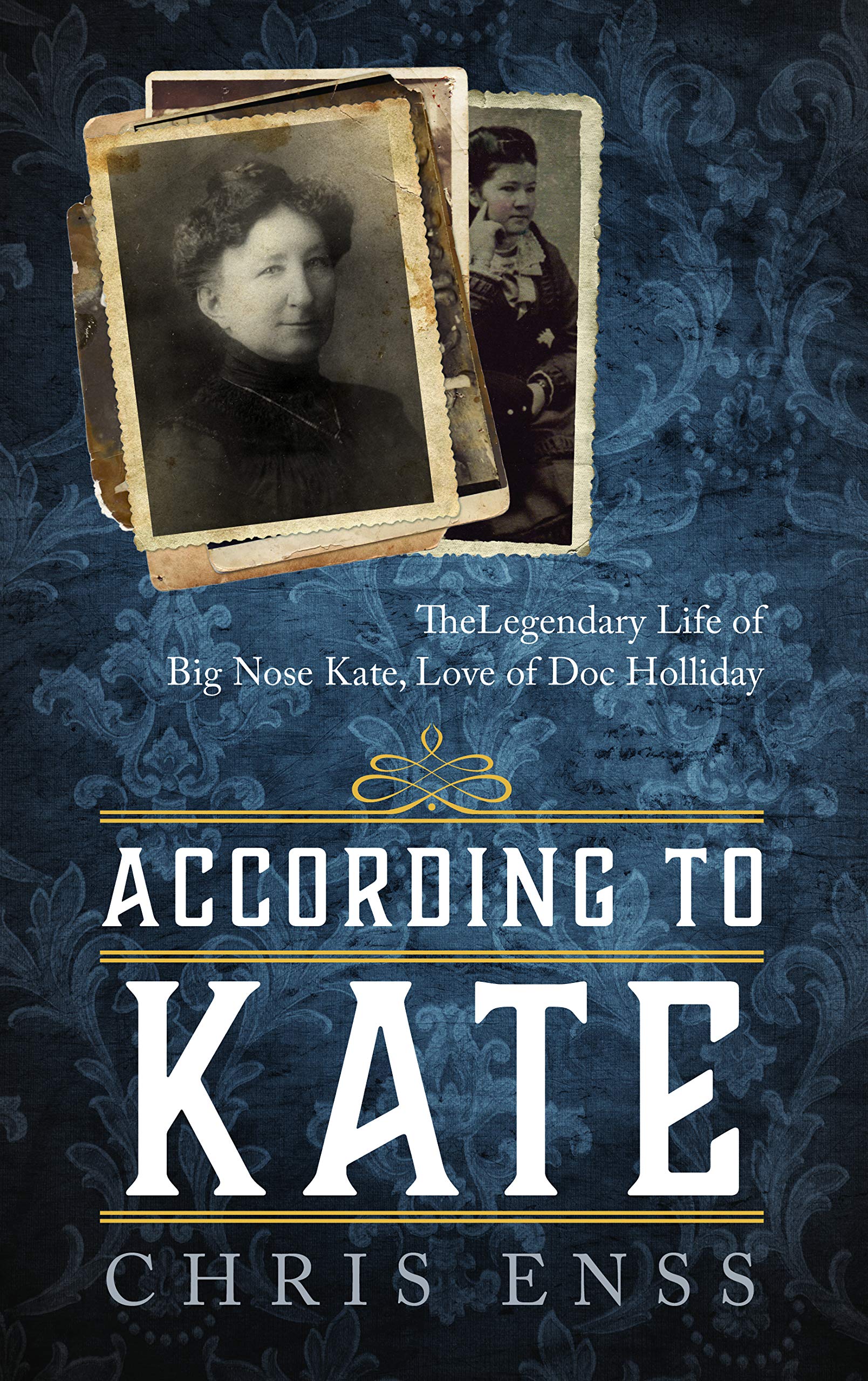 According To Kate, Chris Enss, Two Dot, $24.95, Cloth. Non-fiction, Photos, Notes, Bibliography, Index. This book chronicles for the first time the life story of Mary Katherine Horony, known as Big Nose Kate. Previously small parts of her life have been entwined with stories regarding her association with the Earps and Doc Holliday. If not for her relationship with Doc, it is likely that nobody would have heard of her, or even cared. Kate was a prostitute, a soiled dove, a lady of easy virtue who traveled throughout the rough Kansas cow-towns and mining camps in Arizona.
Her early life seems to have been stable. Her father was a doctor. She claimed to have had one early marriage and a child who died. However, she soon took up life on the wild side and stuck with it until old age caught up to her.
According to Kate, which is the title of this book, she hated the Earps and the nickname Wyatt bestowed upon her, “Big Nose Kate.” This name had little to do with the size of her nose, but because she stuck her nose into other people’s business. Kate and Wyatt contended for the attention and loyalty of Doc Holiday; Wyatt usually won.
After Doc Holliday’s death of tuberculosis in Glenwood Springs, Colorado, Kate married George Cummings, a mining man/blacksmith. In time she left this abusive drunk, and became a housekeeper at a tiny hotel in Cochise, Arizona. From here she became a housekeeper for Jack Howard, a mining man living in Dos Cabezas, Arizona. Thirty years later when Jack Howard died, Kate, nearly destitute was admitted to the Pioneer’s Home in Prescott, Arizona. She spent the last ten years of her life (to age 90) complaining about the food and accommodations white attempting to sell her memoirs to writers who might use the material for a book. There were no takers willing to give her money for her stories. Kate died at the Pioneer’s Home and is buried there.
This book is an accumulation of Kate’s lifetime adventures. Much of Kate’s story here is gleaned from a combination of her memoirs, some accurate and some not, plus the author Chris Enss’ having gathered historical facts from legal documents, census records, and newspaper articles.
Readers of this book should understand that Kate’s personal letters and memoirs have been picked over tong ago by Earpiana researchers. Nothing here is really new, but it is now well organized. There are only three photos of Kate in the book that are authentic. We have seen them long ago. A fourth shows an attractive teenage girl on the book cover, but it is hard to imagine this is really Kate. Mary Katherine Horony was not a pretty woman. She told some windies in her memoirs probably to help sell her story, but we can excuse an eighty-year-old lady for this. She had no idea that after her death legions of professional researchers would sift carefully through every facet of the lives and times of the Earps and their associates, including “Big Nose Kate.”
Author Chris Enss has done a creditable job accumulating information, both factual and fictional concerning a famous Old West figure who survived hard times; living to old age still feisty and determined to the end According To Kate is a fascinating read, worthy of inclusion in your Old West library.
Editor’s Note: The reviewer Phyllis Morreale-de la Garza is the author of numerous published books about the Old West, including 9 Days At Dragoon Springs, published by Silk Label Books, P.O. Box 399, Unionville, New York 10988. www.silklabelbooks.com.
*Courtesy of Chronicle of the Old West newspaper, for more click HERE.
Denver’s First Trial

The Cowboy Kid

Heard Around the Bunkhouse #2 – Old West Terms
 In our feature Heard Around the Bunkhouse we bring you Old West terms and sayings that they used back in the Old West. Hope you enjoy them, and send us your favorite terms from those past times.
FISH – A cowboy’s rain slicker. Slicker was manufactured by a company whose trademark was a fish.
RICH – Amusing, funny, improbable.
BILK – Cheat.
THE WHOLE KIT AND CABOODLE – The entire thing.
BAZOO – Mouth as in “Shut your big bazoo.”
GONER – Lost, dead.
*Courtesy of Chronicle of the Old West newspaper, for more click HERE.
Old West Book Review: The Ranger Ideal, Texas Rangers in the Hall of Fame
 The Ranger Ideal, Texas Rangers in the Hall of Fame, Volume 1, Darren L. Ivey, University of North Texas press $39.95, Cloth. 672 p.p., Photos, Notes, Bibliography, Index.
For anyone interested in the history of the Texas Rangers, this book is a must read. It is the first of a three-book series telling about the lives of the most important men involved with the founding of the Texas Rangers. The time period it covers is from 1823 – 1861, and includes Stephen F. Austin, John C. Hays, William A. A. “Big Foot” Wallace, Samuel H. Walker, John S. Ford, and Lawrence S. Ross. All of these men have been inducted into the Hall of Fame and Museum at Waco, Texas.
The author points out in his Preface that several of these men are well-known, but the others have been mostly overlooked and do not have biographies or even extensive coverage in history books. All of these men are honored in the Texas Ranger Museum at Fort Fisher located near the Texas city of Waco. Visitors to the museum find Ranger displays including guns, clothing, saddles, equipment and artwork. The museum opened to the public in 1968, and continues its work educating the public about the important contributions Rangers made to Texas.
Readers find a timeline of Ranger history to help us better understand the enormous upheavals Texas went through beginning in 1821 when Americans established a colony on land that originally belonged to Mexico. Political changes are explained as Texas went from Mexican control to annexation to the United States in 1845.
Each of the seven men featured here were vastly patriotic, and did not hesitate to join in any and all of the fights, shoot-outs, military campaigns, long marches, sometimes capture and imprisonment in Mexico, and including every hardship imaginable. By the 1860s, two Rangers featured here joined the Confederate Army when civil war was declared and Texas went with the South. The battle records of these men are shown here, their adventures and derring-do included a multitude of battles and skirmishes reminiscent of Bruce Catton’s Civil War books where readers follow the amazing courage these soldiers displayed under the most difficult circumstances.
In 1860 Ranger John Ford was involved in the recovery of the highly publicized white woman Cynthia Ann Parker who, when still a child, was taken captive by Comanches. By the time she was rescued years later, she had mostly forgotten her white way of live, and even how to speak English.
Of the seven Rangers featured in the book, only three ever married while the others seem to have dedicated their lives to Texas. Two of these men died fighting.
The author has done an impressive job of researching for truths related to this material. Anyone looking for information about the Texas Rangers will find this tome invaluable.
Darren L. Ivey is to be commended for his good writing and careful research into an important topic about the American West. In addition to The Ranger Ideal, Texas Rangers in the Hall of Fame his writing includes a previously published book on this subject titled The Texas Rangers; A Registry and History.
Thus far, thirty-one individuals have been honored in the Texas Ranger Hall of Fame. If you are a Texas Ranger fan, you will want this one for your Old West library, and will look forward to reading the next two books in the series.
Editor’s Note: The reviewer Phyllis Morreale-de la Garza is the author of many books including Death For Dinner; The Benders of (Old) Kansas, published by Silk Label Books, P.O. Box 700, Unionville, New York, 10988-0700. Ph. (845) 726-3434. www.silklabelbooks.com
*Courtesy of Chronicle of the Old West newspaper, for more click HERE.
Christmas Day 1890
Christmas Day 1890. How the Various Churches Will Observe the Festival.
There will be Services Appropriate to the Season and in Most of the Churches Special Music.
 December 24, 1890, Daily, Woodland, California – In all of the churches of this city Christmas day will be fittingly observed. The sermons and in most of the churches there will be special musical service.
At St. Luke’s Church the quartette choir of St. Luke’s will give a full musical service appropriate to Christmas day, tomorrow morning at 11 o’clock. The choir is composed of Della Prior-Pierce, Minnie Prior, Wilbur Blair and C. W. Bush; Maggie Ellis, organist. Mrs. Pierce will sing the solo to the beautiful anthem of Williams’. “There Were Shepherds Abiding in the Fields,” and Adolf Adams’ famous “Noel” for the offertory.
Dudley Buck’s festival Te Deum will be a feature of the service.
All are cordially invited to be present. Sunday school at 10 o’clock.
There will be special services in the Congregational Church both morning and evening. Rev. Joel Martin will preach at 11 o’clock. Mr. Martin is well known in the East as an earnest, logical and attractive speaker. Since coming to this coast he has held very successful meetings in Oakland, where large audiences have greeted him in the several churches where he has spoken. At 7 p.m. there will be special children’s Christmas concert service in which the children will take an active part and Mr. Martin will speak. Special music has been prepared. On the afternoons and evenings of Tuesday, Wednesday and Thursday Mr. Martin will also hold services in the church. A cordial invitation is extended to all to attend these services.
The services at the Christian Church tonight will be an old-fashioned Christmas tree. A short program will be given by the Sunday school at 7:30 o’clock. The tree will be beautifully decorated, as the young ladies of the church are sparing no pains to make it the most attractive and interesting that they have ever given. The service tomorrow will be of a special nature. Miss Mary Browning will sing “The New Born King” at the morning service. Special music by the choir in the evening. Subject of the morning sermon at the Baptist Church tomorrow, but there will be a meeting of the young people and Sunday school at the usual hours. The Sunday school children will give an entertainment this evening, after which a Christmas tree will be utilized to distribute the favors of good Santa Claus.
At the Church of the Holy Rosary the first mass will be celebrated at 8 o’clock and the second mass at half past 10. The pupils of Holy Rosary Academy will render appropriate Christmas hymns and carols.
At the M. E. Church Rev. J. A. Van Anda will preach Christmas sermons at 11 o’clock in the morning and 7:30 p.m. The music will be of an appropriate character. This evening there will be a Christmas tree in the church to which all friends are invited.
The pastor, Rev. C. O. Steele, will preach a Christmas sermon at the M. E. Church south at 11 a.m. There will also be other appropriate services. The Sabbath school will begin at 10 a.m. At 6:15 the league will meet.
The Second Christian Church will hold Christmas tree exercises next Monday evening.
At the German Church there will be a musical and literary program and a Christmas tree, and tomorrow Rev. J. Endter will preach a Christmas sermon and there will be special music.
Train – Oxcart Race
Women’s Suffrage

Chuckwagon: Cowboy Catsup
 To make Cowboy Catsup take one gallon skinned tomatoes, three heaping tablespoonfuls of salt, some black pepper, two of allspice, three of ground mustard, half dozen pods of red pepper and add to a large pot.
Stew all slowly together in a quart of vinegar for three hours. Strain liquid, and simmer down to half gallon. Bottle hot and cork tight.
*Courtesy of Chronicle of the Old West newspaper, for more click HERE.
Old West Book Review: Nighthawk Rising
 Nighthawk Rising, Diana Allen Kouris, High Plains Press, $19.95, Paperback 416 pp, Photos, Maps, Notes, Bibliography, Index.
Nighthawk Rising is the fascinating story is the biography of “Queen” Ann Bassett, an accused cattle rustler living in Brown’s Park in the 1880s through the turn of the century. Brown’s Park is a wildly beautiful area spanning the rugged mountains throughout western Utah, southern Wyoming, and eastern Colorado. This is the land of the Wild Bunch, Butch Cassidy, the Sundance Kid, deadly range wars and Tom Horn.
Ann Bassett’s parents settled here, trying to make a living in the difficult cattle business. Ann’s mother ruled the roost, a tough woman who rode sidesaddle while directing her cowboys. Ann’s father was a quiet gentleman more likely to be found at home writing poetry.
Ann and her three siblings grew up learning self-sufficiency. The little girl was a tough cookie, riding the most spirited broncs, and refusing sidesaddles. She dressed in buckskin trousers, was a top hand with a lariat, and could handle guns. Headstrong and resisting discipline, as a teenager she roped a grizzly cub and got her horse killed when mama bear came to the rescue. Ann got a well-deserved spanking from one of the cowboys who saved her life, but even that did not deter the girl from adventuresome deeds. She was always in the middle of things, whether driving cattle in a snow storm or crawling into a cave to kill coyote pups.
Sadly, Ann’s mother died suddenly of appendicitis. It now fell on Ann to be a leader in the family. These changes in the girl’s life coincide with the range war sweeping through Brown’s Park as the big ranchers tried to rid themselves of competition from smaller outfits. Tom Horn was hired as a “range detective”. Unsolved murders occurred thereafter, including the shooting death of Mat Rash, a handsome young cattleman who dated Ann Bassett and was destined to become her husband until his bullet-riddled body was found in the hills, most likely murdered by Tom Horn.
This tragic loss undoubtedly shaped Ann’s personal life thereafter. She never had a young husband. She had several husbands, all older men, and divorces. Her life seemed forever in turmoil in her effort to protect her ranch way of life. She moved from one place to another, was involved in legal disputes, was accused of being a “”rustler”, and nicknamed “Queen Ann” because of her rebellious nature.
Don’t look here for a hard riding bandit queen leading a gang of outlaws. Ann’s day by day life shows a gritty woman determined to survive against powerful men and forces beyond her control.
Diana Allen Kouris, the author of Nighthawk Rising, herself grew up in the Brown’s Park region. Her family is in the cattle business. Even though she was born many years after Queen Ann rode the range, Kouris has been able to relate to Brown’s Park and the people. Her writing is filled with original detail. We detect the author really knows what she is writing about, generating a feeling of respect and empathy for Queen Ann when readers turn the last page: a truly haunting story.
Publisher’s Notes: The reviewer, Phyllis Morreale-de la Garza is the author of numerous books about the Old West, including Death For Dinner, the Benders of (Old) Kansas, Silk Label Books, P.O. Box 399, Unionville, New York, 10988. Ph. (845) 726-3434. www.silklabelbooks.com
*Courtesy of Chronicle of the Old West newspaper, for more click HERE.
Heard Around the Bunkhouse #1: Cowboy Phrases
 Heard Around the Bunkhouse is a new feature on Cowboy to Cowboy where we will bring you cowboy phrases and sayings that they used back in the Old West. Hope you enjoy them, and send us your favorite terms from those past times.
OLD STATES – Back east.
PILGRIM – Cowboy term for an easterner or novice cowboy.
SHAVER – Slang for a young boy.
BLOW-UP: A fit of anger.
CALIFORNIA WIDOW: A woman separated from her husband, but not divorced. From when pioneer men went West, leaving their wives back home.
DICKER: Barter, trade.
*Courtesy of Chronicle of the Old West newspaper, for more click HERE.