The Great Diamond Hoax
 With the discovery of gold in California fake gold and silver mines became common. Swindlers and con men fooled many a greenhorn with “salted” mines. But there were few con men who did as great a job as two cousins from Kentucky named Philip Arnold and John Slack. They perpetuated the Great Diamond Hoax.
 A young geographical surveyor by the name of Clarence King was suspicious of the stories he heard about the mine. It took one visit to the mine to realize it had been salted… Some of the gems he found had already been cut by a jeweler.
Curly Bill Killed Fred White
 Although Western movies often show a villain or hero’s dexterity with a pistol, much of that dexterity or trick shooting was fiction. But there was one incident where it may have taken place. It was when Curly Bill killed Fred White.

Fred White
Tombstone was barely three years old. Fred White was the town Marshal, and Wyatt Earp was County Deputy Sheriff. A group of drunken cowboys was shooting it up in town. As White and Earp headed toward the cowboys, the group scattered. They cornered Curly Bill Brocius, a ne’er-do-well member of the Clanton gang.
Chuckwagon: Graham Bread
GRAHAM BREAD
From an 1891 cookbook
 Sift together one and a half pints of Graham flour, half pint wheat flour, one teaspoon salt, one teaspoon sugar and two teaspoons of baking powder. Stir in one and a quarter pints of milk until it becomes a soft dough.
Pour into a well-greased bread pan and bake in rather hot oven for forty minutes. Cover the pan with brown paper for the first fifteen minutes. Remove and continue baking.
*Courtesy of Chronicle of the Old West newspaper, for more click HERE.
Transcontinental Telegraph

Old West Book Review: Health of the Seventh Cavalry; A Medical History
 Health of the Seventh Cavalry; A Medical History, Edited by P. Willey and Douglas D. Scott, University of Oklahoma Press, (405) 325-3200, $3295, Cloth. 480 Pages, Illustrations, Maps, Graphics, Charts, Bibliography, Index.
Persons interested in the life and times of members of Custer’s Seventh Cavalry will find this book a treasure trove of information pertaining to the health of these soldiers.
The time period covered is 1866 through the early 1880s. The first chapter talks about the Regimental history of the Seventh, beginning at the end of the Civil War. At this time the Seventh began moving westward to deal with hostile Indians of the Plains. Of course anything to do with the Seventh Cavalry must include information about General George Armstrong Custer, eventually leading to the Battle of the Little Big Horn.
But long before the Little Big Horn, in July 1866, Seventh Cavalry troops were assembling at Fort Riley, Kansas. From here they were dispersed toward the western Plains from Ft. Riley and beyond. One table in the book shows the Seventh Cavalry company assignments by year all the way to 1882.
The authors give detailed descriptions of the various living quarters, expeditions, care of horses, weather conditions and the like. There is one particularly sobering photograph of the arrow-riddled Sergeant Frederick Wyllyams of Company G where he was murdered and mutilated by hostile Indians in 1867.
Always the book’s focus is on the health of the soldiers from information gleaned from, medical records as well as personal accounts written by those who lived and traveled with the troops. Occasionally we hear from Elizabeth Custer and a few other wives as they described weather conditions, injuries, epidemics, living quarters and social events within the forts.
The men of the Seventh were attended by military physicians who had been doctors during the Civil War. A list of their names and dates they served is included here. They treated insect and snake bites, gunshot wounds, venereal disease, horse- related injuries, results of bar brawls, frostbite and contagious diseases such as cholera. The lists include everything from lacerations to mumps. These doctors were also expected to treat civilians who worked at the forts that included officers’ wives and children, and laundresses.
Military doctors were not always looked upon with respect, behind their backs some were referred to as “Pills” and other uncomplimentary nicknames. However, some surgeons such as Assistant Surgeon Leonard Wood earned the Medal of Honor for carrying dispatches through hostile Indian Territory during the 1886 campaign against Apaches in Arizona. Wood was later credited with discovering the cause and treatment of yellow fever.
Eventually the reader arrives at the Battle of the Little Big Horn, and much information is gleaned through forensic examination of the remains of the men who died with Custer. Extensive examination of bones and teeth reveal many physical ailments the men suffered throughout their lifetimes, and including whenever possible wounds received on the battlefield that led to their deaths.
At the end the authors declared the men of the Seventh were “neither the unsoiled, healthy heroes represented by Errol Flynn in They Died With their Boots on, nor the maniacal one-dimensional soldiers portrayed in Little Big Man”. One observer in the old days described the Seventh Cavalry as “good fighters but mostly heavy drinkers.’
And so be it. They rode with Custer. May they rest in peace. This unique book has everything you’ve ever wanted to know about the health of those brave fighting men. The book belongs in your Old West library.
Editor’s Note: The reviewer, Phyllis Morreale-de Ia Garza is the author of numerous books about the Old West, including the true crime Death For Dinner, The Benders of (Old) Kansas,, published by Silk Label Books, P. Box 700, Unionville, New York, 10988-0700 www.silklabelbooks.com
*Courtesy of Chronicle of the Old West newspaper, for more click HERE.
Thomas Bowe
 Thomas Bowe was a slightly built man, who stood about 5 foot 6 inches. He had a hair trigger, both personally and gun-wise. With a mysterious background that supposedly included murder and stagecoach robbery, Thomas showed up in Silver City, New Mexico during the winter of 1874.
Chief Geronimo and His Braves
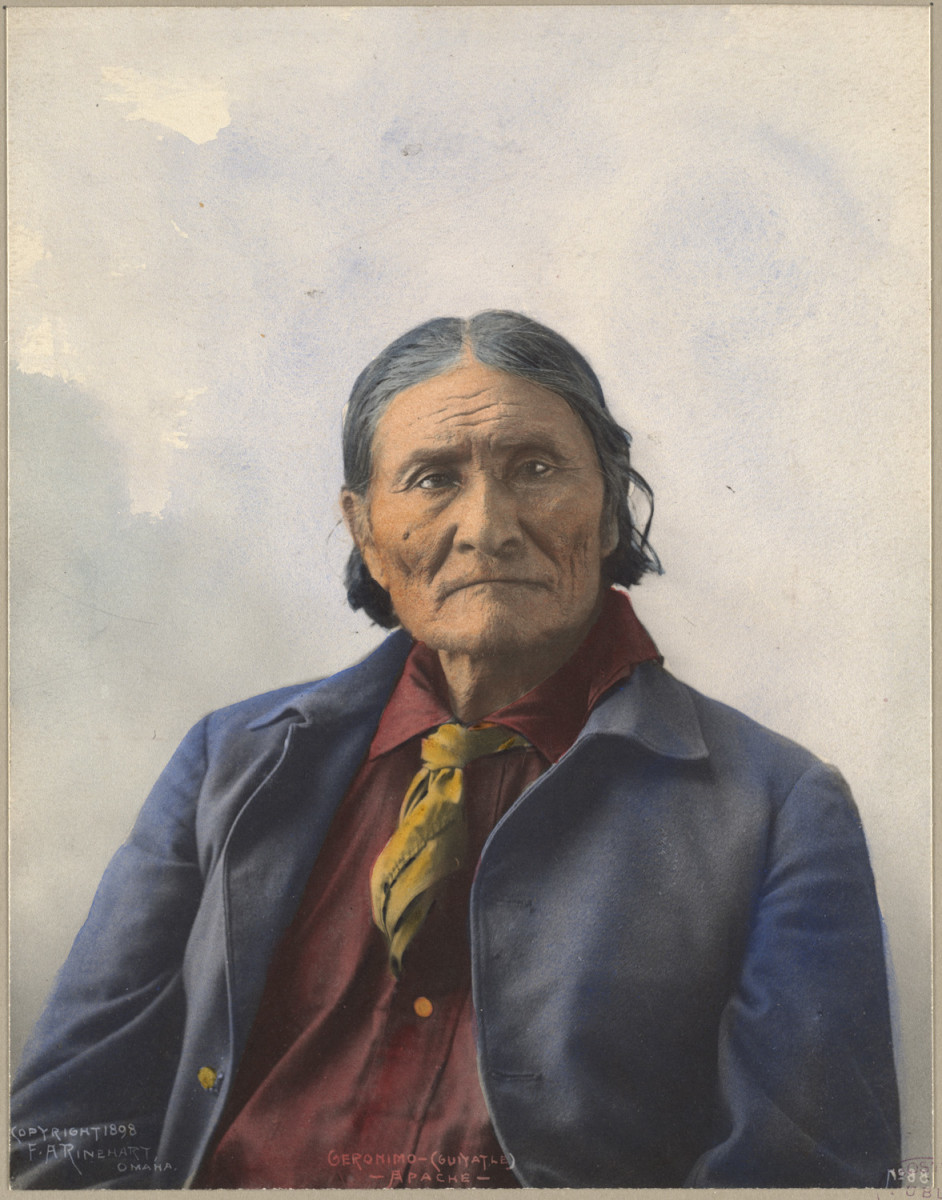 September 2, 1894, Daily Star, Tucson, Arizona – A dispatch sent out from Chicago is that old Geronimo and his band of Apache savages, who have been prisoners at Mount Vernon barracks, Alabama for a long time, are to be removed to Fort Sill, O. T. Secretary Fairmont has ordered their return to the west, and Captain Marion T. Maus, one of the officers on duty at General Miles’ headquarters in Chicago, has gone, it is said, to Alabama to personally direct the transfer. The Indians, to the number of nearly 300, will be taken to Fort Sill, and after a period of surveillance there, will be returned to their old reservation in the mountains of eastern Arizona.
The Indians, after their capture in March, 1886, by regular troops under General George Crook, escaped and were subsequently retaken by General miles, who had relieved Crook. The cut throats, after their capture, were taken as prisoners of war to Florida.
They were confined there for sometime, but owing to the injurious effects of the climate upon the Indians they were removed to Mount Vernon barracks, about twenty-five miles from Mobile. Here the climate was no better, and many of the Indians died from consumption and other pulmonary diseases. They had been used to the dry air of the plains and the humidity and warmth brought on illness. From 500 or 690 the band has been reduced to less than 300, and their removal is now made in the interests of humanity.
General Crook before his death made strenuous efforts to bring about the removal of these Indians to their new home, and he argues that long imprisonment and suffering had broken them in spirit and taken out of them all desire to renew their former savagery Four years ago a movement looking to their transfer was inaugurated, but the moment it became known the people of Arizona and New Mexico sent a delegation of citizens here to protest. The attempt was then abandoned, and it was not renewed until lately.
The matter was called up in congress a few months ago and a provision was inserted in the Indian appropriation bill setting apart a sufficient sum for removal of these Indians to “one of the territories.” No place was specified and the provision was passed, in spit of Delegates Smith of Arizona, Joseph of New Mexico and Flynn of Oklahoma.
It is in accordance with the provision of the recently approved Indian appropriation bill that Captain Maus, order direction of the war department, will now conduct the Indians from the scene of their long imprisonment. They will be taken to Fort Sill, which is near the center of the Kiowa, Comanche and Apache reservation in the southern part of Oklahoma Territory. It is probable that the citizens of Oklahoma will protest, but as Fort Sill is pretty well garrisoned their need be no fear of an Indian outbreak, even with Geronimo’s band quartered there. Some time this fall it is expected that the band will be returned to Arizona.
So far no action whatever has been taken by the people of Arizona with reference to the removal of Geronimo and his band to Fort Sill. It is not likely that any protest will be made, that being the opinion of the oldest citizens interviewed on the subject that little is to be feared from the return of the band after so long an absence in the south. None of theses oldtimers hesitated in saying that they do not apprehend that these Indians would make any attempt to reach their old haunts from Fort Sill. Geronimo is an old man now and the time is not far distant when he will go to join on the happy hunting grounds the braves gone before him. His hair is turning gray, his shoulders are stooped and his step far from being as firm as in the days he and his followers roamed over Arizona striking terror to the hearts of the settlers. Then, again, it is said he has undergone a change of heart, the old renegade of late years having acted as superintendent of a Sunday school at the old historical Alabama fort. But an Apache is an Apache; he’s not a good Indian till he’s dead.
The Springfield Rifle
“I would rather be shot by a Krag-Jorgensen or Mauser bullet than a Springfield rifle projectile,” said Captain Robert R. Stevens, quartermaster for Fort Sam Houston, to a Light reporter who questioned him yesterday as to the effectiveness of the various bullets.
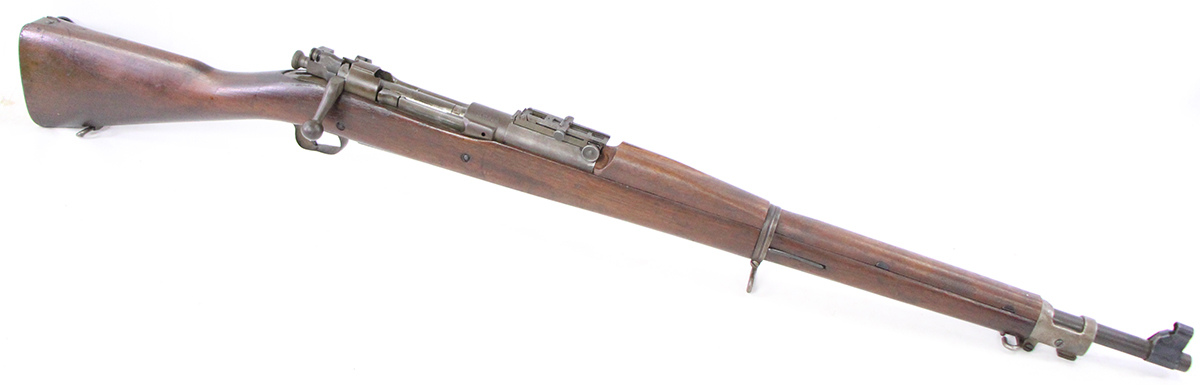
The query was made by the reporter in view of the many criticisms published regarding the arming of Uncle Sam’s volunteers with Springfield rifles Captain Stevens was selected to explain the difference from the fact that the reporter knew he has spent many years in the west in the army when the Springfield rifle was in use and has also had experience in the army with the new gun. Captain Stevens has seen the old Springfield used on the Indians with deadly effect, and although he did not say so, it is a well known fact that the captain has used them on the red skins himself. When speaking of the use to which he had put the guns the captain invariably spoke of shooting deer, or animals of some kind, but his acquaintances know that during his seventeen years of duty as a lieutenant of the Sixth infantry, which is known to have had some hot Indian engagements, that he did not put in all his time shooting deer and wild turkeys.

Nevertheless the captain modestly acknowledged that he knew something about the Springfield rifle and with his usual courtesy, proceeded to compare the guns.
“The Springfield hasn’t the range of the Manser or Krag-Jorgensen, that is true,” said he, “but when a regiment gets close enough to an enemy for the Springfield to reach them they will make it warm for somebody.
“When a Springfield bullet strikes an object it makes a hole and doctors are rarely over puzzled over the outcome. They generally order funeral arrangements for the wounded man.”
“On the contrary the small steel bullet of the Krag-Jorgensen or Mauser rifle only pierces a very small hole and the result is not always fatel. It goes with such force at close range that it goes through a man easily and does not spread out like the lead bullet of the Springfield and makes a hole like a dynamite cartridge.”
“Take for instance wounding of Cadet Howel, of the Rough Riders, as mentioned in your paper of Monday. He was shot through and through with a Mauser bullet and is now able to be on the streets in Washington, scarcely three weeks after being wounded. If it had been a Springfield bullet he would now have been occupying a space in Cuban soil with a pine board marking his resting place. The surgeons would never have been puzzled as to the result of his wound when they examined him, as they were over the Mauser wound.”
“I have had experience with the Krag-Jorgensen and the Springfield rifles out west on hunting expeditions and it was there I noticed the difference. When I hit a deer with a Springfield he dropped, but many a time have I seen a deer run off apparently unhurt when it had been shot through and through by a Krag-Jorgensen bullet.
“I have never had the opportunity to see the result of a man being shot by a Krag-Jorgensen in an engagement, but I have seen Indians who were shot with Springfields. When they were hit once they did not trouble us any more.
“If I had to take my choice of weapons to be shot with I would never choose a Springfield. A man shot with one of those old lead spitters had better prepare his will and give his funeral directions.
“I think also that in actual battle if the Krag-Jorgensen is used as rapidly as it will work that the weapon would soon become too hot to handle and the Springfield which is not operated with such rapidity has the advantage of keeping cool. It is impossible for a man with a rapid firing gun to shoot slow in the excitement of battle and the only way to keep his gun so he can handle it is to give him one that does not shoot so fast. This is a Springfield.
Tombstone, Arizona Territory
 TOMBSTONE, ARIZONA TERRITORY. As the story goes, Ed Schieffelin, while prospecting in southeast Arizona, was told that all he would be able to find would be his tombstone. What Schieffelin found was an area that ended up producing $30 million in silver. On September 3, 1877, he recorded his claim, jokingly naming it the Tombstone Mine.
Chuckwagon: Old West Cornbread
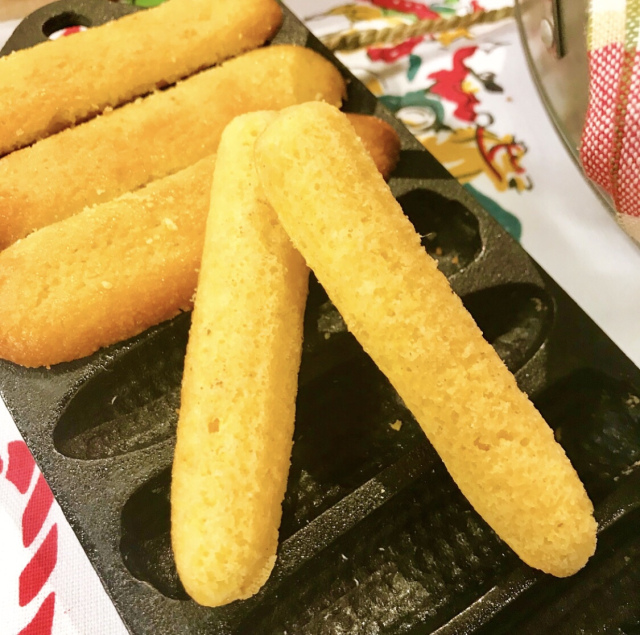
Old West Cornbread Recipe From an 1891 cookbook
Scald one quart of sifted corn meal with boiling water to make a thick batter. Add two tablespoonfuls of lard, half teaspoonful of salt, one tablespoonful of light brown sugar. Beat well.
When it is lukewarm add one cake of compressed yeast, dissolved in one cupful of lukewarm water. Beat together and set it to rise.
When light, pour in greased tins about half an inch thick. Bake in a moderate oven fifty minutes.
*Courtesy of Chronicle of the Old West newspaper, for more click HERE.
Old West Book Review: Dark Territory, A Sheriff Aaron Mackey Western
 Dark Territory, A Sheriff Aaron Mackey Western, Terrence McCauley, Pinnacle Books, $7.99, Paperback. Western fiction.
This second book in the Aaron Mackey series finds Mackey once again keeping law and order in his old Montana home town of Dover Station. This time a group of investors have descended upon the town with an eye on taking over the business interests of this booming community. Mackey determines to defend his town, friends and relatives from those who are devious and have selfish interests in the local mining ranching, and railroads.
Shootouts, bad actors, murder, skullduggery and unresolved love interests all present a myriad of problems to be solved by the sheriff. By now readers have become used to his hair-trigger temper and no-nonsense demeanor, and we can only wonder what will come next in the life of this hero if there is a Book Three.
Editor’s Notes: The reviewer Phyllis Morreale-de la Garza is the author of numerous books about the Old West including the novel, Nine Days at Dragoon Springs, published by Silk Label Books, P.O. Box 399, Unionville, New York 10988 www.silklabelbookscom
*Courtesy of Chronicle of the Old West newspaper, for more click HERE.
Old West Women Dueling
 The year was 1877. The location was Denver, Colorado. In May, the locals were entertained by midget Tom Thumb in P. T. Barnum’s stage show. Three months later, there was a performance of another type that entertained some of the Denverites. It was the first of its kind recorded in the Old West; one where there are women dueling.
History Of The Santa Fe Trail – Pt 2
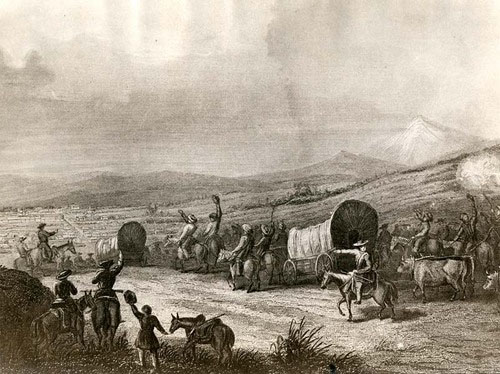 Who is it that has neither seen nor read of Pike’s Peak? If he has not, he has neither traveled nor read the newspapers, and is therefore ignorant of the fact that, that prominent bump (14,147 feet high) upon the earth’s face derived its name from that of Maj Zebulon M. Pike, an explorer, by authority the United States. He was in Santa Fe in 1807. His condition on the route (the future Santa Fe Trail), via the Conejos, across to the Chama, and down that stream past Ojo Caliente and San Juan to Santa Fe, may be inferred from inquiries concerning him and his party; whether those men ragged apparel consisting of overalls, breech cloth leather coats, and without covering for the head, were a tribe living in houses. Pike was promoted to brigadier-general and lost his life in 1813, at the taking of Toronto.
It was a misnomer to call the Santa Fe road a trail. On either side, for miles, a vast expanse of level greensward relieved the solitude that surrounded you – unless, indeed, there was visible a band of Indians, a herd of buffaloes, a prairie dog village, a bunch of antelope, a gray wolf, badger, or long-faced coyotes, with furtive glance, on a swinging trot, putting a deal of real estate between them and supposed danger. A trip over the plains abounded in interest. The rarity of the atmosphere lent enchantment to the scene; the mirage so frequently seen was not the least interesting sight. For hundreds of miles nature denied the wayfarer fuel, but the buffalo in the plentitude of its nature, supplied the omission and no one for the want of fuel was compelled to go supperless to bed.
Thirty-three years ago the incidents of the journey were being related by “a tenderfoot,” who had just arrived in Santa Fe “over land,” from the states. Kit Carson and others were present, and among other astonishing things the newcomer related was, that he had been obliged to cook by a buffalo-chip fire. When doubts were expressed as to the truth of his assertion, “Kit” came to his relief by stating that he had been so frequently reduced to the same necessity that he finally acquired such a taste for the chip that he was induced to throw away the mean and eat the chip.
The writer, the senior of the Belt, inasmuch as he has had some experience, can well credit the statement of the stranger and Carson. The trail is now obliterated, the buffaloes are gone, chips are a thing of the past, railroad cars have superseded the prairie schooner and the carrion crow, on the trail, no longer revels upon the decaying flesh of an overworked ox or mule that fell from exhaustion upon the unfenced expanse west of the Missouri River and east of Santa Fe.
History Of The Santa Fe Trail – Pt 1
 A party of young men, Hugh Stephenson, Lewis Dutton, Lucas Doane, Joshua Sledd, James Kirker, Robert McNight, Henry Corlew and Esteven Chushie, who in 1830, “made the Santa Fe trail and marked the route followed by thousands in after years.” That they marked the route is contradicted by Gregg’s Commerce of the Plains, as also by Niles Register. Fifteen thousand dollars worth of merchandise from St. Louis, Missouri, was delivered in Santa Fe in 1822, and the traffic had increased to $120,000 in 1830, the year in which the Las Cruces Republican claims Hugh Stephenson and others made the trail. All of this marks the history of the Santa Fe Trail.
Freight was carried by pack animals until 1824, when wagons were introduced as an experiment, and making the trip without difficulty, were used exclusively after 1825. In January of that year, through the influence of Col. Thomas H. Benton, of Missouri, a bill was passed by congress authorizing the marking out a road. Thirty thousand dollars was appropriated for that purpose and that of obtaining the Indians’ consent to the road and its unmolested use. The U. S. Commissioners appointed to conduct the survey were Benjamin Reeves, George C. Sibley and Thomas Maher; and Joseph C. Brown as surveyor.
In 1825 a party left Santa Fe in June and in Franklin, Missouri, in August, with 500 mules and horses, and “the Santa Fe trade” continued to grow without intermission until the present time. But not without interruption from the Indians, which caused the committee on military affairs to report to congress, in 1828, in favor of a movable escort rather than a fixed garrison. The recommendation was given effect in 1829, and Major Riley, with four companies of the 6th infantry, from Fort Leavenworth, were detailed as the escort. Protection was not continued the following year; nevertheless, there was an increase in traffic of just 100 per cent over the preceding year.
In 1821 the Santa Fe trade may be said to have become a business proposition. Captain Glenn, Mr. Bicknell and Stephen Cooper were the pioneers of that commercial enterprise, although small parties of trappers and traders had previously visited Santa Fe. In 1815 Auguste P. Choteau and Julius de Mun formed a partnership and went with a large party Upper Arkansas to hunt, trap and trade with the Indians. The following year they visited Taos and Santa Fe, and were well received by Governor Mainez. But there was a change of policy the following year on the part of Mexican government, perhaps for the reason that the “gringos” were becoming too numerous, monopolizing the fur trade, killing the buffaloes for their skins, and making merchandise of buffalo tongues, a luxury in the states, even then in the frontier village of St. Louis they commanded a dollar each.
Old West Book Review: Where the Bullets Fly, A Sheriff Aaron Mackey Western
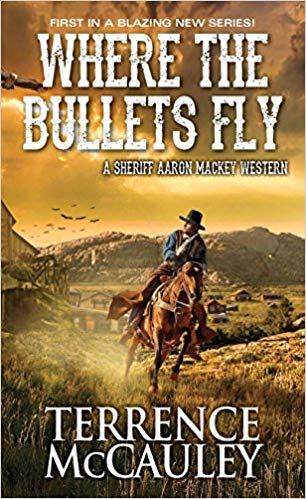 Where the Bullets Fly, A Sheriff Aaron Mackey Western, Terrence McCauley, Pinnacle Books, $7.99, Paperback. Western fiction.
The first book in the Sheriff Aaron Mackey series, this story introduces readers to Aaron Mackey, the sheriff of Dover Station in Montana Territory. Mackey is an ex- cavalry officer, now sheriff. His deputy is a black man who once rode with him in the cavalry. Together, these men try to keep law and order, but when a crazy outlaw named Duramont, leading a band of killers, appears on the scene, Mackey has more than his share of trouble.
Dover Station is surrounded by the Duramont gang, a group of “soiled doves” become Duramont’s hostages along with Mackey’s mistress, who owns the local hotel. The outlaws need guns, horses and supplies while they are on a ride through the west, murdering and robbing along the way. Mackey must rely on a few faithful buddies for help since most of the townspeople understandably want to be left alone without losing their hides. Meanwhile, Mackey’s wife, a beautiful young shrew who hates him, finds out about his mistress and the plot thickens.
Between the killers, the robbers, nighttime ambushes, flying dynamite, burned buildings, runaway stagecoaches and feuding women, the sheriff has more than his hands full. And did I mention he is in the middle of all this while battling pneumonia?
If you like plenty of western action, this is the book for you.
Dark Territory, A Sheriff Aaron Mackey Western, Terrence McCauley, Pinnacle Books, $7.99, Paperback. Western fiction.
This second book in the Aaron Mackey series finds Mackey once again keeping law and order in his old Montana home town of Dover Station. This time a group of investors have descended upon the town with an eye on taking over the business interests of this booming community. Mackey determines to defend his town, friends and relatives from those who are devious and have selfish interests in the local mining ranching, and railroads.
Shootouts, bad actors, murder, skullduggery and unresolved love interests all present a myriad of problems to be solved by the sheriff. By now readers have become used to his hair-trigger temper and no-nonsense demeanor, and we can only wonder what will come next in the life of this hero if there is a Book Three.
Editor’s Notes: The reviewer Phyllis Morreale-de la Garza is the author of numerous books about the Old West including the novel, Nine Days at Dragoon Springs, published by Silk Label Books, P.O. Box 399, Unionville, New York 10988 www.silklabelbooks.com
*Courtesy of Chronicle of the Old West newspaper, for more click HERE.
The Rufus Buck Gang

Wild Bill Hickok Fighting
 On July 21, 1870 Deputy U.S. Marshal Wild Bill Hickok was in a bar in Hayes City, Kansas when two of a group of five Seventh Cavalry troopers suddenly attacked him from behind. It’s not quite clear what provoked the attack, but there is thought it might have had something to do with an encounter Wild Bill had seven months earlier with Tom Custer, brother of George Custer and a member of the Seventh. But one thing is clear, you didn’t want to be on the wrong end of Wild Bill Hickok fighting.
Chuckwagon: Making Tough Beef Tender
Here is an old west recipe for making tough beef tender:
1886 Daily Bee, Sacramento, California
Lay meat out smoothly and wipe it dry. Take a coffee cup full of fine breadcrumbs, a little salt and pepper, a little powdered thyme or other sweet herb, and just enough milk to moisten to a stiff dressing. Mix well and spread over the meat. Roll it up and tie it up with twine. Brown in salt pork fat, then put in half a pint of water. Cover and cook.
The toughest meat is made tender and nutritious when cooked in this way.
*Courtesy of Chronicle of the Old West newspaper, for more click HERE.

Jack Harris
 As a young man, Jack Harris was a scout for the army, and he fought in revolutions in Central American. Returning to America, he hunted buffalo, served as a policeman, and did some serious gambling.
John Wesley Hardin Kills a Town
 There are several great stories about John Wesley Hardin, one of the Old West’s best-known outlaws. One is how he hunted down and killed Juan Bideno. When Hardin told the story, he said he found Bideno in Bluff City. The town was actually Sumner City, and the story is how John Wesley Hardin kills a town .
Texas Ranger Frank Jones
 Born in Austin, Texas in 1856, Frank Jones joined the Texas Rangers at the age of 17. He saw his first action when he and two other Rangers were sent after some Mexican horse thieves. In the process, the horse thieves ambushed the Rangers. Frank’s two companions were immediately taken out, but Frank was able to kill two of the bandits and capture a third.
Wilcox Train Robbery
In 1899, Butch Cassidy and the Wild Bunch were going full tilt. The Wild Bunch may have even divided into two groups, one specializing in banks, and the other in trains. Whether it was by the whole gang or just the train specialists, on June 2, 1899 the Overland Flyer was stopped in the area of Wilcox, Wyoming. Therein lies the story of the Wilcox Train Robbery.
They placed a red lantern on the track just in front of a wooden bridge. Thinking the bridge out, the train ground to a halt. Now, if it were the “train specialists,” they needed more “training” so to speak… because from this point forward things didn’t go well.
They wanted the engineer to pull the train to the other side of the bridge, so they could blow up the bridge. He refused; was pistol-whipped… and still he refused. Finally one of the wild bunch had to do it. After blowing the bridge, they approached the express car. A messenger named Woodcock guarded the car. He refused to open the door.
A well-placed stick of dynamite blew off one side of the car, and rendered Woodcock barely conscious. With Woodcock unable to open the safe, another stick of dynamite was put to the safe. The safe blew apart sending $30,000 flying through the air, and the robbers scrambling after the money.
Now, about the marked money… As the Wild Bunch picked up the money, they noticed it had a red stain on it. At first they though it was blood. But, it turned out to be from a crate of raspberries that was next to the safe. I can only imagine the telegrams sent to banks in the area. “Be on the lookout for money with burnt edges and the taste of raspberries.”

Both Officer and Highwayman Shot to Death
 July 28, 1896, Record-Union, Sacramento, California – The daring and mysterious outlaw who has terrorized this section of the State for the past six weeks, holding up travelers, singly and in groups, in broad daylight and without any attempt at disguise, was run to earth by Sheriff Douglass of this city yesterday afternoon, and in the duel which followed both Sheriff and highwayman were shot to death.
Posse after posse had been dispatched on the trail of the road agent, but he eluded them all and continued his work of impoverishing the traveling public day by day without molestation. Becoming discouraged over the failure of his deputies. Sheriff Douglass determined to hunt the robber single handed. Accompanied only by his dog, the brave officer set out yesterday morning. Nothing was heard from him during the day. This morning his dog returned home, and the Sheriff’s friends became anxious. A search party was organized, and in a short time the officer’s horse and buggy were found by the roadside a few miles from the city. Half a mile distant in the bushes the bodies of the Sheriff and the outlaw were discovered within a few feet of each other, both rigid in death.
The robber had been shot three times, one of the bullets entering his heart. Upon examination it was found that the brave officer had received his death wounds from the rear, evidently at the hands of the robber’s confederate. The outlaw’s camp was discovered, and showed traces of having been occupied by two men.
Fresh posses were immediately organized, and late this evening word was brought to the city that the murderer had been carefully surrounded in the woods and would undoubtedly be taken. Lynching is certain to follow his capture, as Sheriff Douglass was an exceptionally popular officer, and his friends are enraged and determined to avenge the assassination.
The dead outlaw has been identified by several of his victims, but otherwise his personality remains a mystery.
LATER —No further advices have been received to-night from the numerous posses of Deputy Sheriffs and citizens engaged in the search tor Sheriff Douglas’ supposed assassin. The city presents an unusually lively appearance tonight, the streets being thronged with crowds of anxious citizens, eagerly awaiting news from the scene of the tragedy. The dead outlaw has been identified by M. L. Marsh as a man who worked in his sawmill during the month of May last. While in Marsh’s employ he passed as C. Meyers.
Under Sheriff Pascoe, who went out this morning to search for Sheriff Douglass, had not returned at 11 o’clock tonight, and grave fears are entertained that he may have been ambushed and slain. A large posse has been formed to search for him. It is hardly probable that Pascoe would have remained out so long if something had not happened. He is a son of the late W. H. Pascoe, who was killed by Fredericks three years ago while Sheriff of this county.
Dr. Tricknell conducted a post-mortem examination over the bodies of Sheriff Douglass and the outlaw to night. He said the men had been dead fifteen hours.
The rifle used by the robber was stolen from Grant Dart of Rough and Ready, eight miles from here. The dead robber worked for two days at Marsh’s sawmill in this town and also worked for two days at Lord’s livery stable in Grass Valley. He was seen in this city last Friday evening. He drank heavily. No one identified him as the tool-taker.
The murderer of Sheriff Douglass had robbed both his victims and the dead outlaw of all their clothing had been turned inside out, and everything they contained removed.
Clay Allison Dies
 July 26, 1887, The Globe Live Stock Journal, Dodge City, Kansas – Reporting on Clay Allison Dies: Clay Allison, a brave, true-hearted and oft-times dangerously reckless man, when in his cups, has at last died with his boots on, but not by the pistol route. He fell from his wagon in Texas, some days ago, the wheels of the same running over his neck and breaking it. The career of Clay Allison is perhaps unparalleled in the western country and should be written up by some one conversant with it.
All of our old timers knew Clay Allison. He knew no fear, was a good looking man. To incur his enmity was about equivalent to a death sentence. He contended always that he had never killed a man willingly; but that the necessity in every instance had been thrust upon him. He was expert with his revolver, and never failed to come out first best in a deadly encounter. Whether this brave, genteel border man was in truth a villain or a gentleman is a question that many who knew him never settled to their own satisfaction. Certain it is that many of his stern deeds were for the right as he understood the right to be.
By 1883, Allison had sold his ranch and moved to Pope’s Wells (a landmark along the Goodnight–Loving Trail), purchasing a ranch near the Pecos River crossing of the Texas-New Mexico line (50 miles northwest of Pecos, Texas). Clay and his wife, “Dora,” had two daughters: Patti Dora Allison (born on August 9, 1885; Cimarron, New Mexico), and Clay Pearl Allison (born February 10, 1888; Pecos, Texas—seven months after her father’s death).
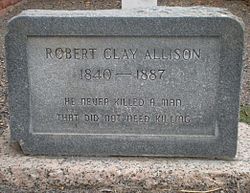
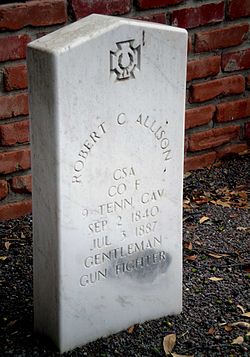
In a special ceremony held on August 28, 1975, Clay Allison’s remains were re-interred at Pecos Park, just west of the Pecos Museum. His grave marker (which has the incorrect birth date of 1840), reads:
| ROBERT C ALLISON CSA CO F 9th TENN CAV SEP 2 1840 JUL 3 1887 GENTLEMAN GUN FIGHTER |
|---|
A second marker was later placed at the foot of the grave (see below); with the added phrase: “He never killed a man that did not need killing”.