SEQUOHAH
The subject of today’s story was considered an ingenious natural mechanic…and his invention changed the life of his people forever.
Sequohah, b orn in 1760 in Tennessee, grew up among his mother’s people, the Cherokee. He became a metal craftsman, making beautiful silver jewelry. As a young man he joined the Cherokee volunteers who joined Andrew Jackson in the War of 1812. While with the American soldiers, he became intrigued with what he called “talking leaves,” or words on paper that somehow recorded human speech. Although Sequohah had no formal education, he somehow comprehended the basic nature of the symbolic representation of sounds.
In 1809 he began working on a Cherokee language. At first he tried picture symbols, but soon found them to be impractical. Then he started looking at English, Greek and Hebrew. He finally developed 86 characters that would express the various sounds in the Cherokee language. It was so simple in its concept that it could be mastered in less than a week.
In 1821 he submitted his new written language to the Cherokee leaders. As a demonstration Sequohah wrote a message to his six-year-old daughter. She read the message and responded in kind. The tribal council immediately adopted the system. And Cherokee of all ages started learning the written language.
The Cherokee were divided into two groups, Sequohah’s in Georgia and Tennessee, and the western Cherokee in Oklahoma. In 1822 Sequohah went to Oklahoma, and taught the alphabet to the Cherokee there.
Finally, on February 21, 1828 the first printing press with Cherokee type arrived in Georgia. Within months, the first Indian language newspaper appeared. It was called the Cherokee Phoenix.
Sequohah later went to Mexico to teach Cherokee there the language. While in Mexico he became ill with dysentery, and died.
Great monuments to the man who developed the Cherokee alphabet stand today along the northern California coast. They are the giant redwood trees called the Sequoia.
FIRST DAYLIGHT BANK ROBBERY
No one noticed a group of men who rode into Liberty, Missouri on February 13, 1866. But, a short while later, when they rode out, everyone noticed them, because they had just done what no one had ever done before.
It was Febr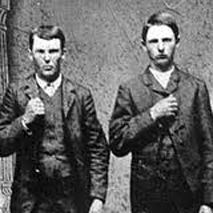 uary of 1866. The Civil War was over. Supposedly, Jessie James was at his mother’s home in Kearney, Missouri recovering from a war wound, and his brother Frank was spending his time with Jessie reading books.
About ten miles away, on February 13, Valentine’s Day, a dozen men rode into Liberty, Missouri. They wore long military coats. It was a cold day, and the streets were deserted. Three men dismounted and took casual positions on the street. The others rode up to the Clay County Savings Association. Two went inside.
A clerk and cashier were inside. One of the men in long coats walked up to the clerk and asked him to change a ten dollar bill. The long coated man then pulled his pistol, and casually asked for all the money in the bank.
These men were doing something that had never been done before…holding up a bank during operating hours. A gain sack was filled with gold and silver coins, paper money and securities totaling $60,000.
After the robbery, the men mounted their horses, and riding at full gallop, whooped, and shot their way out of town. Unfortunately, a 19-year-old college student, George Wymore, was walking down the street. One rider fired at him four times, and Wymore fell dead. A later examination of Wymore discovered that any one of the four shots would have killed him.
In spite of their alibis, this first bank robbery was led by the two James boys from nearby Kearney. Over the next few years they robbed at least twelve other banks, more than a handful of trains, almost a handful of stagecoaches, and even a county fair.
FRONTIER PHARMACY
From:
Current Newspaper, Carlsbad, New Mexico
February 13, 1896
Catnip – The leaves can be made into a tea and fed to babies with colic.
Chicory – Young leaves can be eaten as a spring green and the roots dried and roasted as a coffee substitute.
Dandelion – The leaves and small flower buds are a sought-after spring green. Dried and roasted roots make a coffee substitute. Can also be used as a remedy for dropsy.
Goldenrod – The flowers can be used for dying yarn. The leaves can be made into tea for nausea.
Milkweed – The “fluff” from this plant makes a great stuffing for mattresses and pillows. The leaves can be used to make chair seats; shoots, roots, and young lower buds are all edible.
Red Raspberry – The leaves can be dried and made into a tea for dysentery, to ease childbirth pains and as a wash for sores.
Rose Hips – Tea made from these berries can be used as a treatment for scurvy.
Sassafras – The inner bark of the roots can be boiled in water for a spring tonic and as a beverage with meals.
Willow – The inner bark can be used to make tea for reducing fever.
PEARL GREY
Pearl Grey was born on January 31, 1872. He was a talented baseball player, and played for the University of Pennsylvania while getting a degree in dentistry. Pearl was scheduled to follow in his father’s footsteps as a dentist. Looking for excitement, he played some semi-pro baseball. But that didn’t satisfy his need.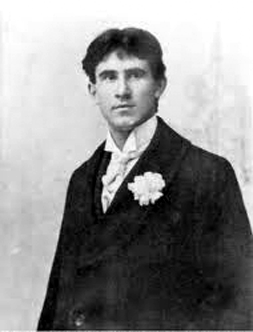
Incidentally, Pearl never liked his first name, which was thought by everyone to be a woman’s name. So he decided to change it to his mother’s maiden name, Zane.
Pearl, or as we know him now, Zane Grey never wanted to be a dentist. He wanted to be a writer. His first novel was a forgettable one about one of his ancestors. But his life was changed when in 1908 he met Colonel C. J. “Buffalo” Jones. Buffalo Jones convinced Zane to write his biography. So Zane could get a feel of the atmosphere of Buffalo Jones’ life, Jones took the 36-year-old writer out west.
While out west, Zane Grey experienced the excitement of the west, like roping mountain lions. Grey was fascinated with the people and landscape. The biography of Jones, “The Last of the Plainsmen” was completed that same year.
Although it got little attention, Zane Grey had found his calling.
About four years later Zane Grey published a novel that gained him lasting fame…Riders of the Purple Sage. This novel was about a weak easterner who became a man because of his exposure to the culture of the West. It was a theme that Zane would repeat in the almost 80 books he published during a life that lasted 64 years.
GOLD DISCOVERED IN CALIFORNIA
On January 24, 184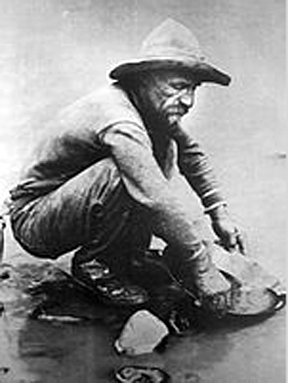 8, John Marshall and John Sutter discovered gold at a sawmill construction site near Sacramento, California.
When James Marshall told Sutter of the gold discovery, his first thought was not of the potential of vast wealth, but of how it would adversely affect an empire he was developing called New Switzerland.
Even though Sutter owned 50,000 acres of land, the mill was on public land. At that time, California was in the process of being transferred from Mexican to U.S. ownership. With no government authority, Sutter and Marshall exchanged clothing and other trinkets with local Indians for a lease of land surrounding the site. Even though they tried to keep the discovery a secret, in no time the whole world knew about it.
As men were panning for gold, Marshall was busy cutting lumber, and Sutter was tending his crops. Within a year, both of their businesses failed. Without a clear title, James Marshal was eventually run off the land where the mill was located.
John Sutter’s 50,000 acres came from two Spanish land grants. One was declared void, and squatters took over the other.
Eventually, both men tried mining for gold. But they failed. John Sutter died penniless in 1880…And James Marshall did the same in 1885.
Although Sutter and Marshall, the discoverers of gold, never saw a profit from the discovery, during the first 25 years following the discovery, over 978 million dollars worth of gold was taken from the area of Sutter’s mill.
OLD WEST ROCK STAR
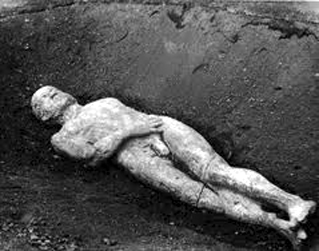 Do you think that rock stars are a creation of modern history? Not necessarily so. Back in 1877, the Old West had a rock star.
It was 1877, and Darwin’s theory of evolution was a hot topic of conversation. To support his theory, in March of that year, a giant petrified man was found in Colorado, along with a petrified turtle and fish. It was announced by its finders that, “We have found the missing link which Darwin claims connects mankind with the beast creation. It is certainly the petrified body of a man with a tail.”
It was named “The Solid Muldoon.” The Solid Muldoon made a tour of the United States ending up in New York. People stood in line to pay money to see this “missing link.” Although Darwin himself, only seeing pictures, felt the whole thing might be an imposture; others said it was definite proof of evolution.
It was February 15, 1878…less than a year after the Solid Muldoon was discovered, that one of the members of the exhibition company, feeling he wasn’t being paid enough, spilled the beans about the missing link.
It seems that back in 1877 two men met to see if they could make some money in connection with the excitement over Darwin’s theory of evolution. One of the men was George W. Hull. Eight years earlier Hull had made money by creating and exhibiting a Cardiff giant he had made with 2,900 pounds of cement. The other was a P. T. Barnum, the great showman and promoter. Hull took some cement and cast the Solid Muldoon along with the turtle and fish. Then they had it hid in the Colorado wilderness, so they could later find it.
With the exposure of the Solid Muldoon as only a piece of rock, this star of the Old West faded. But P. T. Barnum continued showing us just how gullible we really are.
CLOTHES WASHING HINTS
FROM THE DECEMBER 21, 1897 TUCSON, ARIZONA DAILY STAR
In cold weather dry clothes indoors to prevent freezing.
A little kerosene oil put in the hot starch will prevent it from sticking.
Fold napkins square with the initials on the outside. They should also be ironed perfectly dry, and then put away nicely in the drawer.
Have plenty of the best soap, with borax, starch and bluing at hand. Add borax to the water in the proportion of one tablespoonful to a pail of water.
Sort your clothes in five grades. First, towels, table and bed linen; second, family linen; third, light-colored clothes; fourth, dark-colored clothes; fifth, flannels and stockings.
Colored cotton clothing of delicate shades should have the color set before washing. Add of salt a heaping tablespoonful to each pailful of cold water, and do not apply soap directly to the article.
A teaspoonful of borax to a quart of cold starch will make it stiff. Tablecloths should have as few creases in them as possible. Crease them twice lengthwise; have them very damp and iron them perfectly dry; fold over once or twice, according to their lengths, and place them carefully in a long drawer.
EMPEROR OF THE UNITED STATES
 20,000 TURN OUT FOR EMPEROR NORTON FUNERAL
January 10, 1880, Call, San Francisco, California – Emperor Norton I, first citizen of San Francisco, was laid to rest today at the Masonic Cemetery in a service that saw a royal cortege more than two miles long. An estimated 20,000 citizens came to say farewell to this self-appointed supreme leader of the United States of America. He was laid to rest in a black robe with a white starched shirt and black bow tie.
He died shortly after collapsing on California Street near Grant on the evening of January 8th on his way to a debate at the Academy of Science. Businessman William Proll was first to arrive to his aid, and knowing him to be a temperate man, believed the Emperor was distressed. A police officer ordered a carriage to convey him to the hospital. Alas, by the time a hack arrived, Emperor Norton had departed this life.
Joshua Abraham Norton, born London, England on February 14th, 1819, came to this city in 1849 from South Africa. Although he arrived with a $40,000 fortune, a failed attempt to corner this city’s rice market in 1854 separated him from his money. His venture, the result of a rice famine in China, caused the price of rice to skyrocket from four cents to 37 cents a pound. Norton bought the entire cargo of the first ship of rice arriving from Peru for 12 cents a pound, little realizing that more Peruvian rice-laden ships were due to arrive the following day. The glut of rice to this city dropped the price to three cents a pound. Norton, gold-seeker turned rice-seeker, was financially ruined.
Penniless but not without temerity, he arose again and on September 17, 1859, he proclaimed himself Norton I, Emperor of the United States in a declaration concluding:
“In virtue of the authority thereby in me vested, do hereby order and direct the representatives of the different Sates of the Union to assemble in Musical Hall, of this city, on the 1st day of February next, then and there to make such alterations in the existing laws of the Union as may ameliorate the evils under which the country is laboring, and thereby cause confidence to exist, both at home and abroad, in our stability and integrity.”
Many citizens of San Francisco were amused by the Emperor’s Decrees, but many citizens saw him as an honest and noble man, and above all, a diviner with an eye to the future. Under the Emperor’s imperial hand, proclamations were published, most notably: dissolving the Union (July 16, 1860), barring Congress from meeting (October 1, 1860), abolishing both the Democratic and Republican parties (August 12, 1869), that a suspension bridge be built between San Francisco and Oakland Point (September 21, 1872), and that a Bible Convention be held “for the purpose of eliminating all doubtful passages contained in the present printed edition of the Bible, and that measures be adopted toward the obliteration of all religious sects and the establishment of a Universal Religion,” (January 2, 1873). Perhaps most far-reaching was his call upon the leaders of the world to form a League of Nations where disputes could be resolved peacefully. His letters to Abraham Lincoln and Queen Victoria were seriously deliberated.
With the completion of the transcontinental railroad, tourist arrived daily to this city, and Emperor Norton offered them fine sights worthy of their trip. San Franciscans knew Emperor Norton to be a temperate man, and although he had no visible means of income, he issued paper notes in denominations of fifty-cents to ten dollars with which to obligingly pay his bills, signing and dating each to make the transaction official. He had been known to disperse riots against the city’s population of Chinese by reciting the Lord’s Prayer before the aggressors.
This city will miss him walking with his dog, returning the salute of police officers, ordering the cleanliness of our streets, tempering foul language, and in general, making San Francisco a more royal city for his presence.
STUDEBAKERS
If you go to a classic car show, you’ll see a number of Studebaker cars and trucks. But, did you know that the  Studebaker family started making vehicles back in 1852?
Here’s the story. The Studebaker family was known for being great blacksmiths. Looking to take advantage of the westward movement, brothers Henry, Clem and John started the “H & C Studebaker Company” to make their version of a Conestoga wagon. They started with $68 in capital. After a year, they had sold two wagons.
Realizing they needed more capital to be able to buy materials in quantity, brother John agreed to go to California and get some capital in the gold fields. When he got to what is now Placerville, he realized he could generate more money by making wheelbarrows for the gold miners than mining gold.
John did well. In a couple of years, he had saved $8,000. On his way home, John picked up a copy of the great promoter, P. T. Barnum’s book The Art of Money Making. When John got back to Indiana, he was totally excited with the possibilities of making a fortune.
By December 31, 1860 the Studebaker brothers, John and Clem…Henry had decided to leave the business and become a farmer…had 14 employees and a successful business.
During the Civil War, the Studebakers made supply wagons and ambulances for the Union Army. The two brothers were so busy that they grew beards to save time normally used for shaving.
It became an annual ritual to tally the books at the end of each year. Following the Civil War, on December 31, 1867, John tallied the assets. That year they had profits of $223,269.
OLD WEST STORIES
I’ve done a number of short story videos for City 4, our local TV station. The stories are about people or events from the history of  our American West.
Mel, the manager of the TV station has put several of them on YouTube. You can take a look at them by entering “Chronicle of the Old West” in the search line.
Incidentally, the picture isn’t of a wild man, but Al Sieber. Then again, after you hear his story you may think he was a wild man.
WHERE WHITE MAN WENT WRONG
Indian Chief “Two Eagles” was asked by a white U.S. government official, “You have observed the white man for 90 years. You’ve seen his wars and his technological advances. You’ve seen his progress, and the damage he’s do ne.”
ne.”
The chief nodded in agreement.
The official continued, “Considering all these events, in your opinion, where did the white man go wrong?
The chief stared at the government official then replied, “When white man find land, Indians running it, no taxes, no debt, plenty buffalo, plenty beaver, clean water. Women did all the work, Medicine Man free. Indian man spend all day hunting and fishing; all night having sex.”
Then the chief leaned back and smiled, “Only white man dumb enough to think he could improve system like that.”
BEING SCALPED
What follows is a December 20, 1883 article from the San Antonio Light newspaper. It’s the actual words of a soldier who had been scalped:
Quote…“I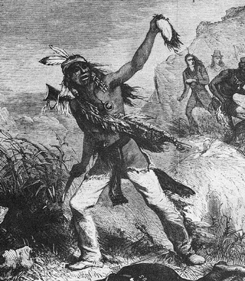 magine someone who hates you grabbing a handful of your hair and giving it a sudden jerk upward, and a not particularly sharp blade of a knife being run quickly in a circle around your scalp in a saw like motion. Also imagine what effect that a strong, quick jerk on your hair to release the scalp would have on your nervous and physical systems, and you will have some idea how it feels to be scalped.
“When that Indian sawed his knife around the top of my head, first a sense of cold numbness pervaded my whole body. A flash of pain that started at my feet and ran like an electric shock to my brain quickly followed this. When the Indian tore my scalp from my head it seemed as if it must have been connected with cords to every part of my body.”…Unquote
Following the attack, a friend of the scalped man killed the Indian who had done the scalping, but, according to the soldier, his scalp wasn’t returned.
After recovery he chose to muster out of the service…but his commanding officer called him into his office, and suggested that the soldier was making a mistake by leaving the army. “Thank,” said his commanding officer, “how surprised and disgusted some red devil of an Indian might be if you should stay with us and happen to fall into his hands. When he went to raise your hair he would find that someone had been there before him.”
Incidentally, his commanding officer was General George Armstrong Custer whose command was wiped out shortly afterward at Little Big Horn.
CHARLES GOODNIGHT
Charles Goodnight was an early Texas cattleman who controlled up to 100,000 cattle on a million acres of land. But, one thing most people don’t know about Charles Goodnight is that he, more than anyone else, was responsible for cowboys “eaten’ good” while on the trail.
At the age of 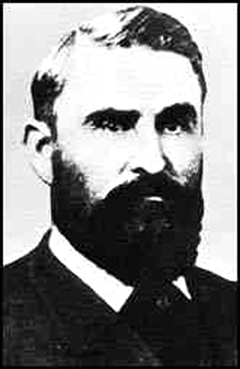 20, he agreed to take care of a neighbor’s cattle…if he was allowed to keep every fourth calf. In four years, he had 180 head of cattle, and later he bought the neighbor’s whole herd.
It has been said of Goodnight that he “stole when he wanted to and lynched when he had to.” By the end of the Civil War, he had a herd of 8,000 cattle.
To keep his burgeoning empire…he did the lynching. One time his wife, expressing her shock over a vigilante hanging said, “I understand they hanged them from a telegraph pole!” Charles Goodnight responded, “Well, I don’t think it hurt the telegraph pole.”
Goodnight was an innovator who, throughout the years, raised Durham, Hereford and Anus stock. He even did some early experiments with what was then called “cattalo”…a crossbreed of buffalo and beef cow. Unfortunately, the calves were sterile and the mother often died in birth. However, Goodnight’s southern plains buffalo were later bred with northern ones to create the hardy strain of buffalo that now occupy Yellowstone and other areas.
In 1890, at the age of 54, he sold his ranching interests, spending the rest of his life as a “snowbird” with summers in Texas, and winters in Tucson, Arizona. Charles Goodnight passed away on December 13, 1929.
Oh yes, I mentioned that Charles Goodnight was responsible for cowboys “eaten’ good” on the trail. It was Charles Goodnight, who in 1866 took a surplus Army wagon, and revamped it into the first chuckwagon.
WOMAN’S SUFFRAGE
Although women had been instrumental the development of our country, as 1869 was coming to a close, they didn’t have the right to hold a political office, or even vote.
But that was changed on December 10, 1869 as the first state gave women the right to vote and hold political office. One would expect that it would be an eastern state…Quite possibly in the New England area. But that wasn’t so. It was probably one of the most frontier areas of that time…Wyoming. So, why Wyoming? Why were the men in the Wyoming Territory so progressive when it came to women’s rights?
One major backer, a middle-aged territorial legislator by the name of William Bright backed the bill because his wife convinced his that “denying women the vote was a gross injustice.” Incidentally, the progressive wife happened to be about half his age. Then there was Edward Lee, the territorial secretary, who argued that if a black man can vote, why couldn’t his dear sweet mother. But most people supported the bill for another reason.
At the time the Wyoming territory had a population of about 7,000 adults. Of those 7,000 adults, only about 1,000 were women. And most of those extra 6,000 men were lonely for the companionship of a woman. So, it was thought that if Wyoming gave women the right to vote, the territory would get national publicity, and in turn women…particularly single women would come to this rugged, isolated area.
When Governor John Campbell signed the bill one lawmaker gave the toast, “To the lovely ladies, once our superiors, now our equals.”
Did it work? Well, if you visit Wyoming today you’ll meet some of the handsomest, most strong-minded women, and happiest men in the United States.
1800’S BREAKFAST DON’TS
The December 9, 1897 Daily Star Newspaper in Tucson, Arizona Territory had the following recommendations for breakfast don’ts. They happen to be good advice for us even today.
BREAKFAST DON’TS
Don’t serve a breakfast on any but a fresh tablecloth.
Don’t expect fresh coffee if you are half an hour late.
Don’t comment on the bills you receive in the morning’s mail.
Don’t ask the man of the house what he would like for dinner.
Don’t ask your husband how much money he intends to leave you for the day’s expenses. After dinner is a better time to settle the financial question.
Don’t become so engrossed in the newspaper that you can’t address a remark to anyone.
Incidentally, this was one of the items in the December 2013 Woman’s Sphere from Chronicle of the Old West.
HARVEY WHITEHILL
Sometimes Old West lawmen chased an outlaw only until he was out of sight. He was lucky. Then there were the unlucky outlaws that were chased by Harvey Whitehill.
As a yo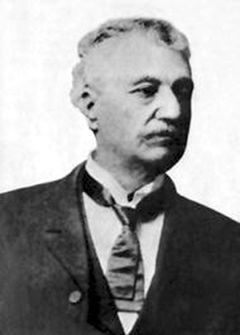 ung man, Harvey Whitehill mined in several areas in Colorado, and following the Civil War did some mining in New Mexico. As one of the founders of Silver City, New Mexico, he ended up as their sheriff. Whitehill came into the spotlight as the first person the arrest a young William Bonney for a petty theft. Bonney was to later became famous as Billy the Kid.
But, Sheriff Whitehill’s true nature came out following a November 24, 1883 train robbery. Four men held up a Southern Pacific train near Deming, New Mexico. In the process, the train’s engineer was killed.
Wells Fargo and Southern Pacific placed a reward of $2,000 on the head of each of the robbers. This whetted the appetite of semi-retired Sheriff Whitehill. Whitehill searched the scene of the crime and found a discarded out of the area newspaper. He traced it back to the subscriber, who was a storekeeper. The storekeeper remembered using it to wrap some food bought by a local Black cowboy named George Washington Cleveland.
Whitehill found Cleveland at a restaurant where he was working. Immediately Whitehill arrested him. Although Whitehill had no idea who else was involved in the train robbery, he said, “I arrested you for killing that train engineer. I already have your partners and they talked.” After that, Cleveland spilled his guts. The other three outlaws were arrested.
But, the four didn’t get a chance to go to trial…because they escaped from jail. When the posse caught up with them Cleveland was killed, and two others were captured, only to mysteriously die at the end of a rope on their way back to jail. Although the fourth person temporarily escaped, he was eventually captured.
BILLY CLAIBORN
Sometimes in life a person needs to let well enough alone, and not push an issue. Billy Claiborne should have learned that lesson.  Unfortunately, on November 14, 1882 he didn’t let well enough alone, and paid the ultimate price.
Billy Claiborne was born in Louisiana in 1862. He came out west where he worked for cattleman “Texas” John Slaughter.
Billy was a cocky young man who would swagger when he walked. And he carried two guns. His friends started calling him “Billy the Kid” after the real “Billy the Kid”. Billy Claiborne liked the name, and so did the girls. He even started referring to himself as “Billy the Kid” Claiborn.
Now, as time passed, Billy wandered down to Tombstone, Arizona and there he hooked up with the McLaurys and Clantons.
On October 26, 1881 “Billy the Kid” Claiborne found himself with the McLaurys and Clantons in a Tombstone, Arizona alley facing the Earps and Doc Holliday. Realizing the desperate situation, Claiborn bugged out just before the shooting started.
Now, this is where Billy Claiborne should have left well enough alone, and high-tailed it out of town for a place where tempers were not raging. But, Billy wasn’t that smart.
After the shootout at the O. K. Corral, and the death of Virgil Earp at the hands of the cowboys, Wyatt Earp declared vengeance against all cowboys. One member of Wyatt’s posse was Buckskin Frank Leslie. During the cowboy roundup, one of the more prominent cowboys, Johnnie Ringo was killed, and Billy Claiborne thought the gunman was Buckskin Frank.
So on November 14, 1882 Billy Claiborne came after Buckskin Frank. Billy shot twice, and missed. Buckskin Frank shot once, and hit his mark.
As Buckskin Frank walked up to Billy, Billy said, “Don’t shoot again, I am killed.” An observer was heard to say, “Sure weren’t no Billy the Kid. He missed at thirty feet.”
RENDEZVOUS
The idea of the rendezvous was not that of a mountain man, but William Ashley, a St. Louis, Missouri merchant on a venture west. Ashley decided to cut out the competition for furs by going to Wyoming where the mo untain men were, instead of waiting for the furs to come to St. Louis.
So on November 10, 1824 William Ashley left St. Louis for Wyoming. It was a six-month trip.
Since mountain men had little use for money, William took traps, weapons, trade goods, supplies and especially liquor. And he marked up the cost of goods as much as twenty times their eastern price, and he paid less than half the St. Louis price for the plews, as the mountain men called the beaver pelts.
But the mountain men didn’t care, this was a chance for these normally solitary men to relax, drink, gamble, drink, womanize and drink. It was an opportunity to rekindle relationships with other mountain men that they hadn’t seen for a year or more. And discover those who had gone to the rendezvous in the sky.
Several thousand Indians also showed up for the party. Even though some of the Indians and mountain men were mortal enemies, the rendezvous was a place of truce.
There were about 15 rendezvous over a period of that many years. By then trading posts, forts and civilization found their way in the remote sections of the west and beaver pelts lost their value. Some mountain men returned to civilization; others came out of the mountains to kill buffalo on the plains; still others went further back into the mountains, never to be heard from again.
DOC HOLLIDAY
The Old West’s most famous doctor didn’t become famous for saving lives, but taking them. His name was Doc Holliday. And on November 8, 1887 he died not achieving the one thing that he tried to accomplish most of his adult life.
Doc Holliday grew u p in Georgia where he went to dental school and started a practice. But soon after he developed tuberculosis and started heading west for a dryer climate.
For Doc Holliday dentistry was more like an avocation with gambling his profession. Doc Holliday gravitated to where the action was: Dallas, Texas, Cheyenne, Wyoming, Dodge City, Kansas and Tombstone, Arizona.
And during his travels, Doc Holliday and Wyatt Earp became friends. Although they both displayed uncanny nerve at times of crisis, in most ways they were different. Wyatt Earp tended to be calm and laid back. He preferred to fight a person with his fists or pistol-whip them…resorting to shooting only if he found no other way to defeat his opponent.
On the other hand, Doc Holliday was a hothead. At 5’ 10” Doc was a frail looking man weighing less than 150 pounds. He wanted to stay away from any physical confrontation.
Of all the shootings Doc Holliday was involved in, the O. K. Corral shootout was the most famous. It’s generally accepted that at the O. K. Corral, Wyatt’s objective was to pistol whip the cowboys…whereas Doc Holliday wanted to kill them, and he probably fired the first shot.
In the late 1800’s tuberculosis wasn’t curable, and most people with it became bedridden with a slow death…Doc Holliday’s adult life was spent with the secret hope that he would be shot and killed before he became an invalid.
This was his greatest failure. Because on November 8, 1887 Doc Holliday died in bed at a Glenwood Springs sanatorium. His last words reflected his since of humor and a realization of his failure. With Doc’s last breath he supposedly said, “This is funny.”
TETON JACKSON
Many people spend their lives doing something they hate. On the other hand, when a person finds something he loves, and d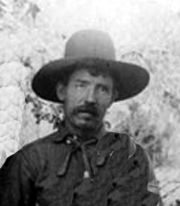 oes it well, even if it is stealing horses, he’s lucky.
Harvey Gleason was over six feet tall. He had a shabby beard, ruddy face with flaming red hair and black eyes. By his mid 40s, he had supposedly killed several soldiers and deputy marshals.
But, people didn’t know him as Harvey Gleason, everyone knew his as Teton Jackson. He got his name from his favorite area in Wyoming, the Teton Mountains and Jackson Hole. For a living Teton Jackson stole horses. Not one or two at a time, but hundreds. For about eight years, Teton and his men stole horsed during the summer and hid out among the Teton Mountains during the winter.
While in Eagle Rock, Idaho, Teton killed a man. When the sheriff came to investigate the shooting, he found the victim frozen stiff on the ground. Needing evidence of the killing, and unable to transport the whole body, the sheriff brought in just the head. An investigation found the killing to be justified.
Finally, tired of loosing horses, livestock associations in Idaho and Wyoming started putting up rewards for Teton and his men. And, money talked. A local sheriff found Teton, and brought him in. He was tried and on November 5, 1885, sentenced to 14 years in prison. Everyone breathed a sigh of relief. But, relief was short lived. For nine months later, Teton escaped from jail. Even though Teton was free for two years before he was recaptured, few horses were stolen because his gang’s numbers were drastically reduced by posse bullets and jail.
After four more years in jail, Teton received a pardon for good behavior. And he continued that good behavior for the next 35 years, marring a Shoshone woman, and doing some guiding, always riding a horse with his brand on it.
WESTERN TV
If you’re a fan of TV westerns, below is a link to a TV western reunion that took place in 1978.
It’s a video gathering of all the western TV and movie greats who were alive at that time hoste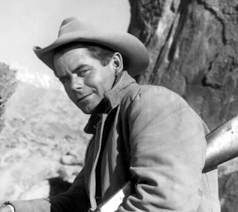 d by Glenn Ford. They gathered in a saloon, and discussed the era when there were more westerns on TV than any other classification.
Be prepared to spend 50 minutes of nostalgia.
http://www.youtube.com/watch?v=7NtMAwx7jF8
 Back in 1835 there was an area of North America that, like the United States some fifty plus years earlier wanted to become independent of their mother country. On October 17, the people of that rebelling area approved the forming of a group of armed and mounted men whose duty was to range the borders and protect them. Some 175 years later that organization is still in existence and going as strong as ever.
That area of North America seeking independence? It was Texas. That group of armed and mounted men? The Texas Rangers.
In 1835 Texas comprised of isolated pockets of frontier settlers. And Texas leaders needed someone to “range” the frontier and protect the borders from Santa Ana’s soldiers as well as hostile Indians within the territory. And that’s exactly what the Texas Rangers did.
Then, a year later when Texas got its independence, it was decided to upgrade this semi-official force into the primary law enforcement authority.
Although they were created by the Texas government, they were an irregular group of civilians who provided their own horses and guns.
They were given considerable independence, carrying out the duties that would normally be done by the army…such as fighting Indians, and law enforcement agencies…tracking down cattle thieves, train and stage robbers and murderers.
As Texas entered into the 20th century the Texas Rangers were still very much an independent agency. But, they were receiving more and more criticism about their using excessive violence and ignoring the finer points of the law. So, in the 1930’s, the state got control of the Rangers, making them a modern and professional law organization.
FIRST EXPRESS SERVICE
If you wanted to send a valuable package in the early 1800’s, your only option was to find an honest looking person going there, and then ask them to carry your package. But all that changed on October 10, 1839.
Sending any type of valuable package in the early 1800’s was a very risky process. First you would try t o persuade a stagecoach driver or steamboat captain to take it for you. If they didn’t want the responsibility, you would then look for a passenger with an honest looking face to take it. And sometimes that “honest person” and your package would disappear.
But on October 10, 1839, a former railroad conductor by the name of William Harnden came up with what could be called the first express company. He started out modestly with deliveries between Boston and New York. Most of the items carried were business documents, bank drafts, currency and newspapers.
The fee was a few cents to a few dollars, depending not on the size of the document, but its value. At first William Harnden made the deliveries himself, carrying the items in a carpetbag.
By 1841, just two years later, he had offices in Philadelphia, Albany, London and Paris. An employee by the name of Henry Wells suggested that instead of expanding to the east, he should expand to the west.
Harnden looked to the west and saw nothing but wilderness and Indians and routes that were hardly traveled, as opposed to messengers traveling by steamship or stagecoach over populated areas. So William Harnden told Henry Wells to “do it on your own account.”
William Harnden died at the age of 33, the result of tuberculosis and overwork. And he was not able to see what happened when Henry Wells took his advice, and along with a partner named William G. Fargo started a company with a name that’s familiar even today, called Wells-Fargo.
OLIVER LOVING
On September 25, 1867, Oliver Loving, one of the great pioneer Texas cattlemen, died at the age of 55. Incidentally, the story of his de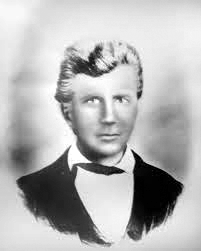 ath may have a familiar ring.
Oliver Loving was born in Kentucky, and moved to Texas at the age of 33 where he engaged in farming and freighting. And finally, at the age of 44, when most men are choosing a quiet life, Loving got involved with cattle, and driving them to places where they had never been.
In 1858 he took Texas longhorns to Chicago along what was to be later known as the Shawnee Trail. About a year later he took cattle up to Denver to supply the needs of the gold miners.
Following the Civil War, Oliver Loving teamed up with Charles Goodnight and in 1866 they established the Goodnight-Loving Trail that went from Texas to Fort Sumner, New Mexico.
The second year they took the trail they encountered a number of Indians, causing delays in the drive. To assure the buyers that the cattle were on the way, Loving and Billy Wilson went in advance of the cattle to Fort Sumner. Along the way they encountered some Indians. And in a skirmish Loving was shot in the wrist and side.
Thinking he was going to die, Loving persuaded Wilson to leave him. But Loving didn’t die. For seven days he crawled, without food, until he encountered some men who took him to Fort Sumner. Gangrene had set in his arm, but an inexperienced doctor chose not to amputate.
When partner Charles Goodnight arrived in Fort Sumner, he was excited to discover Loving had survived. But the news was not good. The gangrene had gotten so bad that even after amputation, Loving died three weeks later.
If the story of Loving’s death sounds a bit familiar, it’s probable because you’ve watched the movie Lonesome Dove, and remember the character, Gus McCall, said to have been patterned after Loving.