Abel Head Pierce
 “There aren’t any cowboys in Rhode Island,” said a friend recently. I had to correct him, for as we will see this week there was a great cowboy who came from Rhode Island.
Abel Head Pierce was born in Rhode Island on June 29, 1834. At the age of twenty he stowed away on a schooner and ended up in southern Texas. Abel took a job for a cattleman named Grimes. Starting out doing odd jobs, Abel worked his way up to trail boss, taking cattle to New Orleans.
Abel Head Pierce was a 6 foot, 5 inch bearded giant of a man who had a habit of wearing spurs with extra large rowels, and strutting around town. Someone remarked that Abel looked like a Shanghai rooster, and he became Shanghai Pierce. Now, that’s a name any cowboy would be proud of.
After serving in the Civil War, Shanghai returned to Texas and started accumulating cattle. Shanghai took a couple of years out in Kansas… supposedly to let things cool down in Texas after lynching a couple of rustlers.
He ended up with a 250,000 acre ranch appropriately called the Rancho Grande. Obviously, Shanghai was a major factor in the Texas cattle industry.
Looking for cattle that would be resistant to ticks that was causing problems with Texas cattle going north, and a breed that would produce more meat, Shanghai went to Europe and ended up bringing home some Brahma cattle, which he crossed with the Texas Longhorns.
By the end of the 19th century Shanghai Pierce’s Rancho Grande approached a million acres. When Shanghai felt his life was close to coming to an end he hired a San Antonio sculptor to make a larger than life statue of himself to be placed over his grave. Asked why, Shanghai responded, “I knew that if I didn’t do it, no one else would.”
Santa Anna
 I’m aware of no one who had higher highs and lower lows than the subject of this week’s story did. Even though he wasn’t a citizen of the United States, his fate was important to our country.
He was born Antonio Lopez de Santa Anna, the son of middle-class parents in Vera Cruz, Mexico. Joining the military, he distinguished himself during Mexico’s fight for independence from Spain. In 1833, he won election to the presidency of Mexico. Within two years, he declared himself Mexico’s dictator.
This brought him into conflict with the Anglos who had settled in a northern part of Mexico, known as Texas. Determined to crush the rebellion, Santa Anna took personal command of the army that went to Texas. After the defeat of the Alamo, and the execution of 400 prisoners at Goliad, Santa Anna became overconfident, and in April of 1836, at San Jacinto, Santa Anna was captured. In exchange for his release, Santa Anna signed an order resulting in Texas becoming an independent republic.
White Santa Anna was in Texas, he was deposed in Mexico. Although he returned to Mexico powerless, Santa Anna took advantage of an unstable situation, becoming, once again, the dictator of Mexico…But an unstable situation is both good and bad. For, once again Santa Anna was overthrown. As a matter of fact, Santa Anna became the dictator of Mexico, and was overthrown eleven times.
Finally, overthrown in 1855, Santa Anna spent his last twenty years scheming with elements of Mexico, United States and France to get back on top. But it never happened. And, on June 22, 1876, this man who played a part in Mexico’s gaining its independence, and loosing a large part of its territory, died in absolute poverty.
GAMBLERS
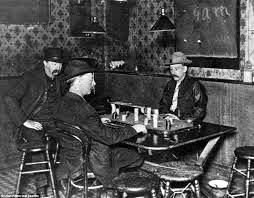 Men who came out west gambled everything on the hopes of becoming prosperous and having a good life. That same spirit led them into gambling halls, and games of chance. One such game started on June 15, 1853 and ended 24 years later.
For people of the Old West gambling was a way of life. They risked their life by going into Indian Territory for furs, precious metal or land. They staked everything they owned on a herd of cattle being driven north. And for sure they enjoyed a game of chance.
There was faro, euchre, monte, casino, and, of course, poker…which, incidentally, was always dealt to the left of the player to make it easier to pull a gun with the right hand in case of irregularities. The origin of most games of chance came from Europe, with the exception of the old three walnuts and a pea, which started in America, probably on the streets of New York, where it still prospers.
Not only did cowboys loose their wages, but whole herds of cattle, and a cattleman’s entire wealth would change hands over night. A few wives were even offered to “match the pot.”
On June 15, 1853, in Austin, Texas Major Danelson and Mr. Morgan sat down to play poker, and evidentially with little to go home to, forgot to quit. The game went on for a week… then a month… a year became years. The Civil War broke out, was fought and lost, but these two Texas gentlemen still dealt the cards. Finally in 1872, 19 years after it started, both men died on the same day…but the game continued. Their two sons took over, and played for 5 more years.
Finally the game ended in 1877 when a railroad train killed one of the sons, and the other went crazy. Not that all of them weren’t crazy in the first place.
BILLY THE KID CONVICTED
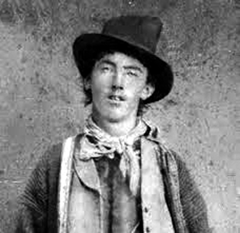 Early in 1880, Sheriff Pat Garrett deposited Billy the Kid in jail, and left town thinking this would be the last he would ever see of “the Kid”. But it wasn’t so. Here is the story of what happened.
Pat Garrett was elected sheriff on the promise that he would bring in Billy the Kid. And within a couple of months after being elected, he made good on his promise. Feeling that chapter closed, Pat Garrett left to find other outlaws.
Billy the Kid was transferred to the town of Messilla, New Mexico for trial. Having a number of possible charges to place against him, they settled on the killing Lincoln County Sheriff William Brady three years earlier.
Billy the Kid was convicted of murdering Sheriff Brady. In pronouncing the sentence, Judge Bristol said, “You are sentenced to be hanged by the neck until you are dead, dead, dead.” Billy the Kid comely responded, “And you can go to…” three times. The hanging was set for May.
Billy the Kid was sent back to Lincoln, New Mexico. Lincoln didn’t have a formal jail so he was shackled, locked in a room on the second floor of the courthouse and placed under a twenty-four hour guard.
On April 28, 1881 Billy received a note with one word on it…“Privy”. Understanding the meaning, Billy said he had to go to the outhouse. Hidden in the outhouse was a pistol. As Billy the Kid was returning to his room, he pulled the pistol and shot his escort. Next he broke into the armory, and got a shotgun. From a second floor window he yelled down to Robert Olinger, a guard that had been ragging on him. When Robert looked up, he was sent to eternity by a blast from his own shotgun.
An hour later, with shackles still hanging from one leg, Billy the Kid rode out of town, once again escaping death.
STAGE HOLD-UP

On March 15, 1881 the Benson-Tombstone stage was held up. Although not intended as such, it ended up being one of the causes for the O. K. Corral shootout. On the other hand, the two objectives of the hold-up were not accomplished.
The main objective was the assassination of Wells Fargo shotgun guard, Bob Paul. As a Wells Fargo guard, Bob Paul had hampered the activities of the cowboys. And, the word around town was that he was to become the Pima County Sheriff. So the cowboys wanted to get rid of him. The assassination failed because when the stage departed Tombstone, stage driver Budd Philpot had gotten stomach pains and Budd exchanged positions with Paul. Orders were to kill the guard…which they did, but it was Philpot instead of Paul.
Paul was also responsible for the robbers not accomplishing their second objective…the theft of $26,000 in silver. When Philpot was shot, Bob grabbed his shotgun and fired off both barrels. One robber was killed and the noise of the shotgun spooked the horses. As the stagecoach was careening out of control, Paul climbed down; secured the reigns of the runaway steeds; and brought the stage safely into Benson.
Later, when he did became the Pima County Sheriff this 6’ 6”, 240-pound mountain of a man, typically using a shotgun, brought in bad guys, stopped lynchings, and hanged many a man legally. It always seemed that he was able to dodge that fatal bullet…That is until 1893 when he couldn’t dodge the one called cancer, and he died on March 26, 1901.
FORTUNE LOST
During the Old West fortunes came and went. Probably there is no better illustration of the gains and losses than the story of Horace Tabor and his wife “Baby” Doe.
 On March 1, 1883 Elizabeth Doe, later known to the Colorado miners as “Baby” Doe, and Horace Tabor got married. Baby Doe wore a $7,000 gown. Her wedding gift from her husband was a $75,000 diamond necklace.
Five years earlier Horace Tabor was the owner of a general store. He grubstaked a couple of prospectors to about $20 worth of merchandise in exchange for a third share of what they found…What they found was a mine called “Little Pittsburgh” that produced $20,000 worth of silver per week. Horace Tabor decided his fortune was in silver mining. Right after this Tabor bought a mine from a scam artist who had “salted” it with silver. To the chagrin of the scam artist the new mine ended up out producing his first.
Following the wedding Horace and Baby Doe moved into a mansion and had two children. Over the next few years they lived an extravagant lifestyle. But by the late 1890’s, because of federal legislation, the market for silver took a dive. Horace and Baby Doe ended up living in a hotel room.
In April of 1899 Horace Tabor died. His last words to his wife were “Don’t give up the Matchless, for it will make millions again.”
Baby Doe moved to the Matchless Mine located at an elevation of over 10,000 feet, and for 35 years she lived in a shack. She wrapped herself in burlap to keep warm. Early in 1935, during a severe snowstorm, she froze to death.
What she didn’t know was that even if silver was discovered on the Matchless, it would have done her no good. Her husband had lost the Matchless with his other assets before he died.
UNDERDOGS

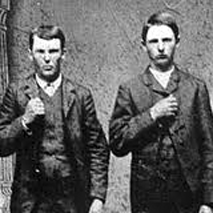 When it comes to public opinion, quite often being the underdog and particularly a persecuted underdog gets everyone’s sympathy.
In 1874, Jesse and Frank James were robbing banks and trains to the point that the railroads decided to hire the famous detective group the Pinkertons to hunt them down. But, the Pinkertons, in spite of their numbers and skill, weren’t having any luck rounding up the James boys. Then late in 1874 one of their agents, John Wicher was found dead close to the James home. The Pinkertons were convinced that the James’ or one of their people had killed him, and they decided to raise the ante.
Receiving information that Jesse and Frank were visiting their mother in Kearney, Missouri, on January 26, 1875, the Pinkertons surrounded the James home with the idea of catching Jesse and Frank. In the process, they threw an incendiary device into the house to illuminate the interior. But it exploded. Unfortunately, it blew off the arm of Jesse and Frank’s mother and killed their little brother. In addition to this, neither Jesse nor Frank was there.
Although the Pinkerstons never acknowledged that they were responsible for the bombing, everyone knew they did it. Realizing they had overplayed their hand, from this point forward the Pinkertons developed a low profile in their search for the James Brothers.
The bombing convinced everyone that the James Brothers were innocent victims of the powerful railroads. The Missouri legislature even came close to passing a bill that would give amnesty to the Jameses. And Zerelda Samuel, their mother, was always willing to make public appearances, showing her missing arm, and giving a melodramatic speech about how the evil railroads were persecuting her innocent sons.
It worked too. Because farmers throughout the region hid and protected the James Brothers, so the Pinkertons were never able to come close to catching them.
LIKE LIVER?
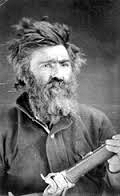
On January 21, 1900 one of the Old West’s most intriguing and gruesome men died in a veterans’ hospital in California. This was a strange ending for this man who was depicted in a movie Starring Robert Redford called “Jeremiah Johnson”.
John Johnson was a red bearded giant of a man who headed to the mountains when most mountain men were leaving them.
Early on Johnson came across a covered wagon that had been attached by Indians. The only survivor was the mother, and she had been driven mad from the experience. Over the years John Johnson provided her with food. The Indians left her alone because they were in awe of those who had been driven mad from the touch of the Great Spirit.
Johnson took a Flathead woman as his wife. One day when he was away trapping, a Crow raiding party killed his wife, and the baby she was carrying.
This started the legend for which “Liver-Eating” Johnson is known. For 20 years Johnson took revenge against the Crow in a savage and bloody way. He supposedly killed as many as 300 Crow Indians, with a few Sioux thrown in for extra measure. And legend says he ate the livers of the Indians he killed.
Later “Liver-Eating” Johnson came out of the mountains, and joined the Union Army during the Civil War. After the war, he was a deputy sheriff in Wyoming.
As he got older, Johnson wisely made peace with the Crow Indians. And on January 21, 1900, he died in a veterans’ hospital in California.
Why did John Johnson eat the livers of the Indians? Was he a cannibal? Technically, yes. But Indians often ate the raw liver of animals they killed. They believed it would transfer the power of the animal to the hunter. Maybe he wanted the Indians to think that anyone who would do something this gruesome was touched by the Great Spirit.
SAMUEL COLT
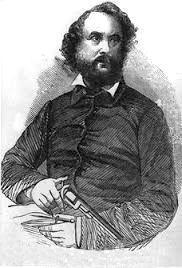
Samuel Colt’s single action revolver, known as the “peacemaker” is a staple to any story about the Old West. But chances are we wouldn’t have ever heard of Colt had it not been for an event that took place on January 4, 1847.
As the story goes in 1830, on a sea voyage to Singapore, Samuel Colt whittled out a wooden model of his revolving handgun. A year later he made two working models, and applied for a patent.
At the time of Colt’s invention, pistols were though of as dueling weapons. The much more accurate rifle was preferred for long distant shooting. For close up self-defense fighting most men preferred knives.
But Colt was sure his pistol would be in great demand. And by 1836 Paterson Colts were coming off the assembly line in Paterson, New Jersey. The Texas Rangers started using the Colt pistol. But they found it to be light, and didn’t hold up well when used as a club to hit someone on the head. So, Samuel Colt made a heavier model, and called it the Walker Colt after Texas Ranger Samuel Walker.
But the demands for Colt pistols weren’t great enough to keep his plant going. And in 1842 Samuel Colt went bankrupt. Giving up gun making all together he started designing submarines.
Then the war with Mexico broke out, and the U. S. government started looking for weaponry. And on January 4, 1847 the government placed an order with Samuel Colt for 1,000 of his .44 caliber revolvers. Colt .44’s served the military so well that the government kept placing orders.
Now infused with capital, Colt developed a system of mass production and interchangeable parts, making his pistols affordable for the average person. And Samuel Colt never looked back. From 1850 to 1860 he sold 170,000 small “pocket” revolvers and 98,000 larger “belt” revolvers…mostly to civilians.
A STRONG MAN & HORSE
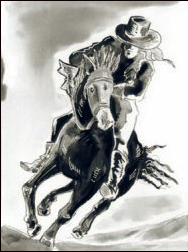
In the Old West men and horses were called upon to perform great feats. But no man and horse did more in a short period of time than John Phillips and a big gray thoroughbred.
It was a cold December in 1866. Fort Phil Kearny was being harassed by Red Cloud and his band of Sioux. On the 21st of December Captain John Fetterman and 80 men left the fort to chase after a small group of Indians. The Indians were decoys, and Fetterman’s command was ambushed. Within minutes everyone was killed.
It was necessary for someone to travel to Horseshoe Station, 190 miles away, and telegraph Fort Laramie for reinforcements. That responsibility fell on John Phillips. He wasn’t a member of the military, but a local prospector who had brought his family to the fort for protection.
Riding a big gray thoroughbred, given to him by the fort commander, John started on the trip wearing a buffalo coat to protect him from the severe cold spell they were having.
Hiding during the daylight hours, John still ran into war parties, but the long legged thoroughbred was able to outrun the smaller Indian ponies. On December 24th John arrived at Horseshoe Station, but they were unable to send a telegraph to Laramie, because the line was down…either the result of Indian activity or the weather. Jumping back on his horse, he rode the remaining forty miles to Fort Laramie. A Christmas party was in progress when John arrived. A half frozen John Phillips entered the hall, told his story, and collapsed on the floor. Early Christmas day a column headed for Fort Kearny.
Although, at the time no one thought the 230-mile ride from Fort Kearny to Fort Laramie was anything more than a long cold ride, but shortly afterward it reached the level of myth…a man and horse enduring devastating weather and wild Sioux to save a beleaguered garrison.
SLOW
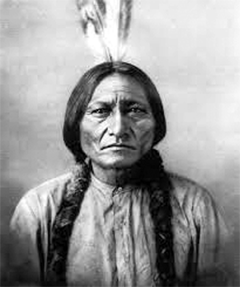 As a young boy his father gave him the name “Slow”. But during a raid against the Crow, at the age of 14, Slow raced ahead of his fellow warriors, and made the first kill. His father immediately changed his name. You may be surprised when you learn his new name.
His father gave him the name of “Slow”…not because he wasn’t bright…but because he was deliberate. But his “deliberateness” never stood in the way of him taking action. At the age of 14 he made his first kill, and his father changed his name to…Sitting Bull.
Sitting Bull is best known for his victory at Little Big Horn against George Armstrong Custer. As strange as it may seem, his victory directly resulted in his defeat. But I get ahead of myself.
Because of his braveness in battle Sitting Bull was soon made the leader of the Strong Hearts, a special society of warriors…and later he became the chief of his Hunkpapa division of the Sioux.
Sitting Bull had special abilities as a leader and organizer. Even though the Federal Government had ordered the Indians to relocate to a reservation, Sitting Bull was able to convince more than 10,000 Sioux, Arapaho and Cheyenne to leave the reservation, and band together…and it was a part of this group that defeated General Custer.
Because of Little Big Horn, the government made an all out effort to defeat the Plains Indians. Finally, with less than 200 followers Sitting Bull and his ragged band surrendered.
On December 15, 1890, Sitting Bull was living on the Standing Rock Indian Reservation. Because of fears of an Indian insurrection, about 40 Indian policemen rushed Sitting Bull’s home to arrest him while he was asleep. In the confusion a fight broke out and the great Sioux Chief Sitting Bull was shot twice…by a Sioux Indian policeman. Incidentally, the 59-year-old Sitting Bull had previously indicated he had no interest in the insurrection.
ELFEGO BACA
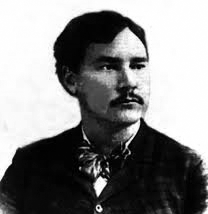 The subject of this story had more grit that the most famous heroes of the Old West. But chances are you’ve never heard of him.
Although the Mexican people had traditionally occupied the southwest, by the 1880’s it comprised primarily of Angelo cattle ranches and towns…some, of whom, considered the Mexicans second-class citizens. A ranch owned by John B. Slaughter occupied the area around what is now Reserve, New Mexico. Now, John B. Slaughter isn’t to be confused with the famous rancher and lawman John Horton Slaughter.
The Slaughter cowboys were known to use the Hispanics in the area for target practice.
A young 19-year-old Mexican by the name of Elfego Baca got tired of this harassment, and got commissioned as a deputy sheriff to do something about it. One of the Slaughter cowboys, Charles McCarthy, shot at Baca. So, Baca arrested him. That evening some of the Slaughter cowboys tried to spring McCarthy loose. During the gunfight a falling horse killed one of the cowboys. The cowboys now felt justified in killing him.
On December 1, 1884 about 80 cowboys came after Baca. By now Baca had taken refuge in a tiny shack. For 36 hours the cowboys, surrounding the shack, filling it with bullet holes. They literally fired thousands of rounds at the shack. Supposedly, many as 400 bullets struck the door alone.
By nightfall Baca had killed a cowboy and wounded several others. By now the cowboys were sure Baca was dead. But they decided to wait until morning to go in after him. In the morning, the cowboys caught the smell of food cooking. It was Baca, cooking breakfast in what was left of the cabin.
Fortunately, for the cowboys, two deputies and several of Baca’s friends showed up, and they retreated. Elfego Baca was tried for killing one of the cowboys, and found innocent. He returned home, an obvious hero to the Hispanics of the area.
GOLD MINE SCAM
 One of the keys to a great scam is for the scam artist not to appear to be as smart as the victim. This week’s story is about a couple of con men who were dumb like foxes.
With the discovery of gold in California fake gold and silver mines became common. Swindlers and con men fooled many a greenhorn with “salted” mines. But there were few con men who did as great a job as two cousins from Kentucky named Philip Arnold and John Slack.
In early 1872 Arnold and Slack showed up in a San Francisco bank attempting to deposit a bag of uncut diamonds. When questioned about the diamonds, the two men immediately left with the diamonds. Curious, the bank’s director, William Ralston later found Arnold and Slack, and discovered that the diamonds came from a mine the men had found. The banker, assuming he was dealing with a couple of country bumpkins, schemed to take control of the mine.
A mining expert looked at the mine, and he reported back that it was rich with diamonds and rubies. The banker, Ralston, formed a mining company and capitalized it to the tune of $10 million. He was able to buy the country cousins off with a meager $600,000.
A young geographical surveyor by the name of Clarence King was suspicious of the stories he heard about the mine. It took him one visit to the mine to realize it had been salted…Some of the gems he found had already been cut by a jeweler.
On November 26, 1872 the whole scheme collapsed. Banker Ralston had to refund the investors, with much of the money coming from his own pocket. The two country bumpkins? They disappeared back in Kentucky, along with the meager $600,000 they had been given.
Incidentally, the young man who exposed the fraud, Clarence King, ended up becoming the first director of the United States Geological Survey.
CARRY MOORE VS JOHN L. SULLIVAN
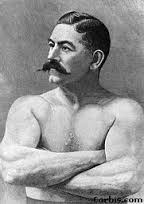
Carry Moore, the subject of today’s story was the only woman to be challenged by famous boxer John L. Sullivan, and accept that challenge. The outcome of that confrontation is interesting.
 On November 21, 1867 Carry Amelia Moore married Dr. Charlie Gloyd. The marriage didn’t start out well, because the groom arrived drunk. And it seems he stayed drunk most of their marriage, which, incidentally, only lasted a year and a half. However this failed marriage ended up affecting a large portion of the population of this country.
After the death of Dr. Gloyd, Carry Gloyd married a David Nation. Although David neither drank nor smoked, Carry found he had his share of problems, and he and Carry had a rocky marriage, with a number of separations.
By now Carrie Nation decided that a number of activities that men participated in were not good, including membership in the Masonic Order, sex, and especially strong drink. Even though Kansas was a dry state, there were a number of bootleg outlets. And Carrie took it on herself to “harass these dive-keepers.” The first place she attacked was actually a drug store, where she destroyed a barrel of “medicinal” whiskey.
Getting rid of her second husband, Carry was now free to spread her word beyond Kansas. She traveled the nation lecturing and destroying. When Carry was lecturing in New York, boxing champion John L. Sullivan, the owner of a beer joint said that if she ever entered his place he would “push her down the sewer.” Taking up the challenge Carry went to his place, and chased Sullivan into hiding in the men’s room where Carry refused to follow. A sign in another New York bar read, “All Nations Welcome Except Carry!”
Although Carry Nation was not able to see the ultimate fruit of her work, in 1919, just 8 years after her death, Prohibition became the law across the nation.
OLD WEST NEWSPAPER
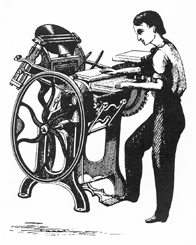 With frontier towns springing up over night, and disappearing as fast, an Old West newspaper had to be on the move to keep customers. This week’s story is about one such newspaper.
Following the Civil War two brothers, Legh and Fred Freeman, were hired to publish a newspaper out of Fort Kearney, Nebraska. During this time the railroad passed through the area. While the railroad was being built in the area things boomed. As the railroad moved on, taking the workers with it, there was a bust.
The Freeman brothers hit on the idea to create a newspaper that would move along with the railroad. So, they bought a hand press, type, ink and paper, named their newspaper the Frontier Index, and hired wagons to take them to the next town where the railroad was to arrive. As the crews arrived with men anxious to read the latest news, they did a booming business. Merchants were willing to pay outrageous prices for advertising, and marked their goods up accordingly.
The masthead of the Index changed each time they moved to a new town. During its existence the Index was published in 25 different cities. Sometimes the Freeman brothers moved so fast that they outran their supplies. One time they had to print the newspaper on wrapping paper.
The Index came to an end in Bear River City. As the population of the city grew, the lawless element started arriving along with the railroad workers. The Index wrote an editorial stating, “Bear River City has stood enough of the rowdy criminal element.” The next day, November 15, 1868, some of “the rowdy criminal element” grabbed a rope, and headed to the tent that headquartered the Index newspaper. The Freeman brothers were able to escape, but when they returned nothing remained of the Index but ashes. The lifespan of the Frontier Index was but two years. Which, incidentally, was a long time for a frontier newspaper.
Death of Ned Christie
 More firepower was used to kill the subject of today’s story that any other single man in the Old West. When you’re finished I think you’ll agree.
Ned Christie was a well-respected member of the Cherokee National Council. But he enjoyed his drink. And in May of 1887, after one such drinking spree, he was accused of killing Marshal Dan Maples. Ned protested his innocence. But, realizing he was getting nowhere, lit out on the run.
For about 6 years Christie was on the lamb. With the exception of one close call, the law just couldn’t catch him.
During this time virtually every crime that took place in the Indian Territory was blamed on him. Dime novels built his reputation to that of the most vicious man to ever raise a gun in the Indian Territory. He was reputed to have engaged in everything from peddling whiskey, to horse thievery and banditry. In the process, he was reputed to have killed as many as 11 people.
With a reward of $1,000 on his head, it was only a matter of time until someone collected it. And it happened on November 3, 1892. Marshal Heck Thomas trailed Christie to a log fort that he had built. Realizing the place was almost impregnable, Thomas sent for reinforcements. As well as plenty of ammunition, the reinforcements also brought along a three-pound field cannon.
During the assault more than 2,000 small-arm rounds were fired. They also shot 38 cannon balls. But they just bounced off. A heaver charge was used. It only succeeded in blowing up the cannon. Finally a dozen sticks of dynamite were placed next to the house. This did the trick.
With black smoke enveloping the area, Ned Christie came out of the house firing his rifle. The deputies returned fire, riddling Christie’s body. It may have taken as much armament as used in a major battle, but the law got their man.
DON’T KILL A MINISTER
 As we all know, if someone kills a lawman, he’ll draw the attention of lawmen everywhere until he’s caught. In the Old West the same was true of ministers. And, that ain’t good.
Reverend F. J. Tolby was a Methodist circuit minister, who, in September of 1875, was traveling between Elizabeth and Cimarron in the New MexicoTerritory when he was waylaid and killed. Suspicion fell upon a mail carrier by the name of Cruz Vega. Cruz was arrested, and later, because of the lack of evidence, released
Friend and fellow minister, O. P. Mains was sure Cruz was the villain. So, he persuaded Clay Allison to talk to Cruz about the murder. You may remember Clay Allison being the subject of a couple of earlier stories. If not, just let me say that Allison was a maniacal killer. Using his own special method of persuasion, Allison was able to get Cruz to spill his guts. In the spilling, Cruz indicated that a Manuel Cardenas actually did the killing.
But, Allison and friends wanted someone to pay for the killing of Reverend Tolby, and unfortunately, Cardenas wasn’t around. So, on October 30, they decided to hang Cruz Vega. But, Clay Allison was a companionate person. So, while Cruz was choking to death, Allison shot him in the back, according to Allison “to put the poor Mexican out of his misery.” And even though Allison wasn’t a religious man, he evidently felt it was important to show people that no one should mess with a man of the cloth, so Allison cut Cruz down from the tree and drug him through town.
Manuel Cardenas was arrested and about ten days later vigilantes shot him to death.
I wonder if the following Sunday’s sermon of Reverend O. P. Mains, the man who started the killing spree, was on the sixth commandment.
A TOWN TREED
 Hunters are known to tree a mountain lion or a bear now and then, but in 1859, a gang of thugs treed a whole town. That’s right, a whole town.
It was the mid 1800’s. Anglos from other parts of the United States were coming to Texas in groves, and taking over land previously owned by Mexicans.
Juan Cortina, saw his family’s land holdings shrink. When he became a man, Juan put together a gang of disgruntled Mexicans and started taking back some of the land. In mid September of 1859 one of Juan’s men was arrested in Brownsville, Texas. Juan and his men shot the Marshal and freed the gang member. This, of course, infuriated the citizens of Brownsville. For days they talked about putting together a posse and getting revenge. But it seems that talk was all they were want to do.
Juan Cortina, on the other hand, wanted action, and getting tired of waiting for the posse to come after him, on September 27 he led a thousand cutthroats into Brownsville, captured Fort Brown, and took over the town. After killing anyone who had previously caused him grief, Juan demanded one hundred thousand dollars in gold or he would burn down the town.
News of the Brownsville situation got out and a contingency of men came to the rescue. Unfortunately, for them, news of what Cortina was doing also reached his friends and his gang had grown to a much larger size. After defeating the relief column, Cortina went after Edinburg, Texas and then took on Rio Grande.
Cortina then wisely retreated back to Mexico where for 15 years he made raids across the border. Finally in 1875, the Texas Rangers decided to put an end to Juan Cortina’s shenanigans, and went down to Mexico and kicked his butt. From then on Juan stayed south of the border and played politics there.
BATTLE OF BEECHER’S ISLAND
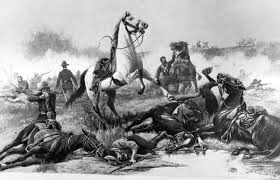 The summer of 1868, Indians were conducting major raids on railroad work camps and homesteads. Major George Forsyth was ordered to put together a detachment of 50 volunteer frontiersmen to teach the Indians a lesson.
The first part of September they arrived at Kansas’ Fort Wallace, and immediately took after a group of Indians who had stolen some stock. On September 16, Forsyth and his men, low on rations, camped on the banks of the Arikaree River.
Unknown to Forsyth 4,000, Cheyenne, Arapaho and Sioux had been following him for three days. The morning of September 17 Major Forsyth and his men were awaken by the sounds of war cries. The 50 volunteers, with their animals, retreated and dug into a 40-yard by 150-yard sandbar.
By 9 A.M. the Indians had killed all of the volunteers’ horses and mules. Now there was no way of escape. A half hour later 300-mounted warriors, headed directly for the 50 volunteers. But, what the Indians didn’t realize was that all of Forsyth’s men were equipped with Spencer seven-shot repeating rifles and Colt pistols. Waiting until the last second to start firing, the charge was broken.
For eight days the Indian attacks continued, and the Spencer rifles kept them away from the volunteers. Two of the volunteers were able to get away and make it to Fort Wallace for help. By the time reinforcements arrived, the bulk of the Indians had left, with only a small contingency staying to starve out the volunteers.
Technology had made it possible for 50 men to face and essentially defeat a force of 1,500 warriors. During the battle, 10 of the volunteers were killed, and 20 wounded. But Indian causalities were estimated to be around 50 killed and as many as 200 wounded.
CRAWFORD GOLDSBY
In the Old West it seemed necessary to have the appropriate name before a person could make a reputation. That sure was true wit h a man named Crawford Goldsby.
If someone came into a bank in the Old West and announced, “I’m Crawford Goldsby, and this is a hold-up,” the teller would probably have laughed. That’s why you’ve never heard of outlaw Crawford Goldsby.
Crawford was born in 1876. His mother was a combination of black, Cherokee and white. His father was white, Mexican and Sioux. At the age of 16 Crawford had a dispute with a man who proceeded to whip him. He got a gun and shot him. Although it wasn’t fatal, Crawford hightailed it to the Indian Territory.
Next, Crawford came up with a name with a little more pizzazz. He became “Cherokee Bill.” Now he could build a reputation. And he wasted no time doing it.
On June 26, 1894 Cherokee Bill killed his first man…a posse member that was chasing him. His sister’s husband had beaten her. Shortly afterward, the brother-in-law was dead. Next a railroad agent was killed in a holdup. A railroad conductor was killed when he tried to throw Cherokee off a train. And then a bystander was shot during another holdup.
Cherokee Bill was finally arrested, brought before Hanging Judge Parker, convicted, and sentenced to hang.
Cherokee Bill walked up the 12 steps to the hangman’s noose. When he got to the top he looked at the crowd, smiled and said, “Look at the people. Something must be going to happen.” When asked if he had anything to say, he replied, “I came here to die, not to make a speech.”
He died at the age of 20, after killing almost 13 people in just two years…An obvious result of changing his name from Crawford Goldsby to Cherokee Bill.
TODAY’S HERO – TOMORROW’S BUM
Often things moved fast in the Old West. Today’s hero is sometimes tomorrow’s bum. Or, in Caldwell, Kansas to day’s hero is tomorrow’s dead bum.
Born in Tennessee, George Flatt, went out to Caldwell, Kansas. George had a bit of a stubborn streak that came out in July of 1879. After more than a few drinks, a couple of cowboys in the Occidental Saloon started shooting their pistols. Constable Kelly and a posse that included George Flatt came to take care of the problem. The posse cautiously entered the saloon, and saw the two cowboys with their guns pointed at them. The cowboys started for the door. But Flatt stepped forward and blocked the door. Carrying two guns, the cowboys demanded that he drop them. Flatt responded, “I’ll die first.” A shot from one of the cowboys whizzed past Flatt’s head. Flatt went into action. Each gun took out a cowboy.
Things moved fast in Caldwell. In a matter of weeks, George Flatt advanced from posse member to the city’s first marshal. And capitalizing on his new found fame he went into partnership with William Horseman operating a saloon.
But many times as fast as things go well, just as fast they turn bad. Flatt was a heavy drinker. And within a year not only had his partnership with Horseman fallen apart, but Horseman had even replaced him as city marshal.
Then on Saturday evening, June 19, 1880 after spending some time drinking in the bars, George Flat headed for home. From the dark a rifle shot rang out. It hit Flatt in the skull. Once he was down, three more slugs filled his body. Yes, things moved fast in Caldwell, Kansas…From a marshal and businessman to a dead drunk laying face down in the dirt in less than a year.
SEMINOLE-NEGROES
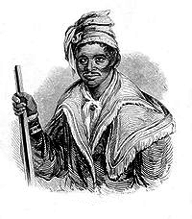 On April 8, 1875 four soldiers encountered 30 Comanche. Three of those four soldiers received the Congressional Metal of Honor. This was but one escapade in the life of a most unusual group of soldiers.
During the 1870’s there was a small group of men who guarded the Texas–Mexico border against Comanche Indians. These men were the Seminole-Negroes. They were runaway slaves who had gone to Florida and lived with the Seminole Indians. When the Seminole were chased west, the black families went with them.
In 1870, looking for extra help in fighting the marauding Comanche, the Seminole-Negroes were hired as a special unit to track down the Comanche Indians. Although the Seminole-Negroes were a rag-tag looking bunch with a combination of military and Indian attire, which even included war bonnets, they had the ability to follow trails that were weeks old and live on nothing but rattlesnakes.
The commander of this group was a white Lieutenant by the name of John Bullis. Lieutenant Bullis had the respect of the Seminole-Negroes, because he was willing to live and fight right along side of his men. One time while on a patrol Lieutenant Bullis and three of his enlisted men encountered some 30 Comanche. Being vastly outnumbered, the soldiers retreated. Unfortunately, in the process Lieutenant Bullis was captured. Not willing to leave their commander behind; the men changed into the midst of the Comanche, rescuing Lieutenant Bullis. Each enlisted man received the Congressional Metal of Honor.
For their service, the government had promised the Seminole-Negroes land, but, mysteriously, when it came time to pay up, the War Department had run out of land. But, living up to their commitment, and ever hopeful, they stayed on until their job was done.
Incidentally, as an indication of their skill as scouts and fighters, during the service of the Seminole-Negroes, not one was ever killed or injured in battle.
MORGAN KILLED
1881 wasn’t a good time for the Earps with the O. K. Corral shootout in which Virgil and Morgan were seriously shot. And then later Virgil was shot again. It was hoped that 1882 would be a better year. But it wasn’t.
Morgan Earp was the youngest of the three Earps who participated in the O. K. Corral shootout. He was also the friendliest of the clanish Earps who were not known for having a smile on their face.
For a while in Tombstone, Morgan was a shotgun guard for Wells Fargo. But realizing dealing faro was more profitable and less dangerous, he got a job at the Occidental Saloon.
During the O. K. Corral incident Morgan was seriously shot through the right shoulder. Over the next few months he healed to the point that by the following March he could participate in his favorite activity, billiards.
It was March 18, 1882. Morgan and Wyatt had just attended a play. Afterward they went to Hatch’s Saloon so Morgan could play a game of billiards with owner Bob Hatch. As Morgan was chalking up his cue, two 45-caliber gunshots blasted through the saloon window. The first shot hit Morgan. The other barely missed Wyatt…Quite possibly both Morgan and Wyatt were both marked for assassination. But, as was the story throughout Wyatt’s life, the second bullet missed.
When the smoke cleared Morgan was on the ground in a pool of blood. The 45 had shattered Morgan’s spine. The doctors said there was no hope. With brothers Wyatt, Virgil, James and Warren by his side, Morgan said, “This is the last game of pool I’ll ever play.” Then he whispered something to Wyatt. Morgan was dead in less than an hour from the time he was shot.
Later Morgan was dressed in one of Doc Holliday’s suits and brother Virgil took him to Colton, California to be buried where his parents lived.
KANSAS CATTLE TOWNS
To Texas cattlemen Dodge City, Abilene, Caldwell, Ellsworth, Hays and Newton were all spelled with dollar signs.
They were the end of the trail for cattle drives. In reality, were it not for cattle and the cowboys, they would 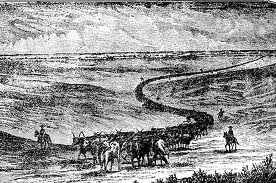 probably have never grown beyond a few shacks and a dusty road.
But, on March 7, 1885, the Kansas legislature passed a bill that prohibited Texas cowboys and their cattle from coming into Kansas between March and December. What’s going on here?
Actually, four things…first, the future of Kansas’ “Cow Town” industry was very shaky at best. Railroads were being built directly to Texas, and soon Kansas railheads would no longer be needed. Second, it had been discovered that the plains of Kansas were good for more than just providing feed for passing cattle. Farmers were turning over the sod and planting crops. Although the cattlemen attempted to respect the farms, strays inevitably created havoc with crops. For some drives, conflict with farmers was a daily event.
The third, and probably most important reason was that Texas cattle were carriers of a tick fever. Over the years Texas cattle had become immune to the disease, and since it didn’t affect humans, there was no big concern. But, as the cattle passed through Kansas, ticks would leave the Texas cattle and infect the local dairy cows.
And then there was the preverbal straw that broke the camel’s back. The residents of these famous “Cow Towns” were getting fed up with the rowdy cowboys and the messy cattle.
So, the bottom line was that, as least this time, most of Kansas was behind this seemingly radical move by the legislature.