Mountain Men Battle Indians
The next day Ashley got 20 horses from the Arikara in return for gun powder and shot… a trade they were later to regret. In the middle of the fourth night there, one of two men who were staying in the Indian’s village came running out screaming that his partner had been killed. It’s not known if it was part of a plan or there had been a problem, but at the break of dawn the air was filled with arrows and just traded bullets, fired from behind the stockade. The horses were the first to die. Using the dead horses as shelter, the mountain men yelled for the boats to come ashore and pick them up.
Finally, Ashley was able to get a couple of skiffs up to the shore. It was every man for himself. Those who didn’t make it in a skiff were washed downriver. Finally, with the survivors aboard the keelboats, they drifted downriver about 25 miles before they pulled ashore to take inventory.

Frank James Surrenders
 Six months after a member of his own gang shot Jesse James in the back, and after committing at least twenty robberies, on October 5, 1882, Frank James, Jesse’s brother surrendered to Missouri governor Thomas Crittenden.
 Governor Crittenden had replied that he could not give amnesty… but if Frank James went on trial and was convicted, he could give him a pardon.
So Frank James went on trial for murdering Frank McMillan, a passenger who had been killed during a train robbery a year earlier. After seven days of witnesses, and two days of legal arguments, Frank was acquitted. It seems the case against him had mysteriously collapsed.

Chuckwagon: Mormon Johnnycakes
Here is a form of cornbread used not only by the Mormon immigrants, as the name indicates, but quite often by most of the immigrants traveling west. Because of the inclusion of buttermilk, a source of fresh milk was a necessity.
2-cups of yellow cornmeal.
½-cup of flour.
1-teaspoon salt.
1-teaspoon baking soda.
Combine ingredients and mix in 2-cups of buttermilk and 2-tablespoons molasses.
Pour into a greased 9” pan and bake at 425 degrees for 20 minutes. To get a lighter johnnycake include two beaten eggs and 2 tablespoons melted butter.
*Courtesy of Chronicle of the Old West newspaper, for more click HERE.
William Becknell Creates the Santa Fe Trail
 In the early 1800’s the Southwest was part of Mexico, and Mexico was under the domination of Spain. Because the Spanish were afraid of the expansion of the Anglos, they closed the area to anyone from the states. Any American trader they found in the area ended up in jail.
Chinese Massacred at Rock Springs
 Coal was very important for the operation of the railroad. And because of that, many railroads controlled their supply of coal by owning the coal-mining operations. One such mining operation owned by the Union Pacific Railroad was located in Rock Springs, Wyoming.
Old West Book Review: Captain John R. Hughes
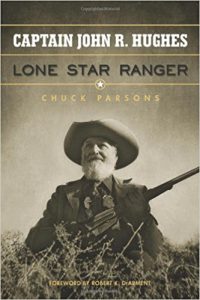 The true story of Texas Ranger Captain John R. Hughes is another splendid work of author Chuck Parsons who specializes in writing about the life and times of various outlaws and lawmen. His non-fiction books are fast-paced, exciting Old West adventures.
This one begins with the early history of John R. Hughes’ ancestors with examination of his younger days leading up to his adventuresome life with the Texas Rangers. Hughes was born in 1855, one of seven children. His family was in the farming business in the Midwest.
Young John was adventuresome, and when he became curious about stories he’d heard about Indian Territory,” he ran away from home and worked at a number of jobs. At one ranch he single-handedly recovered a herd of stolen horses from a band of outlaws. His wandering led him all the way to Texas, where John and his older brother ran a horse operation for nine years known as the Long Hollow Ranch.
In time John Hughes joined the Texas Rangers, and author Parsons carefully follows the monthly return records that chronicle the unrelenting hunt for cattle rustlers, horse thieves, drunkards, embezzlers, smugglers, train robbers, and murderers. Many photographs appear throughout the text of steely-eyed Texas Rangers packing plenty of iron, including one filled with more than thirty armed Rangers standing at the ready to prevent the Fitzsimmons-Maher prizefight in 1896. This event alone is worthy of a separate story.
Not all who dealt with the Rangers admired them. Bat Masterson, who lived in Texas during his early career considered the Rangers little more than “a four-flushing band of swashbucklers.” This statement is wildly hilarious when one considers that Bat Masterson was associated with the Earps who were hardly choir boys.
This biography of Capt. John R. Hughes is filled with hard riding, straight-shooting derring-do. Hughes covered thousands of miles in all kinds of weather, recovering stolen stock while faced with sudden death in ambushes and shootouts. Combined with this, Hughes as Captain dealt with personal problems of his men along with administrative concerns and political distractions.
One photo in the book shows Hughes with the beautiful and mysterious Elfreda Wuerschmidt taken near Rockport, Texas. This twenty-year-old beauty, the love of Hughes’ life, died of unknown circumstances, leaving Captain Hughes a lifelong bachelor who often visited the lady’s unmarked grave. He never shared his broken-hearted feelings with snoopy biographers, thus we do not know how she died.
By 1915, after 27 years of faithful service, Hughes retired from the Texas Rangers. Nearing sixty, he spent his remaining years gathering honors, and resounding best wishes from his legions of grateful and admiring citizens of the Lone Star State. He became a celebrity giving newspaper interviews and riding in rodeo parades. He traded his horse for an automobile and even became the protagonist in a Zane Grey novel, titled Lone Star Ranger.
At age 92, wracked with illness and infirmity, white saddened by the gradual loss of friends and family, on June 3, 1947 Captain John R. Hughes took his own life with his pearl handled Colt 45.
Chuck Parson’s well-written, carefully researched and deeply sentimental tribute to this fascinating Texas Ranger belongs in your Old West library. Get your copy HERE.
Editor’s Note: Reviewer Phyllis Morreale-de Ia Garza is the author of numerous books about the Old West, including the novel Railroad Avenue, published by Silk Label Books, P.O. Box 700, Unionville, New York 10988-0700. www.silklabelbooks.com
*Courtesy of Chronicle of the Old West newspaper, for more click HERE.
Jesse James’ Home Fire-Bombed By Pinkertons
 In 1874, Jesse and Frank James were robbing banks and trains to the point that the railroads decided to hire the famous detective group the Pinkertons to hunt them down. But, the Pinkertons, in spite of their numbers and skill, weren’t having any luck rounding up the James boys. Then late in 1874 one of their agents, John Wicher was found dead close to the James home. The Pinkertons were convinced that the James’ or one of their people had killed him, and they decided to raise the ante.
Sitting Bull’s Personal Secretary and Interpreter

Johnnie Brughuier was born the son of a white father and Sioux mother near present day Sioux City, Iowa. His father sent him to St. Louis for an education. When he returned home, on December 14, 1875, in the process of breaking up a fight between his brother and another man, Johnnie killed the other man. Afraid that he would be arrested for murder, Johnnie fled to the camp of Sitting Bull.

 In 1879 his past finally caught up with him, and he was arrested for killing the man back in 1875. At the trial General Miles testified on his behalf. It took the jury just one half hour to bring back a verdict of not guilty.
Chuckwagon: Potato Pie
from 1885 Farmer Almanac
Boil on-quarter pound potatoes until soft, then peel them and rub them through a sieve. Add one quart of milk, three teaspoonfuls of melted butter, four beaten eggs, and sugar and nutmeg to taste. Bake as you would a custard pie.
*Courtesy of Chronicle of the Old West newspaper, for more click HERE.
A Horse Thief That Was Caught

Little is known of William Arnett prior to his arriving with a couple of buddies in Goldcreek, Montana on August 21, 1862. The trio had a string of six good horses. However, there was something strange about the men. Although they looked as if they had done some hard traveling, they had no saddlebags or other evidence of men who would own fine horseflesh.
Teddy Roosevelt: The Cowboy President

On September 14, 1901 with the death of President William McKinley, his Vice President, Theodore Roosevelt was sworn in as the 26th President of the United States. Roosevelt was a very unlikely man to become the leader of our country.
Old West Book Review: Texas Ranger N.O. Reynolds
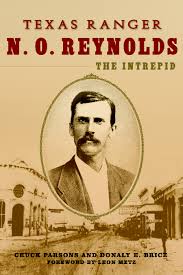 Parsons and Brice have chosen Texas Ranger (Nelson Orcelus) N.O. Reynolds not because he is well-known, but because he is deserving of recognition. Reynolds was one of those brave, dedicated individuals who believed in justice, law and order. He was willing to ride hard, shoot straight and suffer all of the hardships and dangers in a land filled with deadly intrigues.
Author Parsons has written numerous Western history books. He was for seventeen years “The answer Man” for True West magazine, as well as editor for the Quarterly and Newsletter of the National Association for Outlaw and lawman History. (NOLA).
For writing this book, Parsons has partnered with native born Texan Donaly E. Brice, Senior Research Assistant of the Texas State Library and Archives Commission. Brice has authored a number of books depicting Texas history.
Carefully researched, well-written, the biography of N.O. Reynolds is fast-paced reading about a man who served with the Texas Rangers, Company E, Frontier Battalion in various ranks for nearly five years. During that time only one man, Tim McCarty was killed in Reynold’s command. “Citizens of Texas wanted lawmen with courage and efficiency,” and they certainly got that with N.O. Reynolds. He seemed always in the middle of things when it came to a variety of feuds and gunslinger escapades. The Horrell-Higgins feud, Comanche raids, the Hoo Doo War, the transporting of Texas man-killer John Wesley Hardin, night rides, unruly lynch mobs, shootouts, ambushes, tracking thieves and killers, and capturing the Sam Bass gang were all part of Reynolds’ Job which he handled with steadfast efficiency.
In 1879, after nearly five years of service in Company E, Reynolds resigned from the Ranger Service citing health issues. He had been a Texas Ranger since 1874. At this time he went into the liquor business and bought property and ran a bar for a while but in 1880 he accepted a job as commander of Company D with the Texas Rangers. However, he stalled taking the job citing trouble selling his business, and the job was filled by somebody else.
in 1882 Reynolds, at age 35, married the 20-year old Irene T. Nevill, the younger sister of one of his sergeants. The couple married at the bride’s home in Austin. They would have two daughters, Emma Elizabeth and Lula Jenkins. Lula Jenkins Reynolds Blunt died of appendicitis when still a young woman; her early death was a great tragedy for the family
In 1883 Reynolds became City Marshal of Lampasas, Texas. Here he was still a businessman, his name carne up periodically in newspapers as locals tattled on him for selling liquor on Sundays.
In 1888 to 1890 he was elected sheriff of Lampasas County. He dealt with murder, mayhem and fence cutters. Ranchers cut fences in desperation allowing their cattle to roam for grass and water during a hard drought. Murder followed as desperate cattleman struggled over open rangeland vs private property.
Eventually Reynolds would move to the Gulf Coast of Texas where he worked in the shoe business. According to newspaper advertising, within ten years he was back again in the liquor business. Reynolds’ final employment was work as a night foreman at the Yellow Pine Paper Mill in Orange, one hundred miles east of Houston. He remained here until his retirement in old age. Reynolds died of pneumonia March 1, 1922. His wife died in 1947, and the two rest side by side in the Center Point Cemetery where thirty-two Texas Rangers are buried.
In 1987 the Kerr County Historical Commission with the Center Point Sesquicentennial Committee sponsored a marker dedication honoring these men. In addition, in 1999 a Texas Ranger memorial service sponsored by the Former Texas Ranger Association of San Antonio was held here honoring these brave men who rode, fought, and lived in a different time. Get your copy of this book HERE.
The reviewer, Phyllis Morreale-de la Garza is the author of numerous books about the Old West, including the true crime Death For Dinner, The Benders of (Old) Kansas, published by Silk Label Books, P. 0. Box 700, Unionville, New York, 10988-0700 www.silklabelbooks.com.
*Courtesy of Chronicle of the Old West newspaper, for more click HERE.
An Old West Poker Game That Went On & On!

For people of the Old West gambling was a way of life. They risked their life by going into Indian Territory for furs, precious metal or land. They staked everything they owned on a herd of cattle being driven north. And for sure they enjoyed a game of chance.


On June 15, 1853, in Austin, Texas Major Danelson and Mr. Morgan sat down to play poker, and evidentially with little to go home to, forgot to quit. The game went on for a week… then a month… a year became years. The Civil War broke out, was fought and lost, but these two Texas gentlemen still dealt the cards. Finally in 1872, 19 years after it started, both men died on the same day… but the game continued. Their two sons took over, and played for 5 more years.
Chuckwagon: Sorghum Cake
This was a dessert made either at the ranch or restaurants in town. It couldn’t be made on the cattle drive because of the need for butter and eggs, two items that would not remain fresh during a three month cattle drive.
2 Tablespoons butter
½ Cup sugar
2 Eggs
1 Cup sorghum molasses
½ Cup water
½ Teaspoon baking soda
2 Cups flour
Start by mixing the butter and sugar. Then add the eggs. In a separate bowl mix the molasses, water and baking soda. Mix all the ingredients together. Bake about 45 minutes at a 350 degree temperature.
*Courtesy of Chronicle of the Old West newspaper, for more click HERE.
Rattlesnake Dick

As a teenager Dick Barter and two of his relatives went to the California goldfields to seek their wealth. Dick’s relatives found working a sluice box too tough and went up to Oregon. But Dick loved the possibility of becoming wealthy.
Indians vs. The Army

The year was 1867. The Red Cloud War had been going on along the Bozeman Trail for almost two years. On August 1 some 500 Sioux, Cheyenne and Arapaho led by Dull Knife and Two Moon, attacked a small detachment of eight troopers and nine civilians that were led by Lieutenant Sternberg. At the time of the attack, Lieutenant Sternberg’s group was in the open crossing a hayfield. Fortunately, they were able to make it to the shelter of a nearby corral. Even more fortunately, the troopers and civilians had repeating rifles.
Old West Book Review: Dragoons in Apacheland
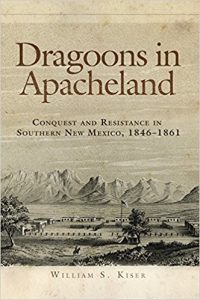 Dragoons in Apacheland details the fifteen years from 1846 through 1861 when the U.S. Army was engaged in dealing with the Apaches in southern New Mexico Territory. The conflicts and misunderstandings led to daily turmoil as the dragoons tried bringing peace and order to the region.
Deadly Apache raids, heat, dust, long marches in the desert, lack of decent food and shortages of equipment were only part of what the men were forced to put up with. Army posts usually consisted of crude huts, shabby tents, harsh weather, sick horses and mules, and sometimes squadrons of mosquitoes.
Meanwhile, civilian leaders and politicians from Washington to the Territorial governors, lawmen and regional mayors only added to the confusion. No one seemed to agree on how to handle this new land with its new problems. At the same time, various Apache bands including Mescalero, Mimbres, Mogollon and Chiricahua fought to hold their ancestral homelands. Indian raiding, kidnapping, horse and mule rustling and murder occurred regularly. Some of these Indians took the blame for others, while a few wise old leaders like Mangas Coloradas tried to negotiate peace. Mangas knew instinctively that the wave of white settlers would eventually wipe out the Apache bands by sheer numbers alone. He held off the inevitable as long as he could. The disputes raged endlessly between military men, Apaches, Mexicans, white settlers, and adventurers crossing the territory.
The author gives detailed accounts of the many skirmishes and battles between Apaches and the U. S. Military during those fifteen years prior to the Civil War. Anyone doing research about the Apache Wars and what led up to the 1880s Indian Wars will find this a valuable source of information. Readers will find this book a wonderfully detailed and accurate account of the pre-Civil War period in New Mexico Territory not often written about. This time period seems to have been skimmed over until now, perhaps because people think of the Indian Wars having always to do with the names we are familiar with such as Geronimo, who came much later.
Kiser points out the Apaches presented an obstacle to those politicians, ranchers, farmers and businessmen working toward civilizing the new frontier. Meanwhile, the Apaches driven from their land had good reasons of their own to offer resistance to those encroaching on their old way of life. Both sides of the problem are presented here in careful detail, without taking sides. The reader is given the opportunity to judge for his or herself what can happen when one civilization takes over another.
The book has maps showing the Chiricahua Apache homelands that extended from New Mexico (part of what is now southeastern Arizona) and far into Sonora, Mexico. Eventually part of New Mexico Territory would split off and become Arizona Territory. At the outbreak of the Civil War, the American troops were called back east for the horrific fighting about to begin. At that time New Mexico was not a priority for the United States government until the Civil War ended, and troops returned to the Western Frontier.
Carefully written and accurately documented, the author has gleaned his information from military records, U.S. government documents and publications, newspaper accounts and important books and papers on the subject. Personally, he explains how when he was a child, his father took him to some sites of the old abandoned forts. Here, sifting through the debris with a metal detector, he found a few precious mementos that piqued his interest to eventually write this book, an important addition to your Old West library. Be sure and get your copy HERE.
Editor’s Note: The reviewer, Phyllis Morreale-de Ia Garza is the author of numerous books about the Old West, including Hell Horse Winter of the Apache Kid, published by Silk Label Books, P.O. Box 700, Unionville, New York, 10988-0700 www.sllklabeIbooks.com.
*Courtesy of Chronicle of the Old West newspaper, for more click HERE.
John Colter After Lewis & Clark
About a year later the Blackfoot captured John and a fellow trapper. In the process John’s friend was killed. They had something special for John. He was stripped of his clothing, and told to run. With a 500-yard head start, the braves started after him.

Even with bare feet and body being cut by the rocks and brush, John managed to outdistance all but one brave. Just as the brave caught up with him, John turned and faced the Indian. Startled at the bloody sight, the Indian stumbled, and John killed him. Even with the remaining Blackfoot Indians still in pursuit, John was able to travel the 250 miles to safety.
Chuckwagon: Cornmeal Pudding
3 Cups cornmeal mash
2 Tablespoons flour
5 Beaten eggs
½ Cup melted butter
1 Cup molasses
½ Cup milk
Juice and rind of 1 lemon
Stir altogether and bake ½ hour in a very moderate oven.
Serve with a sweet sauce.
*Courtesy of Chronicle of the Old West newspaper, for more click HERE.
Medicine Man Isatai At War

In 1843 a trading post was built in what is now Hutchinson County, Texas. Over the years the trading post was abandoned, and it fell into disrepair. Thirty years later, about a mile away from the original post, another trading post was established. It comprised of a store, saloon, blacksmith shop and another building. Whites called it Adobe Walls.
Because of their log construction and sod roofs, the buildings were virtually impregnable. In addition, the buildings contained 29 buffalo hunters, including Bat Masterson, all with 50 caliber “buffalo guns.”
On June 27, 1874, 700 Comanche, Cheyenne, Kiowa and Arapaho warriors attacked Adobe Walls head on. With the buffalo guns taking their toll, and his horse shot from beneath him, Quanah Parker realized the yellow paint wasn’t working.
Old West Book Review: Reshaw
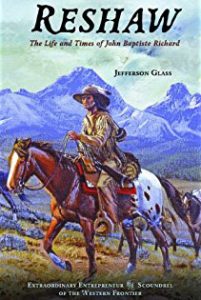 A Frenchman, his surname Richard was pronounced Reshaw by those who knew him, and this 1850s Old West character crisscrossed the frontier in what is now known as Wyoming and Colorado. While reading the book, it occurs to us that perhaps Reshaw was the inspiration for the Pasquinel character featured in James Michener’s Centennial.
Richard was a contradiction who could be at one time very generous and at other times confrontational. The Indian tribesmen gave him a name in Sioux that meant “Always has plenty of meat” because he was willing to share with those in need. On the other hand, he could display a vicious temper and it was said that during a whiskey-drinking spree, he wildly drove his carriage into an emigrant train causing a stampede that killed several people.
Richard bought and sold commodities such as bacon in St. Louis, and sold it at highly inflated prices to the miners and travelers. He was a fur trapper, buffalo hide trader, whiskey peddler, livestock dealer and all around opportunist who always looked for ways to make money. By the time he was fifty years old the 1860 Colorado census records show his personal estate was worth $50,000, a huge sum for those days.
He married an Indian woman, and some of their children were eventually sent to St. Louis to be educated. This book goes into great detail about the lives of Richard’s children as well as his many business associates, as well as information about the history of Wyoming and Colorado, fights between the U.S. military and Indian tribes, attacks at stage stations and the numerous depredations that took place.
One of Richard’s most lucrative business ventures had to do with a toll bridge he constructed across the North Platte River near present day Casper, Wyoming. Richard was quick to see the advantage of charging the emigrant trains to cross their wagons, livestock and equipment over his bridge as they made their way west. He ran this operation for many years, but around 1865 he departed from his toll bridge business on the North Platte. It was suggested that due to his family connections with the Sioux Indians and other tribesmen, he was warned that big trouble was coming between the Indians and the U.S. government, and he would be wise to make himself scarce before it was too late. The Plains Indians were on the prod following the Sand Creek Massacre, and retribution would be forthcoming.
Even without his toll bridge business, Richard continued to be involved in various business ventures. He died a violent death where he camped along the banks of the Niobrara River. Supposedly he was transporting a large quantity of gold. While his body was recovered, it was never known for sure who the killers were. Both boot prints and moccasin tracks were found at the murder scene. Some men were suspected, one was arrested, but due to lack of evidence the murder of John Baptiste Richard remains an unsolved mystery.
This man was kind, he was clever, he was mean, he was generous, he was complicated. A husband, father, trail blazer, entrepreneur, he was a fascinating character that history has mostly overlooked until now.
The author has done a huge amount of careful research, presenting here not only the life of John Baptiste Richard but including a great deal of Wyoming and Colorado history. One photo in the book may or may not be that of John Baptiste Richard. It was labeled differently by several different historians. We might never know exactly what he looked like which only adds to his mystique. Grab your copy of this interesting book HERE.
Editor’s Note: The reviewer Phyllis Morreale-de la Garza is the author of numerous books about the Old West including Hell Horse Winter of the Apache Kid, published by Silk Label Books, P.O. Box 700, Unionville, New York. 10988-0700. Www.silklabelbooks.com
*Courtesy of Chronicle of the Old West newspaper, for more click HERE.
Killer Deacon Miller
 Deacon Miller was a little man who was quiet, and never cussed. He dressed like a traveling minister, and was an avid churchgoer. At the same time, this Jekyll-Hyde character was one of the most ruthless assassins of the Old West. It’s estimated that 40 or more people died from lead that came from his guns… Some of them were even his relatives. His contracts were usually carried out on unarmed men from behind a rock or tree, while using a rifle.
 Deacon Miller’s last contract kill was on a lawman named Gus Babbitt. As was his style, Miller ambushed Babbitt. Unfortunately, Babbitt lived long enough to describe Miller. Miller and his three helpers were arrested.
Chuckwagon: Molasses Pie
3 eggs
1 teacupful of brown sugar
½ of a nutmeg
2 tablespoonfuls of butter
Beat well together. Stir in 1 teacupful of molasses with above ingredients. If you have no molasses, maple syrup will work. Bake in pie shell.
*Courtesy of Chronicle of the Old West newspaper, for more click HERE.
Mountain Man Joe Meek
By 1840 Meek realized the golden era of the mountain man was coming to an end. So, he took his Indian wife and led one of the first wagon trains along the Oregon Trail. Meek settled down in western Oregon and became a farmer.
At this time Oregon wasn’t a territory of the United States, and there was no military protection from Indians. So, in 1847 Meek led a delegation to Washington seeking territorial status. The heavily bearded and buckskin Meek was a sight to behold. He announced himself as the “envoy extraordinary and minister plenipotentiary from the Republic of Oregon to the Court of the United States.” Congress responded by making Oregon an American territory.