Old West Lifestyle & Stories

Latest

NORTHFIELD RAID

The movies show frontier town folk as being meek and easily intimated. But this was not so. These were people who were tough enough to brave the trip to the frontier, as well as being tough enough to endure frontier life. And after 1865 many were ex-soldiers.

A good example of the toughness of the frontier people is an event that took back in 1876 on September 7.

The James-Youngers were the “cock of the walk.” They were robbing everything in sight. And even though the famous Pinkerton Detective Agency was after them, the Pinkertons were stymied at every turn.
So, the gang decided to go to Northfield, Minnesota and rob a bank there.

From the moment they walked into the bank, they encountered resistance. The bank cashier said the safe was on a time clock. Then a bank teller ran out the back door and sounded the alarm.

The citizens of Northfield surrounded the bank and shot the robbers as they tried to escape. The result was that, with the exception of Jesse and Frank James, the gang was either shot up in Northfield or was captured by a posse some two weeks later.

It seems there was another gang known as the Daltons who had a similar problem in Coffeeville, Kansas.

CRAZY HORSE

He had blue eyes, light brown hair and pale skin. He was one of the greatest cavalry tacticians of his time. When he was born, his name was simply “Curly.” However, when he was a teenager his father gave him his name, which was “Crazy Horse.”

Crazy Horse was an Oglala Sioux chief who showed his skills in war as he took part in the Fetterman fight, the Hayfield fight and the Wagon Box fight. And, he harassed the outposts along the Bozeman Trail until the government abandoned them.

In 1876 when the War Department ordered all Sioux to come to reservations, Crazy Horse ignored their order. Crazy Horse and his people joined Sitting Bull, who had also defied the War Department. In June of 1876, he played a major role in the defeat of Custer.

After the battle, most of the Indians migrated to Canada. But, Crazy Horse and his people stayed in Montana. In May of 1877 he came in and was placed on a reservation near Camp Robinson in Nebraska.

Fearing Crazy Horse was going to leave the reservation, a party was sent to arrest him. On September 5, 1877, while being transferred to jail in the company of soldiers and Indian police, a soldier bayoneted Crazy Horse, and he died.

RENDEZVOUS OF GUNFIGHTERS

This Friday we’re headed down to Tombstone, Arizona for the Labor Day weekend’s Rendezvous of Gunfighters.

For 31 years our friend Ben Traywick has been hosting this gathering of gunfight groups from around the country.  The groups will be performing their shows in the O.K. Corral.

The festivities begin Saturday, September 1st and run through Monday, September 3rd.  An 1880’s costume parade will be held on Sunday, September 2nd at 12:00 pm.  During the parade a panel of independent judges will choose the most authentic appearing costumes for the 1880-1890 era in the following categories:  Gunfighter, Cowboy, Male Townsperson, Madame, Saloon Woman, Female Townsperson, Children (16 & under).

If you happen to be in the area, stop by and say hi as we walk the streets of Tombstone.


JOHN WESLEY POWELL

Today’s story is a lesson about quitting.

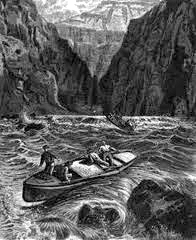
Back in 1869 John Wesley Powell took an expedition of 11 men and 4 wooden boats down the Colorado River through the Grand Canyon. It was an under-financed project, and virtually every day the expedition was on the verge of destruction.

On this date, near the lower end of the canyon, the party saw a giant rapids. They spent the night on the shore. Powell wrote, “The billows are huge and I fear our boats could not ride them…There is discontent in the camp tonight and I fear some of the party will take to the mountains but hope not.”

The next day, convinced the rapids were impassable, three of Powell’s men did leave. On this day in 1869, Seneca Howland, O.G. Howland, and William H. Dunn said goodbye to Powell and the other men and began the long climb up out of the Grand Canyon.

The remaining members of the party steeled themselves, climbed into boats, and pushed off into the wild rapids. Amazingly, all of them survived and the expedition emerged from the canyon the next day.

When Powell reached the nearest settlement, he learned the three men who left had been less fortunate–they encountered a war party of Indians and were killed.

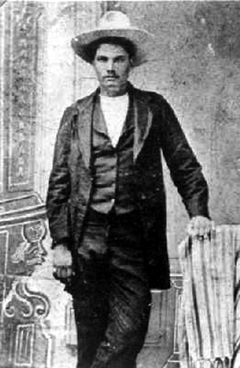
JOHN WESLEY HARDIN ARRESTED

August 23, 1877 climaxed probably the most dramatic manhunt in the Old West.

Although John Wesley Hardin had killed a number of men, on May 26, 1874 Harden Killed Deputy Sheriff Charles Webb in Texas and killing a lawman couldn’t be overlooked.

For three years Hardin was able to elude the Texas Rangers by using an alias and keeping a low profile. He also moved to Florida.

But, the Rangers discovered where he was, and even though they had no authority in Florida, sent John Armstrong after him.

Acting on a tip, Armstrong spotted Hardin in the smoking car of a train stopped at the Pensacola station. Local deputies were stationed at both ends of the car, and the men burst in with guns drawn. Hardin reached for the gun holstered under his jacket. The pistol caught in Hardin’s fancy suspenders, this allowed Armstrong time to club Hardin with his long-barreled .45 pistol instead of having to shoot him.

They spirited Hardin back to Texas on the next train. Hardin was tried and found guilty of killing Sheriff Webb and sentenced him to life in the Texas state prison at Huntsville. He served 15 years before the governor pardoned him.