Old West Lifestyle & Stories

Latest

WIND WAGON

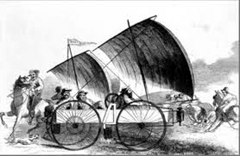
Wind WagonIn the 1860’s when a pioneer family headed out west, they usually did it in a covered wagon pulled by horses or oxen. One man, Samuel Peppard, didn’t have horses or oxen, but that didn’t stop him.

On May 9, 1860 Samuel Peppard headed out west. This was during the time of the Pike’s Peak gold rush, and Samuel wanted to do some gold prospecting. He didn’t have any horses or oxen, and he didn’t want the obligation and expense of taking care of them.

But, he did live in the Kansas Territory. And anyone who has been through Kansas knows it’s pretty flat, and the wind tends to blow rather strongly. Being a creative person, Peppard decided to take advantage of the resources at hand, and so he designed the world’s first wind-sailor. Built like a small boat, it was about 8’ long and 3’ wide, and it had four large wagon wheels. Weighing about 350 pounds, it was designed to hold 4 people.

The first time out, the wind blew the wagon over. So Peppard reconstructed the sails, rudder and brakes. By now everyone called it “Peppard’s Folly”.

With three of his friends aboard, Peppard raised the sails, and “Peppard’s Folly” took off across the prairie. Depending on the strength of the wind, it got up to 30 miles per hour.
On days when there was no wind, Peppard and his three friends just sat back, smoked a cigarette, and swapped stories.

They traveled about 500 miles before a dust devil came along and turned the wind wagon into a pile of rubble.
Peppard and his friends finally made it to Denver, but like most seekers of gold, they didn’t find anything.
Peppard later went back to Kansas, and lived to the ripe old age of 82. But he was always known as the guy who sailed to Denver.
NEWSPAPER BATTLE

Being first wasn’t always important in the Old West.  But, it made all the difference in one race.  And, the objects of the race didn’t even move an inch.Printing Press copy

In 1859 the Pikes Peak Gold Rush was a bust.  The settlements of Cherry Creek, Montana City and Denver City were on the verge of becoming ghost towns when another gold vein was discovered, and people came running.

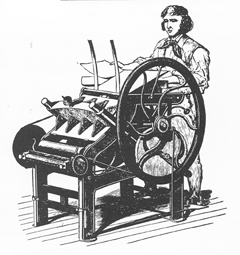
John Merrick decided the area needed a newspaper.  He bought an old press and headed to Cherry Creek.  Not seeing any reason for haste, Merrick took his time putting his newspaper together.

But, four days after Merrick had arrived; William Byers arrived from Omaha, Nebraska also with a printing press and the same idea.  Byers immediately located an office in the best building in town.  It happened to be an attic of a tavern, and the roof leaked so bad a canvas had to be hung over the press to keep it dry.

A race was on.  Bets were placed, and everyone cheered on their favorite editor.  Finally, on Saturday evening, April 23, 1859, William Byers’ Rocky Mountain News hit the streets just twenty minutes before the first copy of John Merrick’s Cherry Creek Pioneer.  In the news industry, a scoop of twenty minutes is like a lifetime.  So, John Merrick sold out and left for the gold fields.

William Byers had the area to himself.  However, his troubles weren’t over.  There was a battle between the two neighboring towns on either side of Cherry Creek.  So Byers couldn’t be accused of favoritism, he moved his equipment to a building that was virtually astride Cherry Creek.  Not a good move.  Four years after he started his newspaper, the area flooded, and washed away the building.  His press wasn’t found until 35 years later.

BOB PARKER

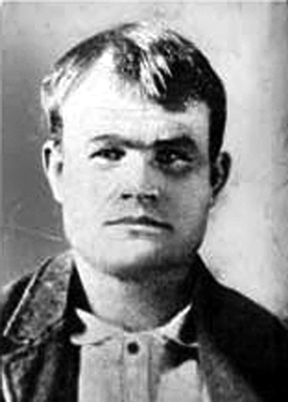
On April 13, 1866 the Old West’s least likely looking and acting head of a bandit gang was born in Utah.  His name was Robert Leroy Parker.Butch Cassidy

Bob Parker spent his childhood near Circleville, Utah, a hangout for outlaws.  As a young person Bob Parker befriended an outlaw by the name of Mike Cassidy.  Mike Cassidy taught Bob how to shoot.  He also took Bob with him on some of his cattle rustling ventures.

Bob Parker, along with Mike Cassidy, stole a few horses, robbed a bank or two and created general havoc in a small way. Bob also had some legitimate jobs.  He worked for a short while as a butcher in Rock Springs, Wyoming.
As Robert Leroy Parker started getting into trouble he assumed an alias, in part to make him sound meaner, and to save his family embarrassment.  His last name came from his early friend, Mike Cassidy.  His picked up his first name while a butcher in Rock Springs.

Butch Cassidy, and his partner the Sundance Kid, also an alias – the result of his spending time in a jail in Sundance, Wyoming – were lost in history until a movie starring Paul Newman and Robert Redford was released.

Although the real Butch Cassidy didn’t look anything like Paul Newman, he had the same “happy-go-lucky” attitude that Paul Newman portrayed.  Although he was 5’9” tall, and was known for clowning around, he had the ability to rule a gang of bad desperados known as “the wild bunch.”

The biggest controversy concerning Butch Cassidy was portrayed at the end of the Newman – Redford movie.  Although tradition says that Butch Cassidy and the Sundance Kid died in Bolivia, Robert Leroy Parker’s family maintains he returned to the United States, purchased a ranch, and searched for the loot he and the wild bunch had stashed until he died in 1937.

RICHARDSON/LOVING GUNFIGHT

Richardson-LovingGunfights in the Old West were usually caused by one of three reasons…women, gambling and revenge.  As we shall see, one of Dodge City’s most famous gunfights was over a woman.

Levi Richardson was a buffalo hunter who, because of the lack of buffalo, had become a freighter.  He was a well-liked, hard working individual who was known for his proficiency with a pistol and rifle…As well as having a quick temper.

Frank Loving, also known as “Cock-eyed” Frank because his eyes tended to look toward each other, was an ex-cowboy turned gambler.  Loving, unlike Richardson, was known to be cool, with a steady nerve.  Both men were spending some time in Dodge City, Kansas.

Now comes the catalyst…a woman. It seems that Levi Richardson fell in love with a young woman.  Unfortunately, for him, she loved another. And, that person was none other than Cock-eyed Frank Loving.

It was about 8:00 Saturday evening, April 5, 1879.  Richardson was warming himself at the potbelly stove in the Long Branch Saloon, when Loving came in and took a seat at one of the gambling tables.  Richardson followed him to the table. A few, less than genteel, words were exchanged.  With both men standing face to face, Richardson went for his gun.  He pulled off a shot as Loving was drawing his pistol.  Loving’s first shot misfired.  Seeking cover, Loving ran behind the potbelly stove.  But Richardson was right behind him taking two more shots.

Fortunately, for Loving, after that first misfire, his gun performed flawlessly.  Using cool deliberation, Loving shot Richardson in the chest, side and arm.  He died on the spot.  Loving, on the other hand, suffered only a scratch on the hand.  After the smoke settled, both guns were checked.  In the fracas, both men had empted them.  The amazing thing about the gunfight was that with led flying everywhere in a crowded room, no bystander was hit.

If you want to learn about more gunfights as they really happened go to www.ChronicleoftheOldWest.com and check out Dakota’s gunfight CD.

SOCKLESS JERRY SIMPSON

Any baseball fan knows of Shoeless Joe Jackson. Do you know about a politician who in the 1890’s was known as “SocklesSockless Jerry Simpsons” Jerry Simpson?

In the early 1890’s the United States was going through an economic downturn. The western farmers were unset over low crop prices, high shipping costs and even higher interest rates. They began forming groups like the Grangers and the Farmer’s Alliances to give mutual assistance. And finally, angered that the major political parties weren’t doing anything to help the plight of the farmer…these groups became the nucleus of the formation of a third party, called the Populists.

One of the farmers having a tough time was a man named Jerry Simpson. As a southwest Kansas rancher, Jerry knew the challenges of making a living by toiling the land. Hoping to be able to get help for the farmers, Jerry became involved in Republican politics. But becoming upset with their lack of action, he quickly became one of the most influential members of the Populist Party.

On March 30, 1891, Jerry declared his candidacy for the U. S. Congress on the Populist ticket. His opponents tried to label him as a backwoods hick who didn’t even wear socks. Jerry knew how to make lemonade out of lemons. And he quickly turned the insult into his advantage. He proudly started calling himself “Sockless Jerry”, the sockless Socrates of the plains. And it worked too. He not only was elected once, he was elected three times to Congress. As a matter of fact, had he not been born in Canada, and ineligible to become President, he would have been the Populist’s candidate for our highest office.

As with most third party movements in the United States, the Populist Party was short-lived. But during its life, it was able inspire the major parties to look at some more progressive ideas, such as the regulation of the railroads.