Old West Lifestyle & Stories

Latest

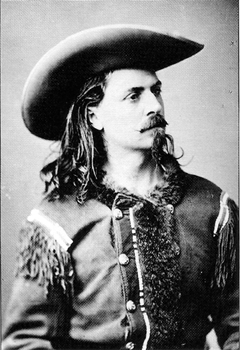
Buffalo Bill Cody

Buffalo Bill CodyOne of the Old West’s most famous personalities quite possibly received his fame because someone else refused it.

 On July 24, 1869 Ned Buntline was looking for fresh material. Now Buntline was a prolific writer of fictionalized books about the Old West called “dime novels.” At $20,000 a year Buntline was by far the highest paid writer of his time…exceeding the income of such famous authors as Whitman, Twain and Melville.

Buntline came to Fort Larned, Kansas looking for a prospective subject…Major Frank North. When he found North and made his proposition, North explained that real men didn’t brag about themselves. “But,” he said, “If you want a man to fill that bill, he’s over there under a wagon.” Buntline went over to the wagon and saw to a young scout sleeping off a hangover.

The writer and the 23-year-old scout ended up spending 10 days together, drinking and swapping stories. Before the end of the year Ned Buntline had written and published “Buffalo Bill, King of the Border Men, The Wildest and Truest Story I Ever Wrote.”

The book was made into a stage production in New York. Incidentally, the New York press called it the adventures of “Bison William.” Buffalo Bill came to see the show, and was intrigued with performing on the stage…After all it was a less dangerous than fighting Indians.

So, they rewrote the show and named it “The Scouts of the Plains.” The opening night was in Chicago. Even though there were no professional actors on the stage, and no lines were delivered as written, the audience applauded it enthusiastically.

They went on to St. Louis and eventually New York where Buffalo Bill and Buntline had a falling out. Buntline then hired Wild Bill Hickok, who, incidentally maintained that Buntline’s original novel “King of the Border Men” actually contained his exploits, not Buffalo Bills.

Dodge City

  Dodge City 2 As the railroad headed west, towns grew up along side it. One of the more famous Western towns was named Buffalo City. However, that wasn’t the name under which it became famous.

   It was the middle of July 1872 when the Atchison, Topeka and Santa Fe Railroad reached a peddler’s camp by the name of Buffalo City, Kansas, located about five miles from the military reservation of Fort Dodge. Almost overnight tent saloons and gambling dens sprang up. Within a matter of weeks it was a town of false-fronted buildings. And shortly afterward the Buffalo City town signs were taken down and replaced with signs reading, Dodge City, after the name of one of the town fathers, Colonel Richard I. Dodge.

   Because it was against the law to sell liquor in unorganized regions of Kansas, the Dodge City residents petitioned to organize the county of Ford. Interestingly, the petition contained the names of as many transients and railroad people as residents. Even though it was challenged, the state legislature, out of expediency, approved Ford County

   Dodge City started out as a hangout for buffalo hunters. Then when the cattle drives and cowboys started coming north, with twenty saloons, numerous dance halls and houses of ill repute, Dodge City became known as the “Queen of the Cow Towns.”

   Over the next few years the likes of Wyatt Earp, Doc Holliday, Bat Masterson and Belle Starr took residence there. But, they only stayed there temporarily, because fame had other places to go and other events in which to participate.

    Dodge City only had about 3,000 residents at the height of the population. By 1885, a little over 15 years after it became a town, the railhead had moved on to other towns. The Chisholm Trail was being plowed under by wheat farmers, and the law was maintaining order, so Dodge City settled down and became civilized.

Warren Earp

C2C Warren EarpAs we shall see this week, it’s tough being a little brother…Especially if your older brothers are famous, and you’re still living at home with mom and dad.

    Imagine you’re the youngest of five brothers living at home with your parents in Colton, California, while your older brothers James, Morgan, Virgil and Wyatt are having fun in a wild town named Tombstone. That was exactly Warren Earp’s situation.

But, in 1880, at the age of 25, he got a chance to go to Tombstone. Virgil was a lawman at the time, and Warren got to guard prisoners and join in posses. Unfortunately, in July of 1881 Warren got shot in a ruckus with some Mexicans, and went back to Colton to recuperate. And, wouldn’t you know it, while he was still at mom and dad’s, he missed out on the O. K. Corral shootout.

Warren returned to Tombstone after brother Virgil was shot, and was there when Morgan was killed. Warren finally saw action as he accompanied Wyatt seeking revenge against the cowboys. Bitter, disillusioned, and deep in the bottle, he returned to Colton.

With Warren regularly getting into trouble, his father got fed up with him and sent him packing. Warren ended up in Willcox, Arizona where he did a little cowboying and a lot of drinking. On July 6, 1900, Warren got crossways with a John Boyet. Some say it was because of a woman, others say it was a carry-over from the Tombstone days. In a confrontation, Warren kept pushing Boyet, until Boyet finally pulled his gun and killed him. This was a case of bringing a knife to a gunfight. For, it was discovered that Warren didn’t have a gun. But he did have a knife.

It seems that, to his dying day, Warren was trying to live up to the reputation of his brothers Wyatt and Virgil by being able to buffalo a man, and disarm him

Abel Head Pierce

Able Head Pierce“There aren’t any cowboys in Rhode Island,” said a friend recently. I had to correct him, for as we will see this week there was a great cowboy who came from Rhode Island.

Abel Head Pierce was born in Rhode Island on June 29, 1834. At the age of twenty he stowed away on a schooner and ended up in southern Texas. Abel took a job for a cattleman named Grimes. Starting out doing odd jobs, Abel worked his way up to trail boss, taking cattle to New Orleans.

Abel Head Pierce was a 6 foot, 5 inch bearded giant of a man who had a habit of wearing spurs with extra large rowels, and strutting around town. Someone remarked that Abel looked like a Shanghai rooster, and he became Shanghai Pierce. Now, that’s a name any cowboy would be proud of.

After serving in the Civil War, Shanghai returned to Texas and started accumulating cattle. Shanghai took a couple of years out in Kansas… supposedly to let things cool down in Texas after lynching a couple of rustlers.

He ended up with a 250,000 acre ranch appropriately called the Rancho Grande. Obviously, Shanghai was a major factor in the Texas cattle industry.

Looking for cattle that would be resistant to ticks that was causing problems with Texas cattle going north, and a breed that would produce more meat, Shanghai went to Europe and ended up bringing home some Brahma cattle, which he crossed with the Texas Longhorns.

By the end of the 19th century Shanghai Pierce’s Rancho Grande approached a million acres. When Shanghai felt his life was close to coming to an end he hired a San Antonio sculptor to make a larger than life statue of himself to be placed over his grave. Asked why, Shanghai responded, “I knew that if I didn’t do it, no one else would.”

Santa Anna

C2C Santa AnnaI’m aware of no one who had higher highs and lower lows than the subject of this week’s story did. Even though he wasn’t a citizen of the United States, his fate was important to our country.

He was born Antonio Lopez de Santa Anna, the son of middle-class parents in Vera Cruz, Mexico. Joining the military, he distinguished himself during Mexico’s fight for independence from Spain. In 1833, he won election to the presidency of Mexico. Within two years, he declared himself Mexico’s dictator.

This brought him into conflict with the Anglos who had settled in a northern part of Mexico, known as Texas. Determined to crush the rebellion, Santa Anna took personal command of the army that went to Texas. After the defeat of the Alamo, and the execution of 400 prisoners at Goliad, Santa Anna became overconfident, and in April of 1836, at San Jacinto, Santa Anna was captured. In exchange for his release, Santa Anna signed an order resulting in Texas becoming an independent republic.

White Santa Anna was in Texas, he was deposed in Mexico. Although he returned to Mexico powerless, Santa Anna took advantage of an unstable situation, becoming, once again, the dictator of Mexico…But an unstable situation is both good and bad. For, once again Santa Anna was overthrown. As a matter of fact, Santa Anna became the dictator of Mexico, and was overthrown eleven times.

Finally, overthrown in 1855, Santa Anna spent his last twenty years scheming with elements of Mexico, United States and France to get back on top. But it never happened. And, on June 22, 1876, this man who played a part in Mexico’s gaining its independence, and loosing a large part of its territory, died in absolute poverty.