Old West Lifestyle & Stories

Latest

SUTRO TUNNEL

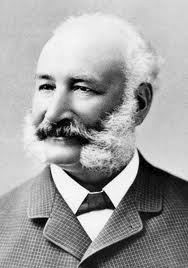
On October 19, 1869, Prussian-born mining engineer, Adolph Sutro, began work on one of the most ambitious projects of the day: a four-mile-long tunnel through the solid rock at the Comstock Lode mining area.
One of the richest silver deposits in the world, the Comstock Lode was discovered in 1859. But as miners sank shafts deeper into the rock, they began to encounter large amounts of water that had to be pumped to the surface at great expense.

Adolph Sutro’s idea was to tunnel through the rock of the neighboring Mt. Davidson and straight into the heart of the Comstock mine. Mine water would thus drain through the tunnel without need for expensive pumps, and the mining companies would also be able to use the tunnel to move men and ore in and out of the mine, greatly reducing transportation costs.

Although everyone agreed that Sutro’s tunnel would be a boon to the Comstock, progress slowed down by resistance from some of the major mining interests who feared that Sutro would use his tunnel to take control of the entire lode. Only after securing European capital was Sutro able to complete the $5-million project in 1878.
It was every bit as successful as Sutro though it would be. Unfortunately, by 1878, the richer sections of the Comstock Lode had been tapped out. However, Sutro was able to sell the tunnel at a fantastic profit. He moved to San Francisco where he became one of the city’s largest landowners as well as the city’s mayor from 1894 to 1896.
WILD BILL LONGLEY

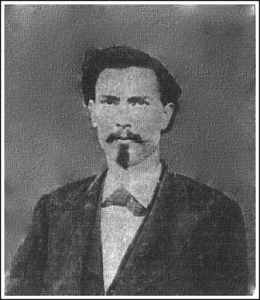
William Preston Longley was born on October 16, 1815. We don’t know his as William Preston, but as “Wild Bill”, a sadistic and murderous Old West gunman.

Although little is know about him as a young man, it’s generally accepted that before he was 20 years old, Longley had already killed several men. He was short-tempered and he frequently killed simply because he believed he had somehow been slighted or insulted. He had a particularly strong dislike of blacks.
Legend has it that Longley was once hanged along with a horse thief; but shots fired back by the departing posse cut his rope, and he was saved.

After killing a minister, Wild Bill fled Texas. But he was captured and returned to Lee County, Texas, where he was tried and found guilty of murder. Sentenced to hang, during his final days Longley became a Catholic, wrote long letters about his life, and claimed that he had actually only killed eight men. On the day of his execution, October 28, 1878, he climbed the steps to the gallows with a cigar in his mouth and told the gathered crowd that his punishment was just and God had forgiven him.

A noose was put around his neck, and he was hanged. Unfortunately, the rope slipped so that Longley’s knees hit the ground. After the hangman pulled the rope taut once more, Wild Bill slowly choked to death. It took 11 minutes before he was pronounced dead.

TOM MIX

On October 11, 1940, the famous cowboy actor Tom Mix is killed in a freak car accident near his ranch in Florence, Arizona. He was driving his single-seat roadster with luggage on the rear shelf of the car. Tom was traveling along a straight desert road, when he unknowingly came to a bridge spanning a shallow gully that was out. When his car went down into the gully a heavy suitcase flew off the rear shelf of his car and crushed him.

Tom Mix had been one of the biggest silent movies stars in Hollywood during the 1920’s, appearing in more than 300 westerns and making as much as $10,000 a week. Unlike most of the actors appearing in westerns, Mix had actually worked as a cowboy, and had been a Texas Ranger.

In 1906, Mix joined a Wild West show, and four years later he started acting in motion pictures. He helped define the classic image of the western movie cowboy as a rough riding, quick-shooting defender of right and justice, an image that would be copied by hundreds of other actors who followed him.

With the coming of talking pictures, Mix’s movie career stalled. When he died in 1940 at the age of 60, he had lost most of his wealth and was largely forgotten.

Today a black iron silhouette of a riderless bronco marks the site of Mix’s death on the highway about 17 miles south of Florence, Arizona.

DALTONS & COFFEYVILLE

On October 5, 1892, the famous Dalton Gang attempted a daring daylight robbery of two Coffeyville, Kansas banks at the same time. They wanted to do something no other outlaw gang had done. Instead, they were nearly all killed by quick-acting townspeople.

The gang rode into Coffeyville and tied their horses to a fence in an alley near the two banks and split up. Bob and Emmett Dalton headed for the First National, while Grat Dalton led Dick Broadwell and Bill Powers into the Condon Bank.

Unfortunately for the Daltons, they were recognized and the word quietly spread that the town banks were being robbed. The townspeople ran for their guns and surrounded the two banks. When the Dalton brothers walked out of the bank, a hail of bullets forced them back into the building. Regrouping, they tried to flee out the back door of the bank, but the townspeople were waiting for them there as well.

Meanwhile, in the Condon Bank a cashier had managed to delay Grat Dalton, Powers, and Broadwell with the claim that the vault was on a time lock and couldn’t be opened. That gave the townspeople enough time, and suddenly a bullet smashed through the bank window and hit Broadwell in the arm. The three men bolted out the door and fled down a back alley. But they were immediately shot and killed, this time by a local livery stable owner and a barber.

When the gun battle was over, the people of Coffeyville had destroyed the Dalton Gang, killing every member except for Emmett Dalton. But their victory was not without a price…The Dalton’s killed four of the townspeople.

BATTLE OF GONZALES

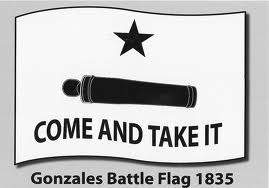
The ever patient Texans could take no more when on October 2, 1835 Mexican soldiers attempted to disarm the people of Gonzales.

Even though Texas had technically been a part of the Spanish empire since the 17th century, as late as the 1820s, there were only about 3,000 Spanish-Mexican settlers in Texas.

After winning its own independence from Spain in 1821, Mexico invited Anglo-Americans to come to Texas in the hopes they would be able to tame the Comanche Indians and the harsh land. During the next decade men like Stephen Austin brought more than 25,000 people to Texas, most of them Americans.

Even though these emigrants became Mexican citizens, they continued to speak English, and had closer trading ties to the United States than to Mexico.

In 1835, the president of Mexico, Antonio Lopez de Santa Anna, overthrew the constitution and appointed himself dictator. Recognizing that the “American” Texans were likely to use his rise to power as an excuse to secede, Santa Anna ordered the Mexican military to begin disarming the Texans whenever possible. This proved more difficult than expected, and on October 2, 1835, Mexican soldiers attempting to take a small cannon from the village of Gonzales encountered stiff resistance from a hastily assembled militia of Texans. After a brief fight, the Mexicans retreated and the Texans kept their cannon.

The determined Texans would continue to battle Santa Ana and his army for another year and a half before winning their independence and establishing the Republic of Texas.